
For the first time in millions of years, the air surrounding our planet has reached an average concentration of 430.2 parts per million (ppm) of carbon dioxide. This significant milestone, primarily driven by human activity and the burning of fossil fuels, signals a dramatic shift in Earth’s atmosphere and serves as a critical indicator of accelerating climate change.
Contents
A Record Broken: The Latest CO2 Numbers
The notable figure of 430.2 ppm was recorded in May 2025 at the National Oceanic and Atmospheric Administration (NOAA)’s Mauna Loa Observatory in Hawaii. Scientists from the University of California San Diego’s Scripps Institution of Oceanography, who have been monitoring these levels for decades, reported this average. This number represents a jump of 3.5 ppm compared to the May 2024 measurement of 426.7 ppm.
“Another year, another record,” commented Ralph Keeling, director of the Scripps CO2 Program. “It’s sad.” Separately, scientists at NOAA’s Global Monitoring Laboratory reported a very close average of 430.5 ppm for the same period.
The Legacy of the Keeling Curve
The continuous monitoring of atmospheric carbon dioxide at Mauna Loa is a legacy started in 1958 by Scripps scientist Charles David Keeling, Ralph Keeling’s father. Charles Keeling was the first to observe the seasonal fluctuations in CO2 levels in the Northern Hemisphere – peaking in May and dipping during the growing season as plants absorb carbon, then rising again in the fall.
These observations formed the basis of the iconic Keeling Curve, a graph documenting the steady, year-after-year rise in global CO2 concentrations. This curve has become one of the most important records in climate science.
Exceeding the 400 ppm mark, which was once considered a distant concern, was first reached in 2013. Now, just over a decade later, levels are firmly above 430 ppm, and scientists warn that reaching 500 ppm within the next 30 years is a real possibility if current trends continue. To put 400 ppm in perspective, it means over 400 million molecules of carbon dioxide exist for every one million molecules of gas in the atmosphere.
According to Ralph Keeling, the last time Earth’s atmosphere held this much carbon dioxide was likely more than 30 million years ago.
“It’s changing so fast,” Keeling noted. “If humans had evolved in such a high-CO2 world, there would probably be places where we wouldn’t be living now. We probably could have adapted to such a world, but we built our society and a civilization around yesterday’s climate.”
Why Mauna Loa Matters
Perched at an elevation of 11,141 feet, the Mauna Loa Observatory serves as the global standard for monitoring average carbon dioxide levels in the Northern Hemisphere. Its remote location minimizes the influence of local pollution sources, providing a clear picture of background atmospheric composition.
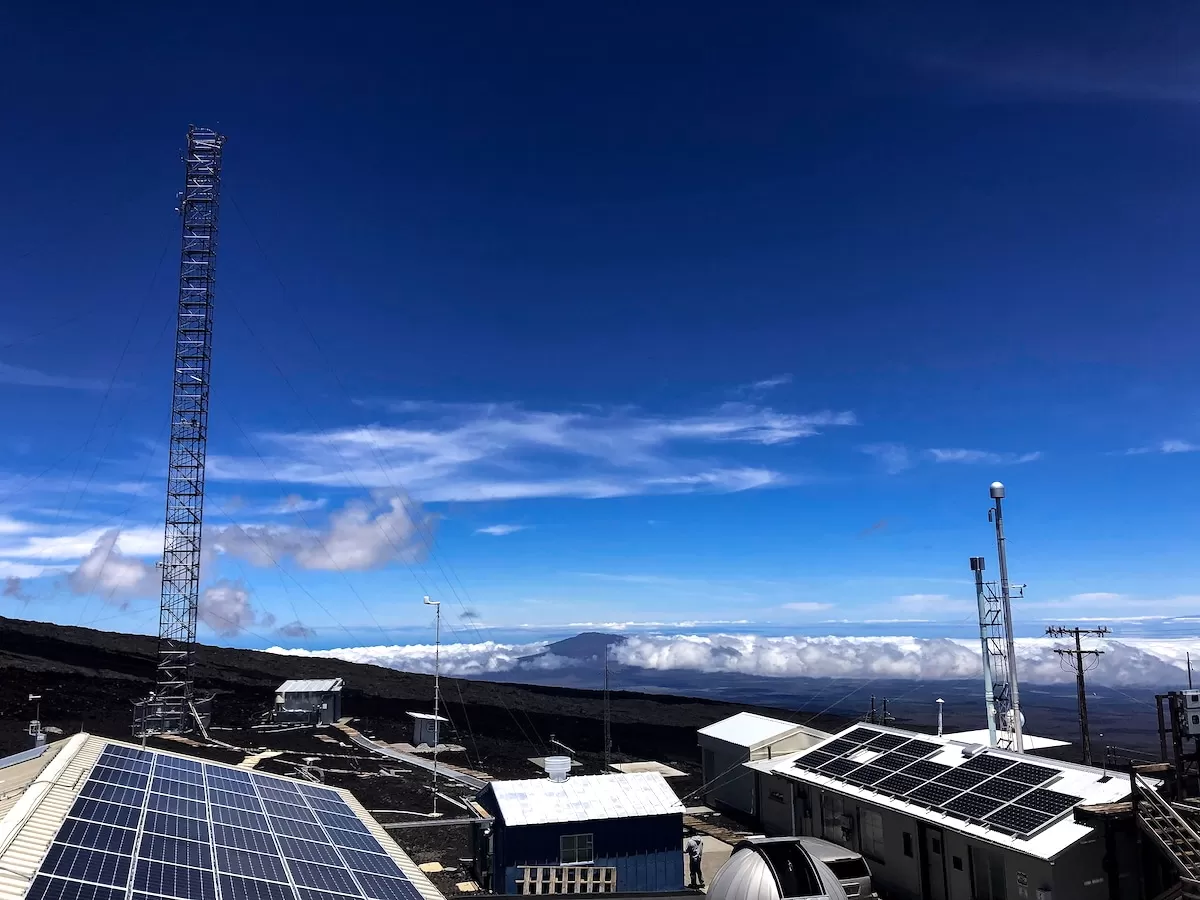 Scientific observatory on Mauna Loa volcano in Hawaii, measuring Earth's atmospheric CO2 levels.
Independent daily measurements by NOAA began at the site in 1974, complementing Scripps’ ongoing work. The combined record from Mauna Loa, alongside data from stations worldwide, forms a crucial baseline for understanding the long-term trend of this critical greenhouse gas. This data is fed into the Global Greenhouse Gas Reference Network, informing policymakers working to address climate change.
While Mauna Loa is a key indicator, it primarily reflects Northern Hemisphere conditions. Monitoring stations in the Southern Hemisphere show a similar rise but with a reverse seasonal cycle, and their averages have yet to cross the 430 ppm threshold. However, the global trend is undeniably upward.
The Impact: Why High CO2 Levels Matter
Carbon dioxide is a powerful greenhouse gas. Think of it like adding an extra blanket around the Earth. It traps heat, warming the lower atmosphere. This trapped heat is fundamentally altering our climate system.
The consequences are far-reaching, fueling extreme events such as more intense heat waves, prolonged droughts, devastating wildfires, heavier rainfall, and increased flooding.
Beyond warming the atmosphere, rising CO2 levels also impact our oceans. The absorption of excess carbon dioxide leads to ocean acidification, a chemical change that makes it harder for marine life like shellfish, corals, and crustaceans to build their shells and skeletons.
A Simple Measure, a Complex Problem
The measurements taken at Mauna Loa, while seemingly simple, provide a powerful diagnosis of the planet’s health. “They’re telling you about your whole system health with a single-point measurement,” Ralph Keeling explained. “We’re getting a holistic measurement of the atmosphere from really a kind of simple set of measurements.”
Reaching CO2 levels not seen in millions of years underscores the urgency of addressing human-caused emissions and transitioning to cleaner energy sources. The data from Mauna Loa and other monitoring stations around the world continue to serve as a vital scientific foundation for understanding and responding to the climate crisis.





