
Earth is currently absorbing significantly more energy than it releases back into space, a critical measure known as the planet’s energy imbalance. This imbalance is the main driver of global warming, caused primarily by greenhouse gases trapping heat in the atmosphere. New research highlights that this imbalance has increased far faster than climate models predicted over the past two decades, and scientists are not entirely sure why.
Contents
This unexpected acceleration means the planet is warming at a pace exceeding expectations. Furthermore, the vital satellites that provide the most accurate, up-to-date measurements of this imbalance are nearing the end of their operational lives, creating a potential blind spot in our understanding of how fast climate change is progressing. Key takeaways: the Earth is trapping more heat than expected, models can’t fully explain it, and our ability to measure this crucial trend is at risk.
What is Earth’s Energy Imbalance?
Think of Earth like a house with the sun as the heater. The planet receives energy from the sun, and naturally radiates some of that energy back out into space, like heat escaping through windows and walls. Earth’s energy imbalance is the difference between the energy coming in and the energy going out.
Greenhouse gases, released by human activities like burning fossil fuels, act like adding extra insulation to the house. They trap more of the outgoing energy in the atmosphere, causing the planet to heat up. A larger imbalance means more energy is being accumulated, leading to faster warming of the land, oceans, and atmosphere.
The Alarming Trend: Faster Than Predicted
According to a recent commentary published in the journal AGU Advances, satellite data shows that Earth’s energy imbalance has more than doubled over the past 20 years. In 2023, it reached 1.8 watts per square meter, which is roughly twice the increase expected based on rising greenhouse gas emissions alone according to standard climate models.
This rapid jump has puzzled scientists. Thorsten Mauritsen, a professor at Stockholm University and lead author of the commentary, told Live Science that researchers initially thought the increase might be due to natural variability or climate patterns like El Niño. However, the trend continued to grow, causing concern. “We were both worried about the big trend, and then on the other hand that we are possibly about to lose capability to observe this,” Mauritsen stated.
The unexpected growth in energy imbalance suggests that something beyond just increasing greenhouse gas concentrations is contributing to the Earth trapping more heat.
Why the Mystery? Looking Beyond Greenhouse Gases
Scientists suspect the increased imbalance is likely linked to a decline in Earth’s reflectivity – how much solar energy the planet bounces back to space. A less reflective Earth absorbs more incoming sunlight. Several factors could contribute to this:
- Melting Ice and Snow: As ice sheets and glaciers melt, they expose darker land or ocean surfaces underneath, which absorb more heat than reflective ice. Watch Greenland lose ice in a disturbing video to see this process in action.
- Changes in Aerosols: Tiny particles in the atmosphere, called aerosols, can either reflect sunlight back to space or absorb it. While pollution controls reduce some harmful aerosols, other changes in their distribution or type could potentially decrease the planet’s overall reflectivity. One study suggested cutting shipping pollution accidentally increased warming by reducing reflective aerosols.
Despite these potential factors, scientists acknowledge that models are still missing something to fully explain the rapid increase observed in the satellite data. “Something is missing [from the models], but we don’t really know right now what it is,” Mauritsen said.
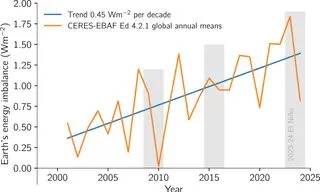 Graph showing Earth's energy imbalance significantly increasing over two decades, exceeding climate model predictions.
Regardless of the exact combination of causes, a larger energy imbalance means the planet’s temperature is rising faster. This also affects the “carbon budget” – the total amount of CO2 humans can emit while still having a reasonable chance of limiting global warming to specific targets, like 2 degrees Celsius (3.6 degrees Fahrenheit). A higher energy imbalance means that threshold is reached with less additional CO2 in the atmosphere.
While satellite data from early 2024 suggests the rate of increase might be returning to more expected levels, the overall imbalance remains high, and future trends are uncertain.
The Critical Need for Satellite Data
Measuring Earth’s energy imbalance precisely relies heavily on specialized instruments carried by satellites. NASA’s CERES mission currently provides the most detailed, real-time picture using four operational satellites. However, these satellites are aging.
The planned replacement, NASA’s Libera mission, is scheduled for 2027 but will only have one satellite. Scientists like Mauritsen worry that a single satellite increases the risk of data gaps due to potential instrument failures, making it harder to track the imbalance’s evolution accurately. Continuous, overlapping data from multiple satellites is crucial for robust analysis.
 View of Earth's clouds from space, illustrating the type of satellite data used to measure the planet's energy balance.
Other ways to estimate the imbalance, such as using ocean temperature data (since oceans absorb most of the excess heat), have a significant drawback: they only reveal trends about a decade after they occur and offer a less detailed view compared to satellite measurements. “What we get from [these] satellites is roughly one decade faster data, so that’s why it’s so critical,” Mauritsen emphasized.
Adding to concerns, there is currently no formal plan for satellite monitoring of Earth’s energy imbalance after the Libera mission ends. While NASA scientists have promising ideas for future missions, like using spherical satellites to measure radiation from all angles, securing funding and implementing these projects takes time. Experts have previously raised alarms about proposed budget cuts affecting NASA’s climate research capabilities.
Why This Matters
Knowing the precise value and trend of Earth’s energy imbalance is fundamental to understanding and predicting climate change. It tells us exactly how much extra heat the planet is accumulating and, therefore, how quickly warming is happening and how close we are to critical climate thresholds.
In their commentary, Mauritsen and colleagues from numerous international institutions call for sustained and improved monitoring capabilities to track this vital metric. As Mauritsen puts it, “It tells us how far we are from stabilizing Earth’s climate, and that’s why we need to measure it. If we don’t know this, then we are driving our climate system blindfolded.”
Continuing to monitor Earth’s energy imbalance with high-quality satellite data is essential not only for refining climate models but also for informing crucial decisions about climate action. Without this information, predicting future warming or determining the effectiveness of mitigation efforts becomes significantly more challenging. To learn more about the broader context of rising emissions and climate impacts, you might find these articles insightful: Global carbon emissions reach new record high in 2024 and Climate wars are approaching.





