
Imagine Earth is like a house with an energy budget. Sunlight is the energy coming in, and heat radiating back into space is the energy going out. For a long time, scientists thought this budget was relatively stable, changing slowly as we added more greenhouse gases to the atmosphere, trapping heat. But new data reveals a puzzling and concerning trend: the planet’s energy imbalance – the difference between incoming and outgoing energy – is growing much faster than expected. This means Earth is holding onto significantly more heat than climate models predicted, accelerating the pace of climate change.
Contents
This unexpected speed-up in Earth’s energy imbalance raises alarms among researchers because it indicates that the planet is heating up more rapidly than our current understanding suggests. It also highlights a critical need for continuous, high-quality data to track this vital sign of climate health.
Earth’s Energy Budget: An Unseen Problem
At its core, Earth’s energy imbalance is the difference between the amount of energy the planet absorbs from the sun and the amount of energy it radiates back into the void of space. Think of it like balancing a household budget; ideally, income (sunlight) roughly matches expenses (outgoing heat).
However, human activities, primarily the burning of fossil fuels, release greenhouse gases like carbon dioxide into the atmosphere. These gases act like a blanket, trapping some of the heat that would normally escape Earth’s surface, similar to how a greenhouse traps solar energy to keep plants warm. This trapped energy is what drives global temperatures up, leading to a net energy surplus – the imbalance.
The Surprising Speed-Up
For years, scientists have used sophisticated satellite instruments to measure this energy flow with incredible precision. These measurements provide the most accurate, up-to-the-minute picture of Earth’s energy budget. And they’ve revealed something unsettling.
Over the past two decades, satellite data suggests that Earth’s energy imbalance has more than doubled. In 2023, the imbalance reached a significant 1.8 watts per square meter. This figure is twice what climate models had estimated based on the known increase in greenhouse gas emissions. It’s as if the house’s energy intake suddenly spiked far beyond what the budget forecast, and scientists aren’t entirely sure where the extra energy is coming from or why it’s accumulating so quickly.
Thorsten Mauritsen, a professor at Stockholm University and lead author of a commentary on this issue published in AGU Advances, expressed concern. “We were starting to see this large trend in the last few years, and it just grew and grew,” he told Live Science. “We were both worried about the big trend, and then on the other hand that we are possibly about to lose capability to observe this.”
Initially, researchers wondered if the faster rate might be temporary, perhaps linked to natural climate patterns like El Niño. But as the rapid increase continued year after year, it became clear something more fundamental was happening, something the current climate models aren’t fully capturing.
What’s Driving the Change?
So, what could be causing Earth to absorb and retain so much more energy so quickly? The inflated imbalance likely stems from a decline in Earth’s reflectivity – its ability to bounce sunlight back into space.
This reduced reflectivity could be due to several factors. For instance, the melting of ice sheets and glaciers exposes darker land or water surfaces underneath, which absorb more heat than reflective white ice. Another factor could be changes in the amount of reflective particles, or aerosols, in the atmosphere. Pollution from things like shipping creates aerosols that can reflect sunlight, and efforts to clean up these industries might have unintentionally reduced this cooling effect, as one recent study suggested.
However, scientists stress that the magnitude and speed of the observed imbalance increase still exceed what these factors, as currently understood, should explain. “Something is missing [from the models], but we don’t really know right now what it is,” Mauritsen said.
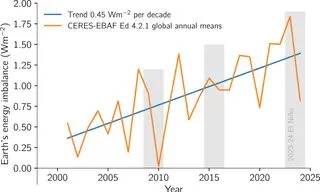 Graph showing the accelerating increase in Earth's energy imbalance over recent decades.
Why This Imbalance Matters for Us
Regardless of the precise reasons behind the accelerated imbalance, its implications are clear and concerning. “The larger the imbalance is, the faster climate change happens,” Mauritsen explained. More energy accumulating means temperatures will rise more quickly across the globe.
The energy imbalance is also a critical benchmark for understanding how far humanity has pushed the climate system and what it will take to stabilize it. The ultimate goal is to bring this imbalance back to zero by drastically reducing fossil fuel emissions. A higher current imbalance means the planet is currently holding onto a larger energy surplus, which could lead to a higher stabilized temperature even after emissions cease.
“If that imbalance stays very high,” Mauritsen noted, “then it pushes further that temperature level that we can stabilize at. That means we have less CO2 left that we can emit before we get to 2 degrees Celsius [or 3.6 degrees Fahrenheit] of warming, for example.” In essence, a larger imbalance shrinks our remaining carbon budget.
Satellite readings in 2024 suggest the rate of increase might be returning towards model predictions, offering a glimmer of hope. But scientists are cautious, unsure if this is a lasting shift or a temporary fluctuation. “If it does bounce up to those high levels [again], then I’m not sure where we’re heading,” Mauritsen said.
The Critical Need for Satellite Eyes
Monitoring Earth’s energy imbalance requires specialized instruments in space. Currently, NASA‘s CERES mission utilizes four operational satellites providing the most detailed and timely measurements. However, these satellites are aging and are scheduled to be replaced around 2027 by the follow-on Libera mission.
The significant concern is that Libera consists of only a single satellite. Scientists worry that a single point of failure could create critical gaps in the data record. Continuous, overlapping data from multiple satellites is essential for accurately tracking the subtle changes in the energy imbalance over time. Without it, interpreting the data becomes much harder.
 A view of swirling clouds over Earth as seen from space, captured by a satellite.
Other methods for estimating the energy imbalance, such as analyzing ocean temperature data, exist. However, these methods provide a much slower and less detailed picture. Ocean temperature data, for example, can lag about a decade behind satellite measurements, meaning we’d be looking at trends that happened years ago. It’s like trying to navigate using a map from 2014 instead of real-time GPS. As Mauritsen puts it, the satellites provide “roughly one decade faster data, so that’s why it’s so critical.”
Furthermore, after the planned end of the Libera mission, NASA currently has no formal plan for continued monitoring of this vital climate metric. While there are ideas for future missions, like “really cool” spherical satellites that could measure radiation from all directions, the path forward is uncertain, especially with potential budget constraints. Instruments on the International Space Station also have limited lifespans.
Looking Ahead
In their commentary, Mauritsen and a large group of international researchers are calling for improved monitoring capabilities and dedicated research into the evolution of Earth’s energy imbalance.
Measuring this imbalance isn’t just an academic exercise; it’s crucial for understanding our planet’s trajectory. “It tells us how far we are from stabilizing Earth’s climate, and that’s why we need to measure it,” Mauritsen emphasized. “If we don’t know this, then we are driving our climate system blindfolded.”
The mystery of the accelerating energy imbalance underscores the dynamic nature of our climate system and the urgent need for continuous scientific observation to navigate the challenges of a warming world.





