
Imagine Earth breathing, its atmosphere expanding and contracting, while deep inside, a giant dynamo hums, generating a protective shield. New research reveals a surprising connection between these two vital parts of our planet: Earth’s magnetic field strength and the amount of oxygen in its atmosphere have risen and fallen in sync over the past 540 million years. While the exact reason for this parallel rise remains a mystery, this discovery offers fascinating clues about the conditions necessary for life, both here and potentially on distant worlds.
Scientists looked back across vast stretches of Earth’s history, from the dawn of complex life during the Cambrian period to the present day. They analyzed two independent records: one charting the history of atmospheric oxygen using fossil clues, like ancient charcoal from wildfires, and another tracking the strength of the geomagnetic field captured in magnetized rocks. Plotting these two datasets together, they found a remarkable correlation: when one increased, the other tended to increase too, and vice versa, over millions of years. A particularly strong surge occurred between 330 and 220 million years ago, coinciding with the age of the supercontinent Pangaea.
Why Might They Be Linked?
The big question is: why are these two seemingly different things connected? Researchers, including Weijia Kuang and Ravi Kopparapu from NASA Goddard Space Flight Center, propose a few possibilities.
One idea is that the magnetic field directly influences oxygen levels. Think of the magnetic field as a giant, invisible shield wrapping around Earth. This shield protects our atmosphere from being stripped away by harsh solar winds and radiation from space. Without this protection, crucial atmospheric molecules could escape into space over time. The magnetic field also shields life on the surface, including the plants and organisms that produce much of our oxygen, from damaging radiation like X-rays and extreme ultraviolet light. A stronger shield could mean better protection, leading to more stable or even increasing oxygen levels.
Another possibility, though perhaps less likely according to the researchers, is that oxygen levels somehow affect the magnetic field. This scenario could involve plate tectonics. Earth’s surface is broken into giant plates that are constantly moving, recycling old crust back into the planet’s deep interior. This process could potentially deliver oxygen-rich materials down to the mantle, the layer above the super-hot liquid outer core. The outer core is where the magnetic field is generated by the swirling motion of molten iron. Changes in the lower mantle, influenced by this recycling, might then subtly affect the dynamo in the core, altering the magnetic field’s strength. Plate tectonics is also known to impact the cycling of chemicals vital for producing oxygen on the surface. Related: Did plate tectonics give rise to life? Groundbreaking new research could crack Earth’s deepest mystery.
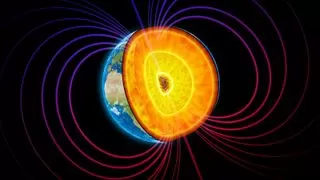 Cross-section diagram of Earth showing internal layers, the metallic core, and the planet's protective magnetic field extending into space.
The third, and perhaps most intriguing, possibility is that neither the magnetic field nor oxygen is directly causing the other to change. Instead, both could be influenced by a third, unknown process happening within or on Earth over geological timescales. The strong spike in both datasets during the reign of the supercontinent Pangaea offers a tantalizing clue. Could the massive churning and rearranging of Earth’s crust associated with the formation and breakup of supercontinents somehow be the underlying driver for both the magnetic field and oxygen? Scientists stress this is a very early idea with limited data, but it’s an “enticing mechanism” they plan to explore further.
What This Means and What’s Next
Finding this deep link between Earth’s internal magnetic engine and its life-giving atmosphere is a significant step. It adds another layer to our understanding of how our planet works as a complex, interconnected system.
Crucially, this research could help astronomers and planetary scientists refine their search for habitable planets beyond our solar system. If a strong magnetic field is indeed essential for a thick, oxygen-rich atmosphere like Earth’s, then detecting a magnetosphere around an exoplanet could become a key indicator in the hunt for alien life.
The next step for the researchers is to continue their detective work, searching for other geological or geochemical processes that might be the missing link connecting the magnetic field and oxygen. As one of the authors put it, scientists are like kids with different Lego pieces, trying to fit them together to see the big picture of our incredible planet. Understanding this newly found link is a crucial piece in that vast, exciting puzzle.