
Imagine Earth as a house with the thermostat broken. It’s letting in more heat from the sun than it’s letting back out into space, causing the temperature to rise. This difference between incoming and outgoing energy is called Earth’s energy imbalance (EEI), and it’s the fundamental driver of global warming.
Contents
Recent research reveals that this imbalance has more than doubled over the past two decades, a jump much faster than current climate models predicted. This rapid acceleration poses a significant challenge to scientists trying to forecast climate change. Compounding the issue, the specialized satellites that provide the most precise, timely measurements of this imbalance are nearing the end of their operational lives, potentially leaving researchers “driving blindfolded.”
What is Earth’s Energy Imbalance?
Earth constantly receives energy from the sun, mostly as sunlight. To maintain a stable temperature, the planet must radiate roughly the same amount of energy back into space, primarily as infrared heat. Greenhouse gases in the atmosphere, like carbon dioxide from burning fossil fuels, act like a blanket, trapping some of this outgoing heat. This disrupts the balance, causing the planet to retain more energy and warm up.
Think of it like a bank account: sunlight is income, outgoing heat is expenses. Greenhouse gases increase the income (or decrease the expenses), leading to a growing balance (stored energy, manifesting as heat).
Why the Imbalance is Accelerating
According to a recent commentary published in AGU Advances, led by Thorsten Mauritsen at Stockholm University, Earth’s energy imbalance reached 1.8 watts per square meter in 2023. This is twice the level estimated by climate models based on the increase in greenhouse gases alone.
Scientists are puzzled by the speed of this increase. While rising greenhouse gas levels are the main long-term driver of EEI, something else seems to be accelerating the rate at which the imbalance is growing in recent years. Potential factors could include changes in Earth’s reflectivity (albedo) — perhaps due to melting ice and snow that exposes darker land or water, or a decrease in reflective aerosols (tiny particles in the atmosphere, some of which are human-made pollutants). However, the exact combination of factors causing this rapid acceleration remains a mystery.
“Something is missing [from the models], but we don’t really know right now what it is,” Mauritsen told Live Science.
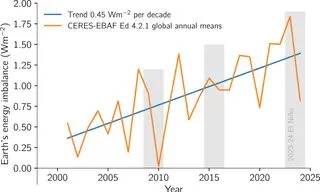 A graph showing Earth
Earth’s energy imbalance, a key indicator of global warming, has significantly increased over the past two decades, exceeding climate model predictions.
The Critical Importance of Measuring EEI
Why does this accelerated imbalance matter? Simply put, the larger the imbalance, the faster the planet accumulates energy, and the faster global temperatures rise. Monitoring EEI gives scientists a real-time pulse on how quickly climate change is progressing.
It also provides crucial information about how much more carbon humanity can emit before exceeding critical warming thresholds, such as 2 degrees Celsius (3.6 degrees Fahrenheit). If the energy imbalance remains high, it means we have less “carbon budget” left than previously thought to limit warming.
The Looming Satellite Gap
The most accurate way scientists measure EEI is using instruments on satellites, like those part of NASA’s CERES mission. These satellites precisely track the amount of solar energy entering Earth’s atmosphere and the amount of energy leaving.
However, the current generation of CERES satellites is aging. A single replacement satellite, the Libera mission, is planned for 2027. Scientists like Mauritsen are concerned that relying on just one satellite increases the risk of data gaps if the instrument fails. Without continuous, overlapping satellite measurements, piecing together the short-term evolution of EEI becomes much harder.
Ocean temperature data can also indicate Earth’s energy imbalance, as most of the excess heat is absorbed by the oceans. However, these measurements lag by about a decade and don’t provide the same level of detail or resolution as satellite data. Losing the satellite record means losing a decade of crucial, up-to-date information, making climate predictions less certain.
 View of clouds in Earth
Satellites orbiting Earth are essential for providing timely and detailed measurements of the planet’s energy balance.
A Call for Continued Monitoring
In their commentary, Mauritsen and colleagues urge for improved capabilities to monitor Earth’s energy imbalance. They highlight the need for sustained observation programs beyond the single Libera mission.
Measuring EEI is fundamental to understanding how far the climate system has been pushed. As Mauritsen states, “It tells us how far we are from stabilizing Earth’s climate, and that’s why we need to measure it. If we don’t know this, then we are driving our climate system blindfolded.” The unexpected speed-up in warming, coupled with the potential loss of key monitoring tools, underscores the urgency of this scientific challenge.





