
The Red Planet isn’t just red. A stunning new image captured by the European Space Agency’s Mars Express orbiter reveals Mars in surprising shades of yellow, orange, and brown, offering a colorful window into its past and future potential. This striking Mars photo of the Arcadia Planitia region highlights fascinating surface features like winding dust devils and a relatively young impact crater, providing vital clues about water ice and wind patterns on the planet.
Contents
A Different Shade of Red Planet
When we picture Mars, we usually think of its rusty red hue. But this new photo from the ESA’s Mars Express shows a more varied palette, displaying vast sweeps of earthy tones that look more like a landscape painting than another world. The image captures light bouncing off dust, sand, and rock across the Martian plains, revealing blues, purples, and browns alongside the familiar reds.
Where This Photo Was Taken
This captivating view focuses on Arcadia Planitia, a vast plain located in the northern hemisphere of Mars. This area is particularly interesting to scientists for several key reasons. It’s covered in ancient lava flows, some dating back billions of years, that shaped the terrain we see today. More importantly, research suggests that significant amounts of water ice might be buried just below the surface in this region. This makes Arcadia Planitia a prime candidate for potential future missions, both robotic and possibly even human, as accessible water ice would be crucial for survival and resource utilization.
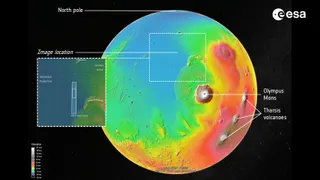 Global map of Mars showing the location of the Arcadia Planitia region, a key area for studying Martian water ice.
Cosmic Whirlwinds and Crater Secrets
Look closely at the image, and you might spot some tiny, pale streaks. These are dust devils – swirling columns of wind that lift dust from the surface, similar to small tornadoes on Earth. They form when the ground warms up, causing the air above it to rise and spin. The Mars Express image shows at least four of these ephemeral whirlwinds gracefully dancing across the plains, a testament to the planet’s active, windy environment.
Near the bottom right of the photo, a large impact crater stands out, measuring about 9 miles (15 kilometers) across. The material piled up around the rim suggests that the ground contained a significant amount of water ice when the impact occurred. Unlike older, more eroded craters, this one appears relatively fresh, helping scientists understand the geological timeline and the distribution of past water ice on Mars.
The ‘Blur’ Tells a Story
You might notice parts of the image look slightly hazy or blurry. This isn’t a camera malfunction! It’s another feature of the Martian atmosphere. Constant winds pick up fine dust particles from the surface, creating a subtle veil that hangs in the air. This atmospheric dust contributes to the planet’s reddish appearance from a distance but also creates this slight diffusion in close-up images taken from orbit.
Colors Painted by Wind and Rock
The different colors across Arcadia Planitia are a result of both the composition of the surface materials and the relentless action of the wind. The reddish areas, particularly towards the top, are shaped by wind erosion. Powerful gusts sculpt features called yardangs, which are elongated ridges carved out of softer rock, leaving behind the more resistant material.
Other areas in the image appear purplish-brown. These regions likely have a different mineral makeup, possibly containing higher concentrations of silicates and less of the iron oxides that give Mars its characteristic red color. The size and density of sand grains also play a role, influencing how they are transported by wind and where they accumulate, creating the diverse and surprisingly colorful patterns seen in this unique view of the Red Planet.
This captivating look at Arcadia Planitia reminds us that Mars is a dynamic world with a rich history and intriguing potential for the future, still holding many colorful secrets waiting to be uncovered by missions like Mars Express and others exploring its surface.
Learn more about recent discoveries on the Red Planet, from peculiar rocks to mysterious streaks:
- Perseverance rover spots peculiar ‘spider egg’ rock on Mars — and scientists have no idea how it got there
- Mars rover captures first close-up photos of giant ‘spiderwebs’ on the Red Planet
- Long, dark ‘streaks’ spotted on Mars aren’t what scientists thought





