
Imagine colossal stars ending their lives in spectacular explosions called supernovas. New research suggests these powerful cosmic blasts, even from hundreds of light-years away, might have dramatically influenced Earth’s climate history by affecting our atmosphere, leaving clues hidden in ancient tree rings. Understanding these distant events could help scientists predict and prepare for future stellar impacts.
Contents
When Giant Stars Explode
Supernovas happen when stars much bigger than our sun run out of fuel. Unable to support their immense weight, they collapse violently, leaving behind a dense neutron star or a black hole. This collapse unleashes a torrent of energy and high-speed particles that races across space.
Scientists know a supernova too close — perhaps within 30 light-years — would be catastrophic, stripping away our atmosphere and ending life. But what about blasts from farther away, say a few hundred light-years? Could they cause significant changes without being instantly fatal?
Robert Brakenridge, a senior researcher, wondered this too. “We have abrupt environmental changes in Earth’s history,” he noted. “What caused them?” While past studies focused on the physics, Brakenridge wanted to see if Earth’s history held physical evidence of such events.
How a Distant Supernova Could Affect Earth
Brakenridge used data from space telescopes to model how supernova radiation would interact with our atmosphere. He found that a burst of high-energy light particles from a supernova could damage Earth’s ozone layer. Think of the ozone layer as Earth’s protective sunscreen, shielding us from the sun’s harmful ultraviolet (UV) radiation.
If the ozone layer is weakened, more UV radiation reaches lower atmospheric layers. This extra energy could break down methane, a powerful greenhouse gas. Methane acts like a blanket, trapping heat. If it decreases, Earth could cool down.
Paradoxically, losing the ozone shield also means more damaging UV radiation reaches the surface, potentially harming life, increasing wildfires, and contributing to extinctions.
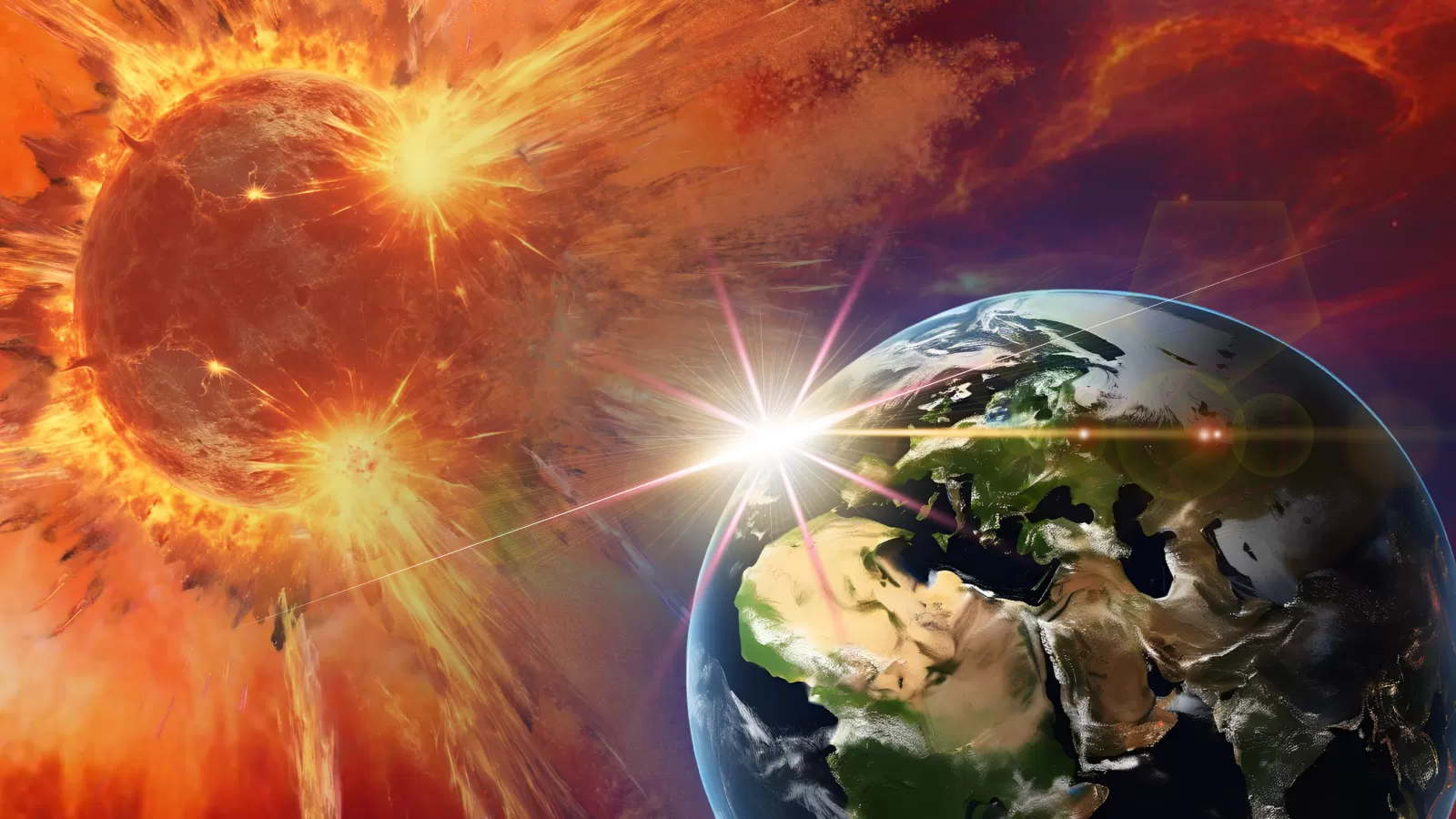 Illustration of a fiery explosion in space near Earth
Since we aren’t currently experiencing such an event (thankfully!), Brakenridge needed to look into the past for evidence.
Tree Rings: Cosmic Time Capsules
He turned to Earth’s geological record, specifically ancient tree rings. Trees absorb carbon from the atmosphere as they grow, incorporating it into their rings. Supernova radiation hitting Earth can increase certain radioactive types (isotopes) of carbon in the atmosphere, like Carbon-14. These isotopes then get absorbed by trees, leaving a signature in their rings.
Looking at tree ring records spanning about 15,000 years, Brakenridge found 11 distinct spikes in radioactive carbon levels. He theorizes these spikes could match times when Earth was bombarded by radiation from nearby supernovas.
“The events that we know of, here on Earth, are at the right time and the right intensity,” Brakenridge stated.
 Image of the Cassiopeia A supernova remnant, a purple and blue shell against black space
However, scientists can’t be absolutely sure yet that supernovas caused these spikes. Another potential source of increased radioactive carbon is powerful solar flares from our own sun. To distinguish between these possibilities, researchers need to check other historical records, such as ice cores and ocean floor sediments, which might hold different clues about past radiation events.
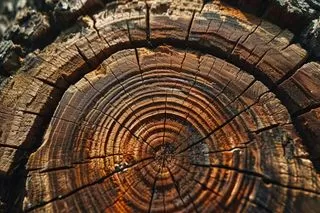 Close-up photo of a tree stump showing distinct growth rings
This research connects dramatic cosmic events to subtle changes recorded on our own planet, exploring how distant stellar deaths might have shaped the environment life evolved in. Related studies have even explored connections between massive stellar explosions and past mass extinctions.
Looking to the Future
Further investigation into this connection could be crucial for preparing for future cosmic events. For example, the red giant star Betelgeuse, about 700 light-years away, is expected to go supernova within the next 100,000 years.
“As we learn more about our nearby neighboring stars, the capability for prediction is actually there,” Brakenridge concluded. More observation and modeling are needed to fully understand Earth’s potential exposure to such dramatic events.
The research was published in the Monthly Notices of the Royal Astronomical Society.
Understanding how supernova blasts affected Earth in the past helps us piece together our planet’s dramatic history and consider potential future challenges from our dynamic universe.





