
For years, powerful, fleeting blasts of X-rays from distant galaxies have puzzled astronomers. These mysterious signals, known as Fast X-ray Transients (FXTs), appear suddenly and vanish just as quickly, lasting only seconds to hours. A new discovery, sparked by a fortunate catch from a new space telescope, reveals these cosmic flashes often originate from a surprising source: massive stars whose explosive death isn’t quite complete. This finding sheds light on the diverse and extreme ways stars end their lives across the universe.
Contents
What Are Fast X-ray Transients?
Imagine a cosmic camera catching an intense flash of light far across space – that’s essentially a Fast X-ray Transient. Detected as powerful bursts of X-rays, these events are incredibly brief and happen billions of light-years away, making them notoriously difficult to study. Until recently, their origins remained a significant mystery in astrophysics.
The launch of the Einstein Probe (EP) satellite in 2024 marked a turning point. Designed specifically to monitor the X-ray sky for sudden, transient events, EP is like a dedicated sentry watching for these cosmic flashes.
Catching the Nearest FXT
In January 2025, Einstein Probe struck gold, detecting an FXT named EP 250108a. What made this event special wasn’t just the flash itself, but its relative proximity – only 2.8 billion light-years away. While that still sounds incredibly distant, it was the closest FXT detected at the time, offering astronomers an unprecedented chance to study its rapid evolution in detail.
A large international team quickly mobilized, pointing various telescopes on Earth towards the location of EP 250108a to capture its signal across different types of light, beyond just X-rays. Telescopes like Gemini South and Gemini North at the International Gemini Observatory, known for their ability to respond quickly, gathered critical optical and near-infrared data.
Unmasking the Aftermath: A Stellar Death
The rapid follow-up observations paid off. At the site of the X-ray burst, astronomers found the glowing remnants of a massive star’s explosive demise – a supernova.
Analyzing the rapidly changing light signals from EP 250108a over the first six days revealed clues about the engine driving this event. The pattern of the light suggested a powerful, jet-driven explosion.
The ‘Failed’ Jet Connection
This led astronomers to compare the FXT to another type of cosmic explosion: Gamma-Ray Bursts (GRBs). Often the most powerful explosions in the universe, GRBs are known to happen when massive stars collapse, launching incredibly fast, concentrated beams, or “jets,” of high-energy particles and gamma-rays almost at the speed of light. These jets blast through the star’s outer layers, producing the intense GRB signal, often followed by a supernova.
The key insight from EP 250108a is that it appears to be a variation of this jet-driven explosion, but with a crucial difference: the jets didn’t successfully punch through the star’s thick outer envelope. Instead, they remained trapped inside.
As these powerful, stifled jets churn within the dying star, they interact with the stellar material, lose energy, and heat the gas, which then releases the burst of X-rays detected by the Einstein Probe.
“This FXT supernova is nearly a twin of past supernovae that followed GRBs,” explains Rob Eyles-Ferris, a researcher at the University of Leicester and lead author of one of two studies detailing these results. “Our observations of the early stages of EP 250108a’s evolution show that the explosions of massive stars can produce both phenomena.”
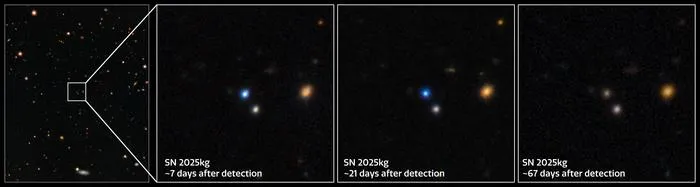 Sequence showing the fading light of Supernova SN 2025kg observed by Gemini and SOAR telescopes, following the Fast X-ray Transient EP 250108a from a massive star death.
Beyond the X-ray Flash: Monitoring the Supernova
While the initial X-ray flash provides clues about the immediate explosion mechanism, understanding the star that caused it requires longer-term observations. The team continued to monitor EP 250108a, watching as the X-ray signal from the trapped jet faded and the more enduring light from the associated supernova, designated SN 2025kg, took over.
“The X-ray data alone cannot tell us what phenomena created the FXT,” says Jillian Rastinejad, a PhD student at Northwestern University and lead author of the second companion paper. “Our optical monitoring campaign of EP 250108a was key to identifying the aftermath of the FXT and assembling the clues to its origin.”
Optical observations showed the typical brightening and fading characteristic of a supernova. The specific details in the light signature (known as a spectrum), particularly broad absorption lines, helped classify it as a specific type: a Type Ic broad-lined supernova. This type is already known to be associated with the collapse of massive stars that have lost their outer layers.
Additional data from the SOAR telescope in near-infrared light helped astronomers estimate the size of the star that exploded. Based on the supernova’s peak brightness, they calculated the progenitor star likely had a mass about 15–30 times that of our Sun.
Failed Jets Might Be Common
“Our analysis shows definitively that FXTs can originate from the explosive death of a massive star,” confirms Rastinejad. “It also supports a causal link between GRB-supernovae and FXT-supernovae, in which GRBs are produced by successful jets and FXTs are produced by trapped or weak jets.”
Combining the findings from both research papers, astronomers now have the clearest picture yet of a supernova linked to an FXT. The evidence suggests that ‘failed’ jets producing FXTs might be more common in massive star explosions than the ‘successful’ jets that create the spectacular GRBs. Since the Einstein Probe began its work, it has detected FXTs multiple times each month, whereas GRBs were historically detected only about once a year.
“This discovery heralds a broader understanding of the diversity in massive stars’ deaths and a need for deeper investigations into the whole landscape of stellar evolution,” says Eyles-Ferris.
The Future of Studying Stellar Explosions
Discoveries like this highlight the power of combining observations from new space missions like Einstein Probe with the rapid follow-up capabilities of ground-based telescopes like the International Gemini Observatory and SOAR.
The future of studying these extreme cosmic events looks even brighter. The upcoming NSF–DOE Vera C. Rubin Observatory and its decade-long Legacy Survey of Space and Time (LSST) will collect vast amounts of detailed data on stellar explosions, providing astronomers with an unprecedented dataset to probe the internal workings of FXTs and countless other transient events across the universe.
“The International Gemini Observatory combines rapid response capabilities with world-leading sensitivity to faint, distant sources,” notes Martin Still, NSF program director for the International Gemini Observatory. “This optimizes Gemini to be a premier follow-up machine for explosive event alerts from gravitational wave and particle detectors, space-borne surveys, and the upcoming Legacy Survey of Space and Time by the NSF-DOE Vera C. Rubin Observatory.”
This groundbreaking research moves us closer to understanding the dramatic final moments of massive stars and the energetic phenomena they unleash into the cosmos.





