
Imagine a city-sized asteroid striking the Moon. While that sounds like science fiction, a specific asteroid called 2024 YR4 has a small chance of doing just that in 2032. While a direct hit on Earth has been ruled out, a collision with our closest celestial neighbor could send debris our way, potentially impacting satellites and creating a spectacular meteor shower.
Contents
Key Takeaways:
- Asteroid 2024 YR4 poses a small, but notable, risk of hitting the Moon in 2032.
- An impact could eject millions of kilograms of material from the Moon’s surface.
- If the impact is on the near side, Earth’s gravity could pull some of this debris down.
- These lunar rocks would likely burn up harmlessly in the atmosphere, but could threaten satellites.
- We might also see a much more intense meteor shower than usual.
Asteroid 2024 YR4: From Earth Scare to Moon Concern
Asteroid 2024 YR4 is a space rock roughly 60 meters (200 feet) wide – large enough to cause significant damage if it were to impact a populated area on Earth. Earlier this year, there was brief concern when initial calculations gave it the highest chance ever measured for a space rock of its size to hit our planet in December 2032.
Thankfully, further observations using powerful telescopes definitively ruled out a direct impact on Earth’s surface. However, tracking the asteroid’s path revealed another possibility: a collision with the Moon. According to data updated in May using the James Webb Space Telescope, the odds of 2024 YR4 hitting the Moon have risen to 4.3 percent.
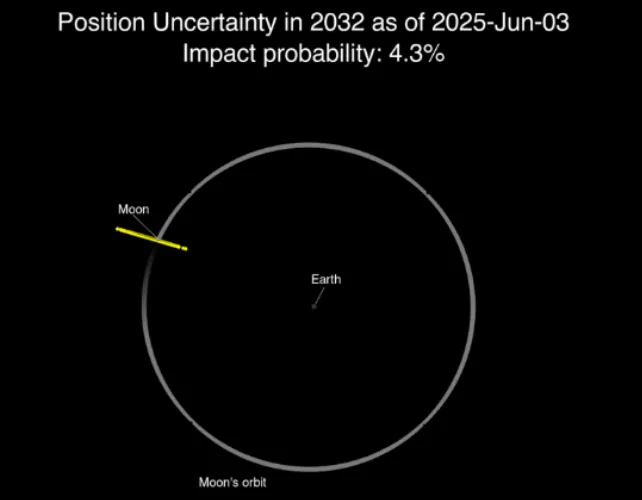 Diagram showing the predicted range of potential impact locations for asteroid 2024 YR4 on the Moon on December 22, 2032
What Happens When a Giant Rock Hits the Moon?
So, what if it actually happens? While the odds might seem low, researchers are already studying the potential consequences. A new study, currently in preprint and not yet peer-reviewed, offers the first estimates of how such a lunar impact could affect Earth.
Lead study author Paul Wiegert from Canada’s University of Western Ontario notes that an impact by 2024 YR4 would be the largest on the Moon in approximately 5,000 years. The energy released would be “comparable to a large nuclear explosion,” he told AFP.
- Related: Scientists Simulated Bennu Crashing to Earth in September 2182. It’s Not Pretty.
Debris Showering Towards Earth
Simulations run by the researchers predict that the impact would blast up to 100 million kilograms (220 million pounds) of material off the Moon’s surface.
If the asteroid strikes the side of the Moon facing Earth – which is about a 50-percent chance – some of this ejected debris could be pulled in by our planet’s gravity over the following days. The study estimates that up to 10 percent of the moon rock material could be captured by Earth’s gravitational pull.
The Threat to Satellites
While Earth’s thick atmosphere acts like a shield, protecting us on the ground from small incoming space rocks, it offers no protection to the thousands of satellites orbiting above.
The millimetre- to centimetre-sized rocks launched from the Moon could become dangerous projectiles in orbit. Wiegert compares a centimetre-sized rock traveling at immense speed to “a lot like a bullet.” By 2032, the number of satellites orbiting Earth is expected to be significantly higher, increasing the potential for collisions. The study suggests that in the days following a Moon impact, the number of potential meteors threatening satellites could be more than 1,000 times higher than normal.
A Spectacular Light Show
For those of us on the ground, a potential upside could be a truly stunning sight. The debris entering Earth’s atmosphere would burn up, creating an exceptionally bright and frequent meteor shower visible across the night sky.
Odds and What’s Next
It’s important to remember that the current odds of the asteroid hitting the near side of the Moon (the side facing Earth, where debris could reach us) remain relatively low, estimated at just two percent.
Scientists won’t have another chance to observe 2024 YR4 until 2028, when it becomes visible again. More data then will help refine its trajectory and the impact probability.
If the chance of a direct hit on the Moon were to increase significantly, humanity might have the tools to do something about it. The asteroid’s size and mass make it a feasible target for a deflection mission, similar to NASA’s successful DART mission in 2022, which changed the trajectory of a smaller asteroid called Dimorphos. Wiegert suggested 2024 YR4 could be “a good target” for another planetary defense test. However, he also cautioned that attempting to deflect an object passing so close to Earth when it isn’t on a collision course could be risky.
The findings from this new study are currently available on the arXiv database and have been submitted to the Astrophysical Journal Letters for peer review.
This research highlights the value of continuously monitoring near-Earth objects and developing our capabilities to understand and potentially mitigate cosmic threats, whether they target Earth directly or impact our neighbors like the Moon. To learn more about tracking asteroids and planetary defense, explore articles on NASA’s efforts in this field.





