
Most space rocks that land on Earth come from the asteroid belt. But we also have precious samples from the Moon and Mars, likely blasted off their surfaces by impacts. Yet, despite being relatively close, meteorites confirmed to come from Mercury have remained frustratingly elusive – until now. A new study suggests two unusual meteorites found on Earth could potentially be messengers from the solar system’s innermost planet, offering an unprecedented chance to peek beneath Mercury’s mysterious surface.
Contents
The Puzzle of Missing Mercury Rocks
Think of meteorites as tiny packages delivered from space, carrying clues about distant worlds. While we have thousands from the asteroid belt and a good number from our Moon and Mars, Mercury has been a planet without mail. Scientists know it’s physically possible for impacts on Mercury to eject material that eventually reaches Earth. So, where are its meteorites? This long-standing puzzle has left a gap in our understanding of Mercury’s formation and history.
Studying Mercury is tough. Its close proximity to the scorching Sun makes sending spacecraft complex and expensive. Missions like NASA’s Messenger have orbited the planet, giving us incredible insights into its surface composition, suggesting minerals like sodium-rich plagioclase, iron-poor pyroxene and olivine, and certain sulfides. But analyzing a piece of the planet in a lab is far more powerful. That’s why finding a natural sample – a meteorite – would be scientifically priceless.
Past candidates for Mercury meteorites haven’t quite fit the bill. One famous meteorite, Northwest Africa (NWA) 7325, was initially considered. However, its mineral makeup, particularly the presence of chromium-rich pyroxene with significant iron, didn’t match the predictions based on Mercury observations.
Aubrite meteorites, known for their unusual composition, have also been suggested as potential Mercurian visitors. Modeling their formation suggests they might originate from a large planetary body, similar in size to Mercury.
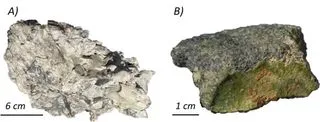 Hand specimen photographs of an aubrite (left, gray) and Northwest Africa 7325 (right, olive green and gray), previously considered potential Mercury candidates.
However, aubrites don’t chemically or spectrally match Mercury’s surface. Some scientists hypothesize they might come from beneath the crust, perhaps from Mercury’s shallow mantle. Despite these intriguing leads, definitive proof has remained out of reach.
Meet the New Candidates
Now, a recent study investigating two peculiar meteorites, Ksar Ghilane 022 and Northwest Africa 15915, has revealed some striking similarities that point towards Mercury. The researchers found that these two meteorites appear related, likely coming from the same parent body in space. Even more exciting, their mineralogy and composition show parallels with what we expect to find on Mercury’s crust.
Both Ksar Ghilane 022 and Northwest Africa 15915 contain minerals like olivine and pyroxene, along with smaller amounts of albitic plagioclase and oldhamite. These are consistent with the mineral suite predicted for Mercury’s surface. Furthermore, their oxygen compositions surprisingly match those of aubrites, reinforcing the idea that these samples might be connected to Mercury in some way. These shared traits make them highly compelling candidates for being actual pieces of the planet.
 Hand specimen photographs of Ksar Ghilane 022 (left, black and gray speckled) and Northwest Africa 15915 (right, olive green), two meteorites newly proposed as originating from planet Mercury.
Intriguing Matches, But Differences Remain
It’s not a perfect match, though. One key difference is the amount of plagioclase. Mercury’s surface is estimated to contain over 37% plagioclase, while these two meteorites only have trace amounts.
Another puzzle is their age. The study estimates the age of these meteorites to be around 4,528 million years old. This is significantly older than the oldest surface units currently recognized on Mercury, which are thought to be about 4,000 million years old based on counting impact craters. If these meteorites are from Mercury, they might represent material from the planet’s very early history that is no longer visible or preserved on its current surface.
Confirming a Cosmic Address
Pinpointing the exact origin of any meteorite to a specific planet or moon is incredibly difficult. For example, we only confirmed lunar meteorites by comparing them to the rock samples brought back by the Apollo missions. Martian meteorites were identified by matching gases trapped inside them to the composition of the atmosphere measured by spacecraft on Mars.
Without samples returned directly from Mercury, it’s challenging to make a definitive link. However, help may be on the way. The BepiColombo space mission, a joint effort by European and Japanese space agencies, is now orbiting Mercury and beginning to send back detailed data.
 A black and white image captured by the BepiColombo spacecraft showing the heavily cratered, rugged surface of Mercury.
This high-resolution information about Mercury’s surface composition and geology could be crucial in determining if Ksar Ghilane 022 and Northwest Africa 15915 truly came from the planet.
Why Does It Matter?
If these meteorites are confirmed to be from Mercury, the scientific implications are vast. Studying them could unlock answers to fundamental questions about the planet, such as:
- The age and evolution of Mercury’s crust
- Its precise mineralogical and geochemical makeup
- The nature of any trapped gases, hinting at its ancient atmosphere
The potential discovery of Mercury meteorites is sparking significant discussion in the scientific community, with upcoming meetings dedicated to exploring their possible origins. For now, the debate continues, based on the tantalizing clues these two space rocks have delivered.
Related Stories:
- Mercury is weird because of a ‘hit-and-run’ incident in its youth
- See Mercury’s frigid north pole in extraordinary new images from the BepiColombo spacecraft
- 9-mile-thick layer of solid diamonds may lurk beneath Mercury’s surface, study hints





