
Neutrinos are among the most abundant particles in the cosmos, yet they remain incredibly elusive. Scientists have long suspected these “ghost particles” have mass, but precisely how much has been a stubborn mystery. A new result from the KATRIN experiment has just set the tightest-ever upper limit on the mass of the electron neutrino, bringing us closer to understanding one of physics’ most enduring puzzles: the exact value of neutrino mass. This measurement provides crucial insights for both particle physics and cosmology.
Contents
The Puzzle That Hinted at a Hidden Particle
Our story starts nearly a century ago with radioactive decay. Scientists observed that when certain atoms decay (specifically, a type called beta decay), they emit an electron and transform into a new element. Simple conservation laws, like energy, suggested the energy of the original atom should exactly match the energy of the resulting atom and the emitted electron.
But there was a problem. The energy of the electron didn’t always add up. It seemed like some energy was missing, vanishing into thin air. This apparent violation of a fundamental law deeply troubled physicists. Was energy conservation truly broken?
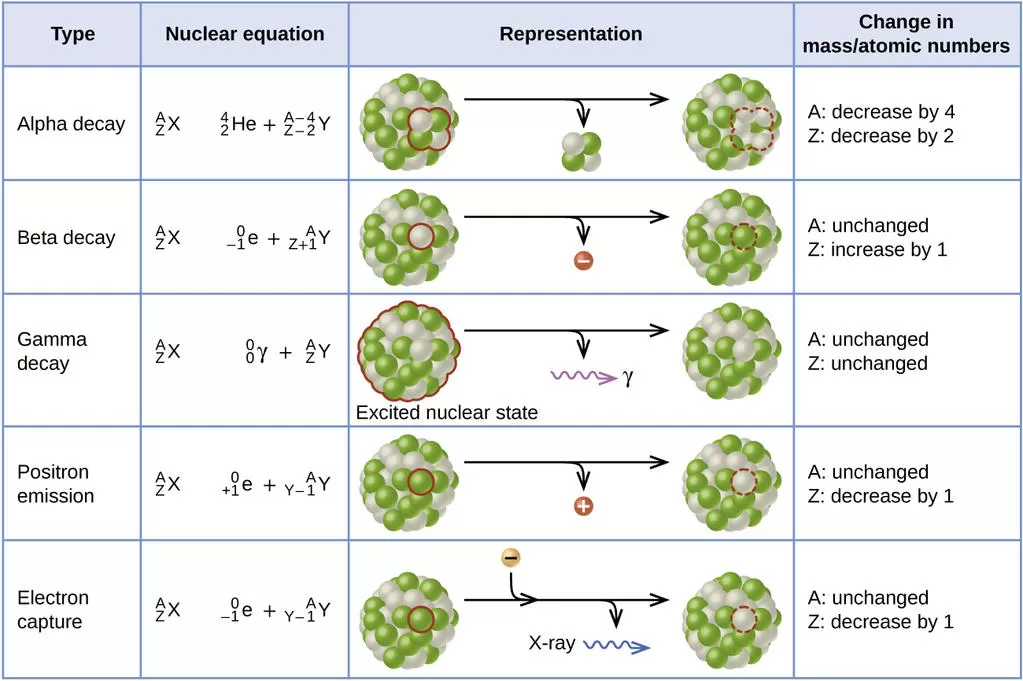 Illustration showing five types of radioactive decay, including alpha, beta, gamma, positron emission, and electron capture, highlighting the particles emitted or absorbed in each process.
In 1930, Wolfgang Pauli had a bold idea. He proposed the existence of a new, unseen particle that was also emitted during beta decay. This particle would be electrically neutral, interact very weakly with matter, and carry away the “missing” energy. He called it the “neutrino,” Italian for “little neutral one.” It was such a revolutionary and hard-to-test idea at the time that Pauli himself was hesitant, famously regretting postulating a particle he thought might never be detected.
Hunting the Ghost Particle
Pauli’s fear proved unfounded, though detecting neutrinos wasn’t easy. Because they interact so rarely, trillions pass through your body every second without leaving a trace. It took until 1956 for physicists Clyde Cowan and Frederick Reines to directly detect antineutrinos (the neutrino’s antimatter partner) near a nuclear reactor, finally confirming the particle’s existence and earning them a Nobel Prize decades later.
Finding neutrinos often requires massive detectors, sometimes built deep underground to shield them from other particles like cosmic rays.
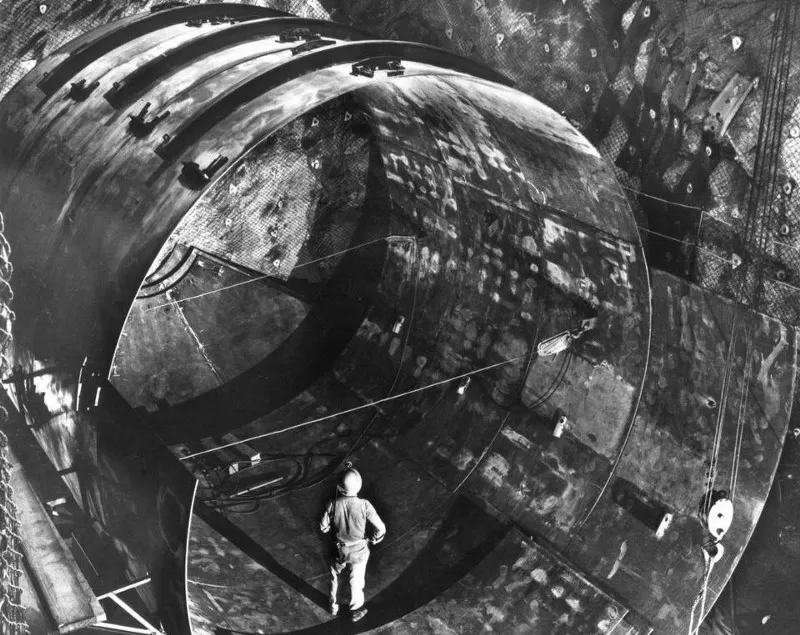 Photograph showing the construction of a large tank used in the Homestake gold mine experiment in the 1960s, illustrating early efforts to detect solar neutrinos deep underground.
The Sun’s Missing Neutrinos and a Quantum Shape-Shift
With neutrinos confirmed, scientists turned their attention to natural sources, like our Sun. Nuclear fusion in the Sun’s core produces vast numbers of neutrinos. Early experiments aiming to detect these solar neutrinos ran into another puzzle: they only found about a third of the number predicted by models of how the Sun works. Was our understanding of the Sun wrong?
It turned out the mystery lay with the neutrinos themselves. Particle physics has different “flavors” of neutrinos: electron, muon, and tau. The Sun primarily produces electron neutrinos. The solution to the solar neutrino puzzle was that neutrinos can change flavor as they travel. This phenomenon, called neutrino oscillation, is a quantum mechanical shape-shift.
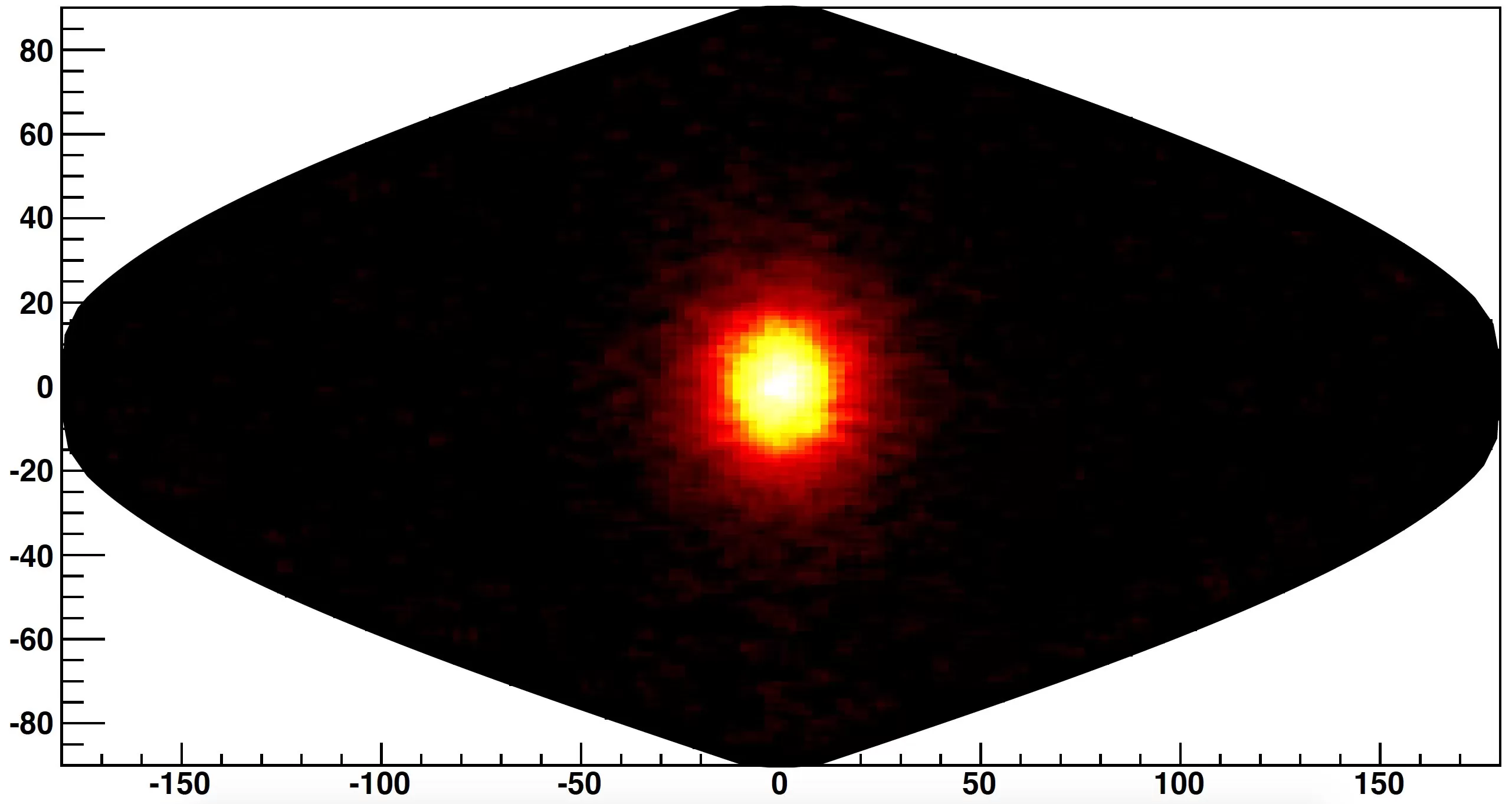 False color image of the Sun as seen by the Kamiokande and Super-Kamiokande neutrino experiments, showing the Sun as the dominant source of neutrinos in the "neutrino sky" and illustrating the target for solar neutrino detection.
But for neutrinos to oscillate, they must have mass. If they were truly massless, like photons, they would always travel at the speed of light and couldn’t change identity. This discovery, recognized with a Nobel Prize in 2015, confirmed that neutrinos are not massless, solving the solar neutrino problem and opening a new chapter in particle physics.
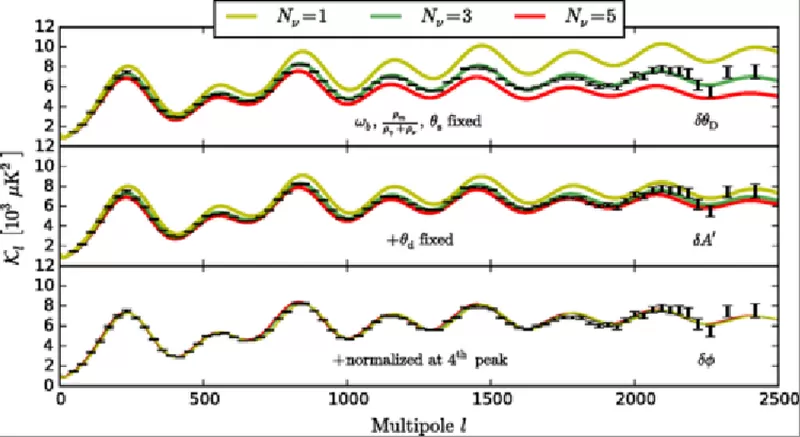 Illustration showing the mixing matrices for neutrinos and quarks, visually representing how different "flavors" of particles can be superpositions of different mass states, a key concept behind neutrino oscillations and the requirement for non-zero mass.
Why a Tiny Mass Matters on a Cosmic Scale
So, neutrinos have mass. But how much? Even a tiny mass has huge implications because neutrinos are incredibly abundant. There are hundreds of neutrinos per cubic centimeter everywhere in the universe, leftovers from the Big Bang. If they had significant mass, they could act as a form of dark matter, influencing the gravitational structure of the cosmos.
Cosmological observations, like studying the faint afterglow of the Big Bang (the cosmic microwave background) and the large-scale distribution of galaxies, are sensitive to the total mass of neutrinos. These observations provide indirect upper limits, suggesting neutrinos are very light and cannot account for all, or even most, of the universe’s dark matter.
Illustration showing the mixing matrices for neutrinos and quarks, visually representing how different "flavors" of particles can be superpositions of different mass states, a key concept behind neutrino oscillations and the requirement for non-zero mass.
Neutrinos also exhibit another oddity: they are always “left-handed” (their spin is always oriented opposite to their direction of motion), while antineutrinos are always “right-handed.” If they were massless and always moved at the speed of light, this is straightforward. But if they have mass, they could potentially move slower than light, creating theoretical headaches related to symmetry.
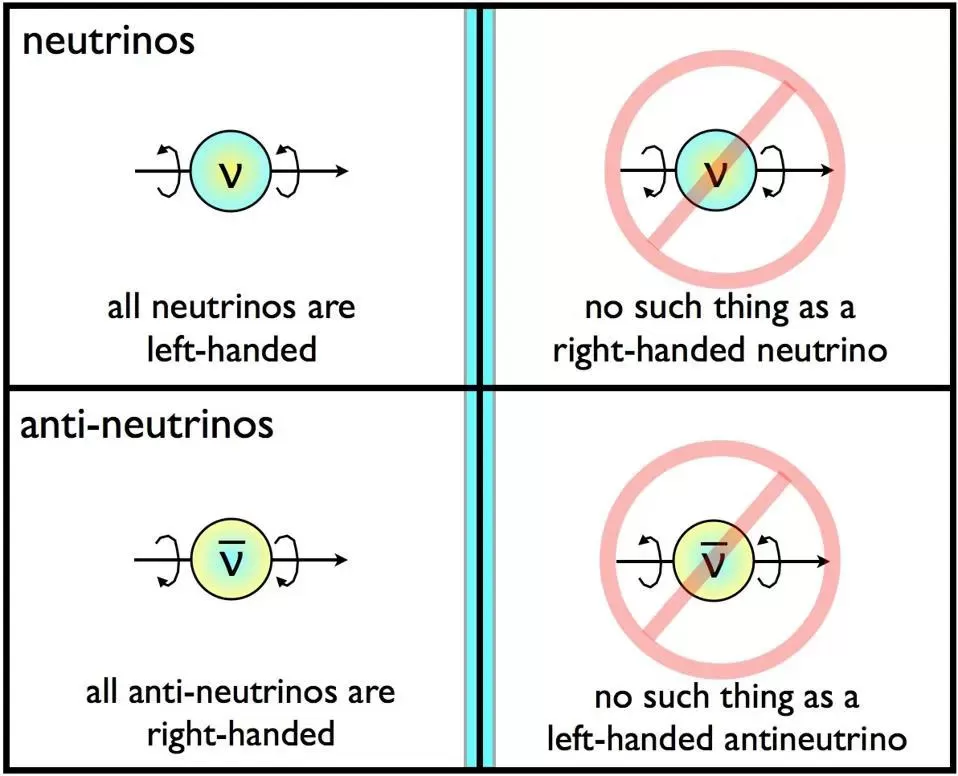 Illustration depicting left-handed neutrinos and right-handed antineutrinos based on their spin relative to their direction of motion, highlighting the violation of mirror-symmetry in particle physics and a key difference between neutrinos and antineutrinos.
Directly Weighing the Unseen Particle
While oscillations prove mass and cosmology constrains the total mass, neither can directly measure the absolute mass of an individual neutrino. For that, physicists use experiments like KATRIN (Karlsruhe Tritium Neutrino experiment). KATRIN goes back to the original beta decay puzzle, using tritium, a form of hydrogen, which undergoes this specific type of decay, producing a helium-3 nucleus, an electron, and an electron antineutrino.
The experiment precisely measures the energy of the emitted electron. According to energy conservation, the total energy of the helium nucleus, electron, and antineutrino must equal the initial energy of the tritium atom. If the antineutrino has mass, it will carry away a small amount of energy as “rest mass energy” (E=mc²), slightly reducing the maximum possible energy of the electron.
By carefully measuring the highest energy electrons emitted, scientists can deduce the minimum energy carried away by the antineutrino, thereby setting an upper limit on its mass.
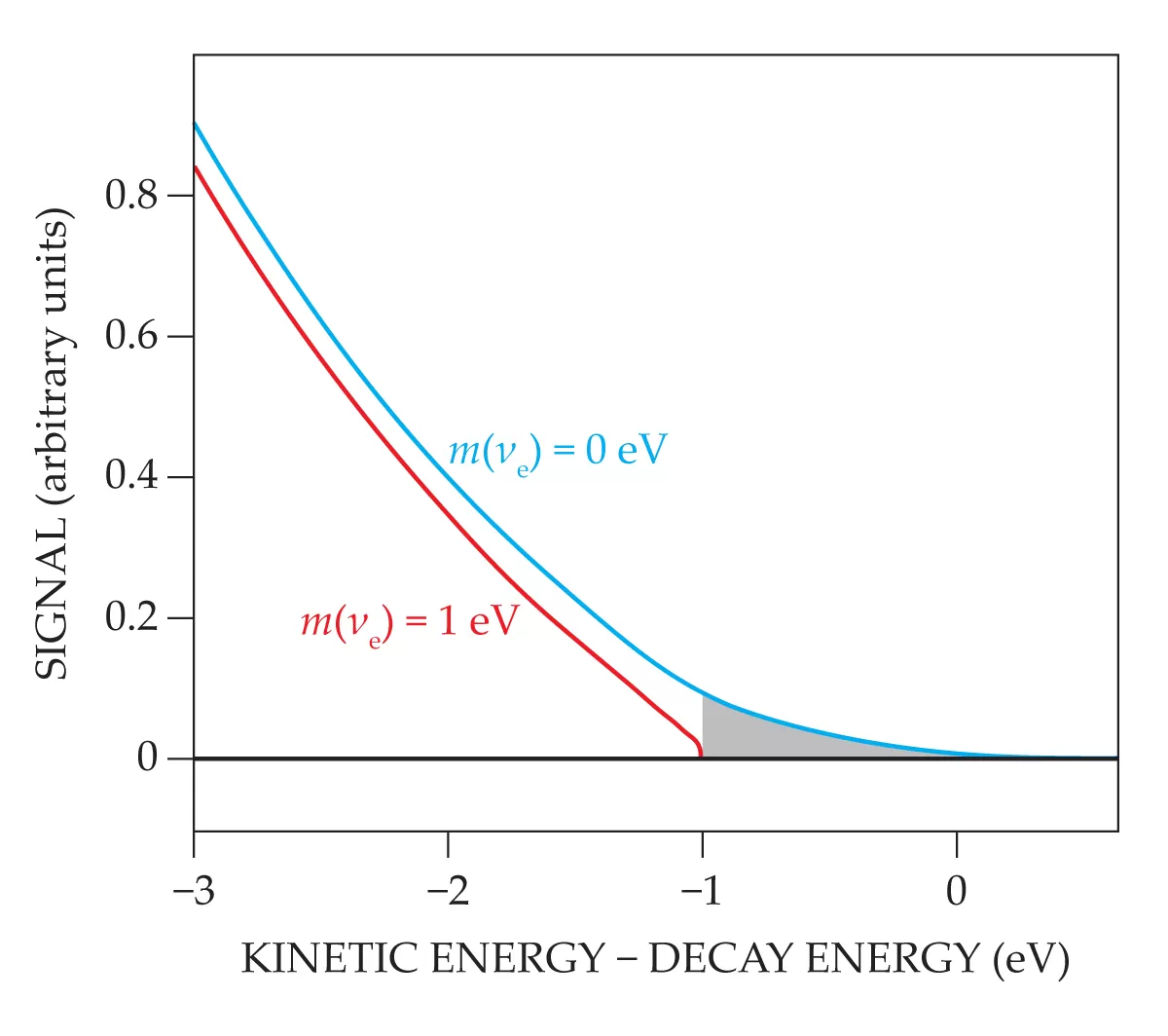 Graph comparing the predicted signal distribution versus kinetic energy minus decay energy for different neutrino masses (0 eV and 1 eV), showing how a non-zero neutrino mass would create a measurable deficit in the electron's maximum energy, illustrating the principle used by the KATRIN experiment.
The New Limit: Incredibly Light
The KATRIN collaboration recently announced their latest results, setting a new upper limit on the electron neutrino mass at 0.45 electron volts (eV/c²). For comparison, an electron’s mass is about 511,000 eV/c². This means the electron neutrino is more than a million times lighter than an electron!
This incredibly tight limit has important consequences. Combined with oscillation data (which gives mass differences between flavors), it implies the other two neutrino flavors (muon and tau) are also extremely light, likely not much heavier than the electron neutrino limit. It reinforces that neutrinos contribute less than 10% to the total dark matter density in the universe.
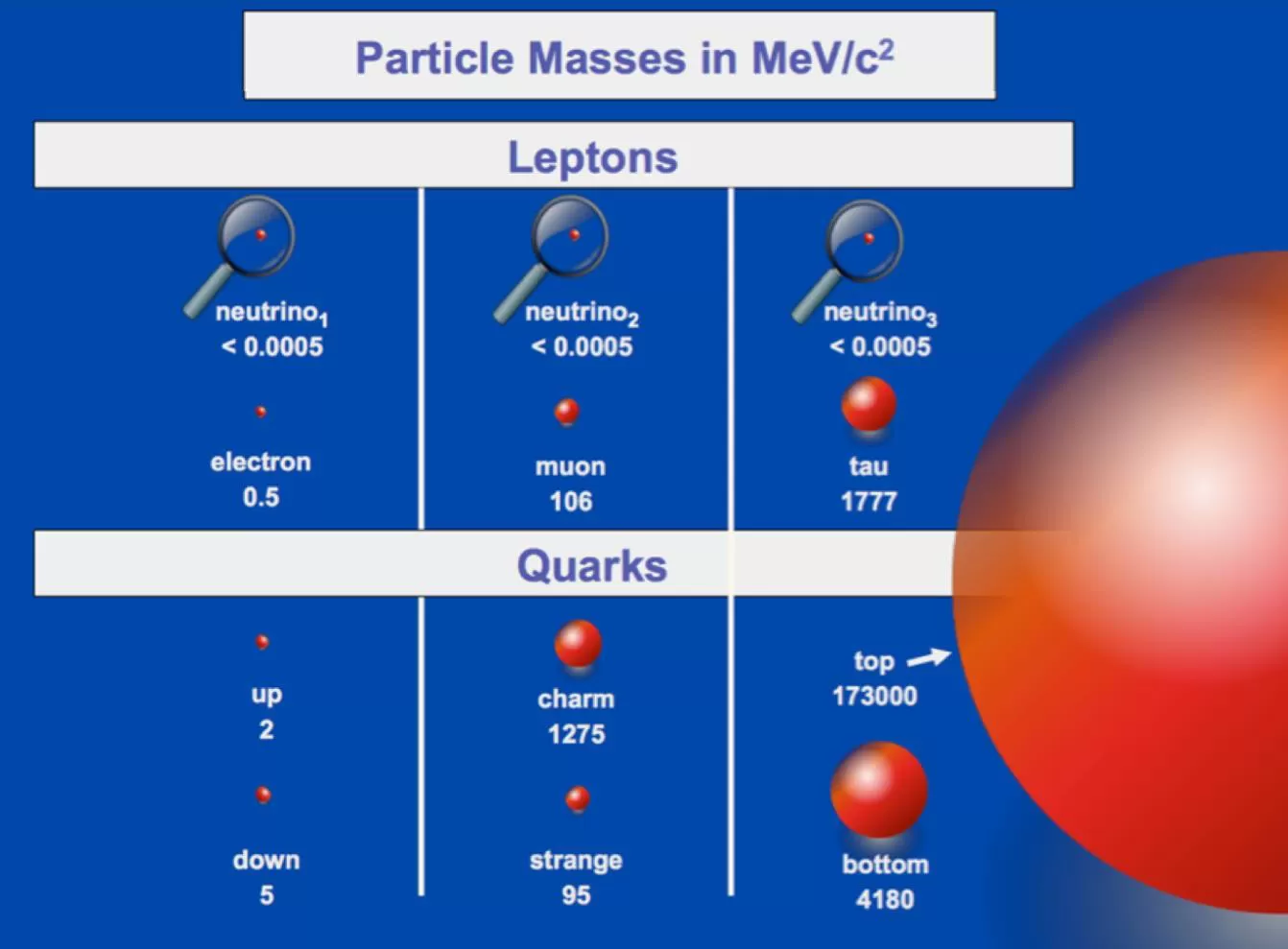 To-scale diagram illustrating the relative masses of elementary particles in the Standard Model, including quarks and leptons, highlighting that neutrinos are the lightest known massive particles and showing the large mass gap compared to even the electron.
Measurements from cosmology and direct experiments like KATRIN are getting closer to the minimum mass required by oscillation data. However, there’s still a tension between the upper limits from cosmology (suggesting perhaps zero total neutrino mass, though with large uncertainties) and the definitive evidence for mass from oscillation experiments.
The Search Continues
The new 0.45 eV/c² limit from KATRIN is a remarkable achievement, pushing the boundary of what we know about this fundamental particle. The experiment is not finished and plans to collect more data, aiming to lower the upper limit even further. The hope is to eventually either detect a non-zero mass within their sensitivity range or constrain it so tightly that it significantly informs both particle physics theories and cosmological models.
While we know neutrinos have mass, the exact value remains one of the most significant unanswered questions in physics. Every step toward pinning down this number helps refine our understanding of the fundamental building blocks of the universe and how the cosmos evolved. The ghost particle continues to reveal its secrets, little by little.





