
Humpback whales are known for their majestic songs and incredible migrations, but a recent study reveals a surprising behavior: they seem to be blowing intricate bubble rings at humans during friendly encounters. This isn’t just a cool trick; scientists believe it could be a form of playful communication, offering a unique window into the minds of these intelligent marine mammals.
Contents
This intriguing discovery, documented by researchers including those from the SETI Institute, suggests that humpback whales may be actively trying to interact with us. Studying this behavior could not only deepen our understanding of animal intelligence but also provide insights for the search for non-human intelligence beyond Earth.
What Did Scientists See?
For decades, scientists have observed humpback whales using bubbles for practical purposes, like creating bubble nets to trap fish for feeding or males blowing bubble trails during competition for mates. However, this new research focuses on a different kind of bubble behavior: large, distinct bubble rings produced when whales approach humans in a curious and friendly manner.
These aren’t random bursts; the bubble rings are similar in form to those humans can make by blowing smoke. Researchers analyzed 12 instances involving 11 individual whales and 39 bubble rings. They noted that the whales often directed these rings toward boats or swimmers, seemingly observing the human reaction.
Playful Interactions or Something More?
The scientists propose that this bubble ring behavior during friendly encounters likely represents play or a form of communication. Imagine blowing bubbles to get a baby’s attention or performing a trick to engage with a friend. This whale behavior could be a complex aquatic version of such interactions.
Humpback whales live in sophisticated social structures and are known for their diverse vocalizations and tool use (like bubble nets). They even assist other species facing danger, highlighting their capacity for complex behavior and interaction. This adds weight to the idea that the bubble rings might be intentional gestures aimed at engaging with humans.
Connecting with Non-Human Intelligence
One of the fascinating aspects of this research is its connection to the Search for Extraterrestrial Intelligence (SETI). Scientists studying alien life face the challenge of interpreting signals that might come from completely different forms of intelligence. By studying how intelligent, non-human species on Earth communicate and express curiosity – like humpback whales – researchers can develop better methods and filters to analyze potential signals from space.
Laurance Doyle, a SETI Institute scientist and co-author of the paper published in Marine Mammal Science, noted that the independent evolution of curious behavior in humpback whales supports the assumption that extraterrestrial intelligence might also be interested in making contact. Studying these aquatic intellects helps build a framework for understanding non-terrestrial communication systems.
 Humpback whale swimming in the ocean near Magdalena Bay, Mexico
Marine wildlife photographer and co-author Jodi Frediani added that they have identified numerous whales across the globe that have voluntarily approached boats and swimmers, blowing these bubble rings during these curious interactions.
A Legacy of Understanding Whales
Research into the complex lives of marine mammals like whales and dolphins has been ongoing for decades. In 2021, SETI Institute researchers famously engaged in what was described as a “conversation” with a humpback whale named Twain using underwater speakers. Learn more about how scientists attempted to converse with a humpback whale.
Scientists have also made breakthroughs in understanding the mechanics of whale communication, such as discovering how baleen whales are able to sing underwater and how human-caused noise pollution can disrupt this vital communication.
What’s Next?
The observation of humpback whales blowing bubble rings at humans opens up exciting avenues for future research. Understanding if this behavior is truly playful, communicative, or a combination, could reveal deeper insights into whale cognition and their capacity for interspecies interaction.
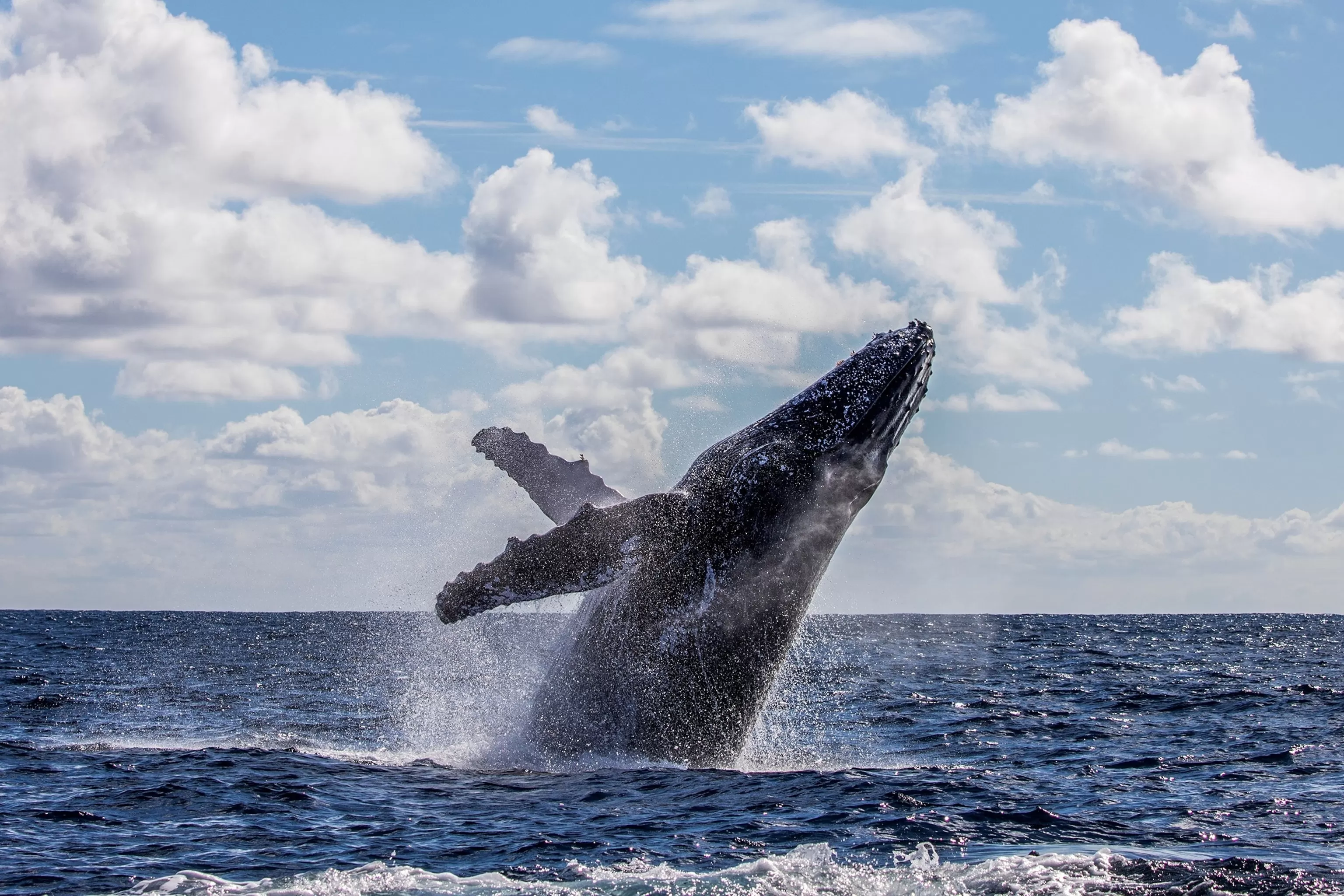 An adult humpback whale breaches, jumping high out of the water
This work underscores the intelligence and curiosity of these ocean giants and highlights how studying life here on Earth, in all its diverse forms, can help us prepare for the profound possibilities of encountering intelligence elsewhere in the universe. As scientists continue to decode the mysteries of whale behavior, we might just be learning the first few words in a potential dialogue with another intelligent species on our own planet.