
Antarctica, Earth’s frozen colossal continent, is showing unsettling signs of rapid change, raising concerns among scientists about potential Antarctic tipping points. Recent dramatic events, like unprecedented sea ice loss, suggest this critical region might be approaching irreversible shifts with profound global consequences, particularly for sea level rise. Understanding these changes is vital because Antarctica isn’t just a distant land of ice; it’s a key player in regulating our planet’s climate.
Contents
The Arctic and Antarctic are far away, but they play a vital role in regulating Earth’s climate. They act like the planet’s air conditioner, reflecting sunlight and storing vast amounts of frozen water. The Southern Ocean around Antarctica also helps absorb significant amounts of the carbon dioxide we release, acting as a critical part of the Earth’s natural carbon pump.
For years, Antarctic sea ice seemed relatively stable compared to the Arctic. But around 2016, things began to change, with the ice starting to decrease. Then, in 2023, something truly unprecedented happened. About 2.5 million square kilometers of sea ice vanished compared to the average – an area larger than Mexico. Scientists called this a “five sigma event,” a statistical anomaly so rare it’s like something you might only see once in tens of thousands or even millions of years. It was a startling signal that something significant is happening.
While the exact causes are still being studied, this dramatic loss is likely linked to global warming and shifts in ocean currents and atmospheric circulation. The sheer scale of the sea ice disappearance has immediate effects. Normally, thick sea ice keeps the air above frigid, but exposed water warms the surface and increases evaporation, drastically changing local weather patterns around the continent.
Scientists talk about “tipping points” in Earth’s climate systems. Think of it like pushing a heavy rock up a hill; it takes effort, and it might roll back down. But once you push it just past the peak, it rolls down the other side on its own, irreversibly, and often much faster. In the polar regions, tipping points represent abrupt, often irreversible changes over human timescales. Ice core records show these have happened in the past, but pinpointing exactly when they might happen now is challenging due to complex interactions.
To understand the risk, we need to distinguish between ice sheets and ice shelves.
The Mighty Ice Sheets
Ice sheets are colossal masses of ice covering vast areas of land, like continents (Antarctica and Greenland have the only two). They hold the vast majority of Earth’s fresh water. They grow from accumulated snow and shrink by melting or flowing into the sea. Antarctica’s ice sheets are particularly worrying because large parts of their bedrock sit below sea level and slope downwards inland. If the ice thins and starts floating in these deep basins, warm ocean water can melt it from below, potentially leading to rapid, catastrophic collapse.
The Floating Ice Shelves
Ice shelves are thick slabs of ice that float on the ocean surface, extending from the edges of land glaciers and ice sheets. They act like natural dams or “buttresses,” holding back the flow of the much larger ice sheets behind them. While ice shelf collapse doesn’t directly add significantly to sea level rise (because they’re already floating), losing them is like removing the doorstop – it allows the huge land-based ice sheets to slide into the ocean much faster, then causing significant sea level rise.
West Antarctica: The Zone of Greatest Concern
Within Antarctica, the West Antarctic Ice Sheet is considered the most vulnerable area. It’s home to massive, fast-changing glaciers like Pine Island and Thwaites, sometimes called the “Doomsday Glacier” due to its instability. Satellites show that the ice shelves buttressing these glaciers are thinning and retreating, allowing the land ice behind them to accelerate its flow into the ocean. This process has been speeding up since the early 2000s. If the entire West Antarctic Ice Sheet were to collapse, it could eventually add around four meters (about 13 feet) to global sea levels.
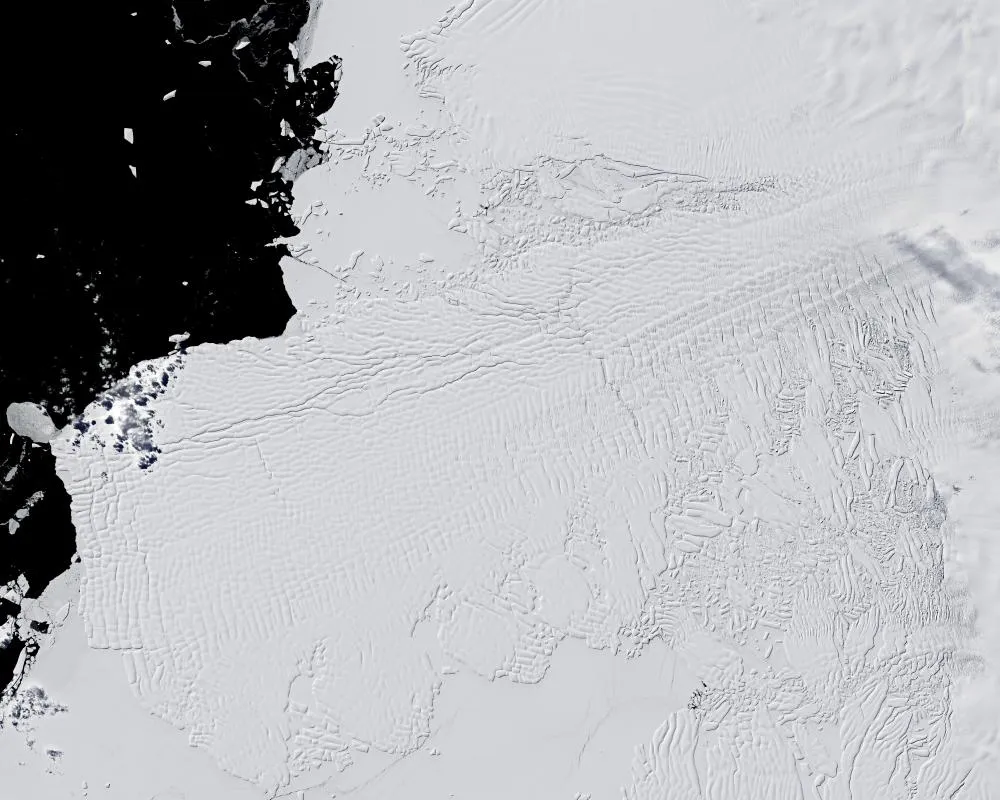 Thwaites Glacier in Antarctica showing ice retreat compared to an earlier date
Comparing Risks: Antarctica vs. The Arctic
While both poles are warming, the risk profile differs. Greenland’s ice sheet, located mostly above sea level, is melting significantly and contributing to sea level rise, which is expected to increase. However, this melt is generally seen as more gradual, though still concerning (Greenland holds enough ice to raise global sea levels by 5-6 meters).
Antarctica is different. While its current contribution to sea level rise is similar to Greenland’s, it holds a staggering amount of ice – potentially raising sea levels by 80 meters if it all melted (though this extreme scenario isn’t expected soon). The critical difference is that large parts of Antarctica’s ice are grounded below sea level and affected by potentially warming ocean currents. This makes it more susceptible to the kind of rapid, catastrophic collapse associated with tipping points, particularly in the West Antarctic region with its downward-sloping bedrock. Scientists are concerned about specific areas in East Antarctica too, where warm water is also encroaching.
Pinpointing an exact timeline is incredibly difficult. While a full collapse of West Antarctica could take hundreds or thousands of years, parts of the system, like ice shelves, can vanish in weeks or months. The fear is that once a major tipping point is crossed, the process could accelerate dramatically, leading to surprisingly rapid “jumps” in global sea levels that would be felt much sooner. Scientists need more research to narrow down these uncertainties.
Are We Already There?
This is the most unsettling question. Some scientific studies suggest that warming oceans may have already pushed parts of West Antarctica past a point of no return, meaning the loss of the ice sheet is now inevitable regardless of future emissions. However, the picture is complex and not entirely clear. While minor, local tipping points may well have been crossed in specific areas, many scientists believe there’s still a chance we haven’t yet passed the major, continent-wide tipping points in Antarctica.
Consequences Felt Around the World
If Antarctica’s major ice sheets begin to collapse and contribute significantly to sea level rise, the consequences would be devastating for humanity. Millions of people live in coastal areas around the globe; a rise of several meters would displace huge populations and inundate cities and infrastructure.
Beyond sea level, losing Antarctic ice could disrupt the vital Southern Ocean ecosystem. This region acts as a massive natural carbon sink, drawing vast amounts of CO2 from the atmosphere through marine life like plankton and krill. If tipping points are crossed, this biological pump could weaken, leaving more CO2 in the atmosphere and potentially accelerating global warming further.
The Urgent Need for Action
What can be done? The most critical action, scientists agree, is to stop burning fossil fuels as quickly as possible. Research suggests that immediately halting carbon emissions would likely stabilize Arctic sea ice and could prevent other parts of the global climate system from crossing further tipping points. Even if some minor points have been passed, avoiding others is crucial to limit the worst impacts.
Geoengineering approaches (large-scale interventions to manipulate the climate) are sometimes discussed, but scientists caution these are speculative and carry significant risks, potentially causing more problems than they solve. They are not a substitute for the primary goal: drastic emissions reduction.
The dramatic changes unfolding in Antarctica are more than just scientific curiosities; they are powerful warnings from a critical part of our planet’s climate system. While the precise timing remains uncertain, the potential consequences of crossing Antarctic tipping points – from catastrophic sea level rise to disrupting Earth’s carbon cycle – are immense and would affect everyone. Understanding this science underscores the urgent need for global action to reduce greenhouse gas emissions and protect the future stability of our planet.





