
Imagine the early universe shrouded in a dense fog. For millions of years after the Big Bang, space was filled with neutral hydrogen gas, making it opaque to many kinds of light. But then, something cleared the fog, transforming the universe into the transparent, vast expanse we see today. This epic event, called reionization, has been a major cosmic mystery. Now, observations from NASA’s James Webb Space Telescope point strongly to a surprising culprit: countless small, energetic galaxies bursting with new stars.
Contents
These findings suggest that while massive galaxies eventually dominated the cosmos, it was the “tiny but mighty” ones in the early universe that packed the necessary punch to drive this dramatic transformation.
Unlocking the Early Universe’s Secrets
For astronomers, figuring out what caused reionization is like piecing together a cosmic puzzle. Was it massive galaxies? Mysterious black holes? Or something else? The James Webb Space Telescope was specifically designed to peer back in time and help answer this question.
A team led by Isak Wold used Webb’s powerful instruments, including NIRCam (Near-Infrared Camera) and NIRSpec (Near-Infrared Spectrograph), to study a region of the sky containing the massive galaxy cluster Abell 2744, nicknamed Pandora’s cluster. Located about 4 billion light-years away, this cluster acts as a natural magnifying glass, thanks to its immense gravity bending and amplifying the light from even more distant objects behind it.
This technique, called gravitational lensing, allowed Webb to spot galaxies so far away their light has traveled for nearly 13 billion years, showing them to us as they were when the universe was only about 800 million years old – right in the thick of the reionization era.
Finding the Starburst Powerhouses
The team specifically looked for small galaxies active during this period. Why focus on the small ones? Scientists theorized that small galaxies might be better at letting out the powerful ultraviolet (UV) light needed to ionize hydrogen gas. Larger galaxies hold onto more gas, which can block this crucial light.
They hunted for galaxies showing signs of “starbursts” – periods of intense star formation. Starbursts not only produce lots of UV light but also create channels through a galaxy’s gas, making it easier for the light to escape into intergalactic space.
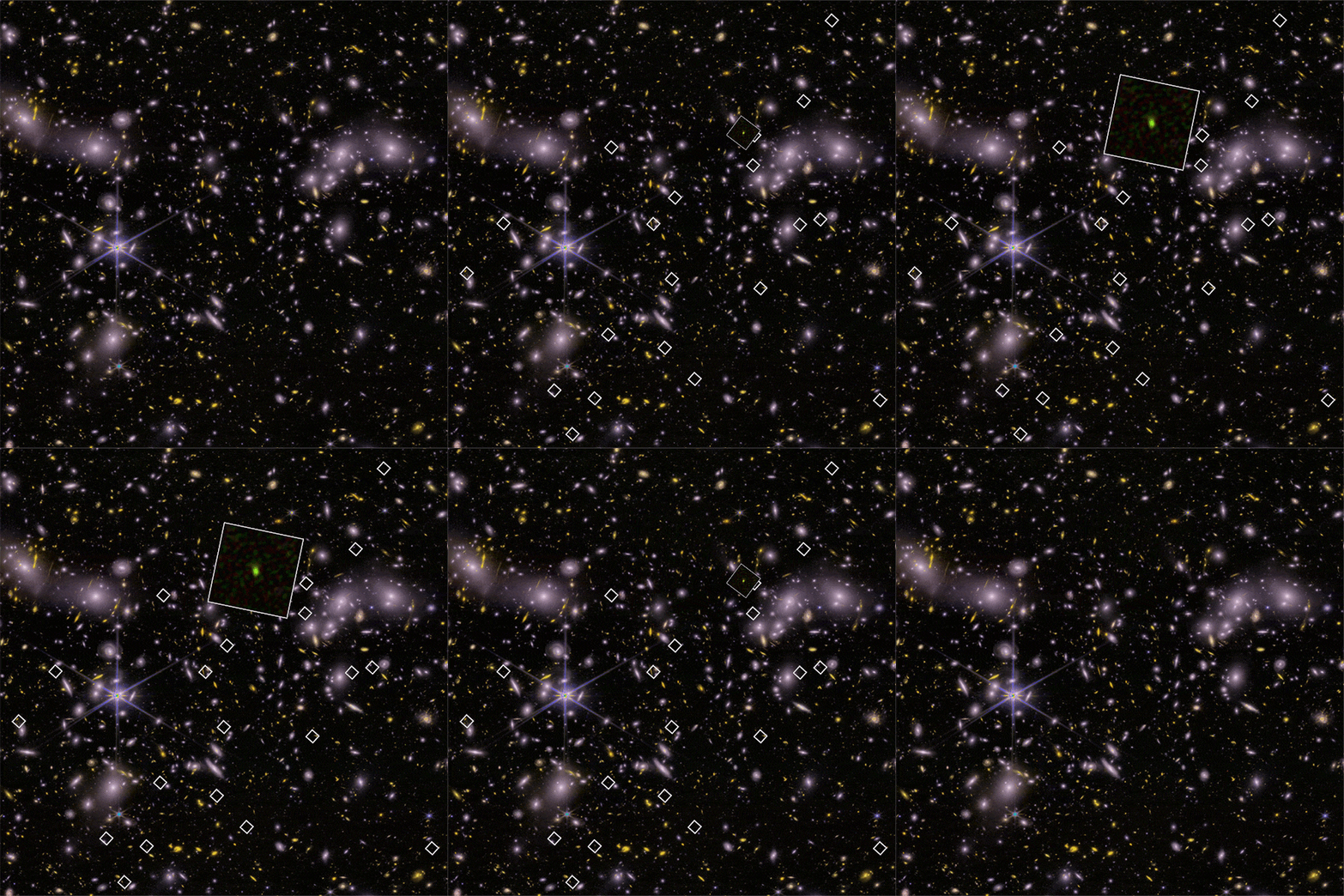 Animation showing the locations of young, low-mass, starburst galaxies around galaxy cluster Abell 2744. White and yellow galaxies of various sizes and shapes appear against the blackness of space. Two bright stars in our own galaxy display prominent six-spike diffraction patterns with bluish rays, visible at center left and lower left. Then 20 white diamonds sweep across the image. One diamond enlarges to reveal an image of a young, low-mass, star-forming galaxy. It looks like a green oval against a red and green checked background. The enlarged image then shrinks back, and the diamonds sweep away. The sequence loops.
Animation showing how James Webb Space Telescope found distant, young starburst galaxies around Abell 2744 cluster, using gravitational lensing to study cosmic reionization.
Using a filter sensitive to a specific wavelength of light emitted by doubly ionized oxygen – a telltale sign of energetic star formation and high UV output – they identified 83 potential candidates. These were small, young galaxies seen as they were around 800 million years after the Big Bang.
The team then used Webb’s NIRSpec instrument to get a deeper look at 20 of these galaxies. NIRSpec can analyze the light from these distant objects, providing crucial details about their composition, distance, and energy output.
James Webb Space Telescope image of galaxy cluster Abell 2744, highlighting locations of small, starburst galaxies from the early universe crucial for reionization.
Punching Above Their Weight
What they found was remarkable. These galaxies were tiny by cosmic standards – many with stellar masses equivalent to just a few million Suns. To build a galaxy the size of our Milky Way, you might need tens of thousands to hundreds of thousands of these little powerhouses!
Despite their small size, the spectral data confirmed they were undergoing vigorous star formation and emitting strong signals of highly energized oxygen, indicating a significant output of ionizing radiation.
Scientists have studied similar small, active galaxies closer to us, like the “green peas,” and found they can release a significant fraction (around 25%) of their ionizing UV light into surrounding space. If the early starburst galaxies Webb observed were similarly efficient, their sheer numbers and combined UV output would be more than enough to clear the cosmic fog and reionize the universe.
Detailed view from James Webb Space Telescope showing three early universe starburst galaxies and their spectra, confirming vigorous star formation critical for cosmic reionization.
Why This Matters
This discovery is a major step in understanding a pivotal moment in cosmic history. It shifts the focus from large, rare objects to numerous small ones as the primary drivers of the universe’s transformation. It highlights the unique capabilities of the James Webb Space Telescope, which can detect these faint, distant galaxies and analyze their light in unprecedented detail.
Close-up image from James Webb Space Telescope showing galaxy 41028, a tiny but mighty starburst galaxy from the early universe potentially responsible for reionization.
While these results strongly support the idea that small, star-forming galaxies were the key players in reionization, the universe still holds many secrets. Future observations with Webb and other telescopes will continue to explore this fascinating era, aiming to confirm these findings and perhaps uncover even more about the forces that shaped the cosmos we inhabit today.
To learn more about different types of galaxies or stay updated on the latest Webb news, explore the resources available.