
The James Webb Space Telescope (JWST) has taken a closer look at a space rock known as asteroid 2024 YR4. While initially thought to potentially pose a small risk to Earth, new, highly precise observations from JWST have confirmed there is no danger to our planet for the foreseeable future. However, these same observations have slightly increased the chances that this “city-killer” sized asteroid could instead collide with the moon in 2032. This discovery highlights the power of advanced telescopes in tracking potentially hazardous objects and offers scientists a rare, albeit small, possibility to study a new crater formation.
Contents
Tracking a “Potentially Hazardous” Visitor
Asteroid 2024 YR4 is a building-sized object, estimated to be between 174 and 220 feet (53 to 67 meters) wide. To picture its size, imagine something about as tall as the Leaning Tower of Pisa tumbling through space. Because its orbit around the sun regularly brings it close to Earth’s path, it’s classified as a “potentially hazardous asteroid.”
When astronomers first discovered 2024 YR4 in late 2024, early trajectory calculations caused some concern. The initial predictions showed a slight possibility of an impact with Earth in 2032. This led to urgent calls for more observations to refine its path, like trying to aim a spotlight on a moving target millions of miles away.
JWST Takes Aim
To get a better handle on the asteroid’s exact route, scientists turned to the powerful James Webb Space Telescope. JWST’s ability to observe objects in infrared light, even faint ones far away, makes it perfect for precisely tracking asteroids.
In an “emergency” use of observation time, JWST’s Near-Infrared Camera captured images of 2024 YR4 twice, in April and May. These observations provided the most accurate data yet on the asteroid’s position and movement. Think of it as upgrading from a blurry snapshot to a high-definition video – suddenly, the path becomes much clearer.
This improved precision quickly brought good news for Earth: the probability of 2024 YR4 hitting our planet in the foreseeable future dropped to zero. Our cosmic doorstep is safe from this particular rock.
A New Target: The Moon?
While the Earth risk vanished, the refined trajectory calculations pointed to a different body in our celestial neighborhood: the moon.
The latest data from JWST suggests there is now a 4.3% chance that asteroid 2024 YR4 will collide with the moon on December 22, 2032. This is a slight increase from the 3.8% odds reported after JWST’s initial look in March. NASA states that it’s “normal for the impact probability to evolve” as more data is gathered.
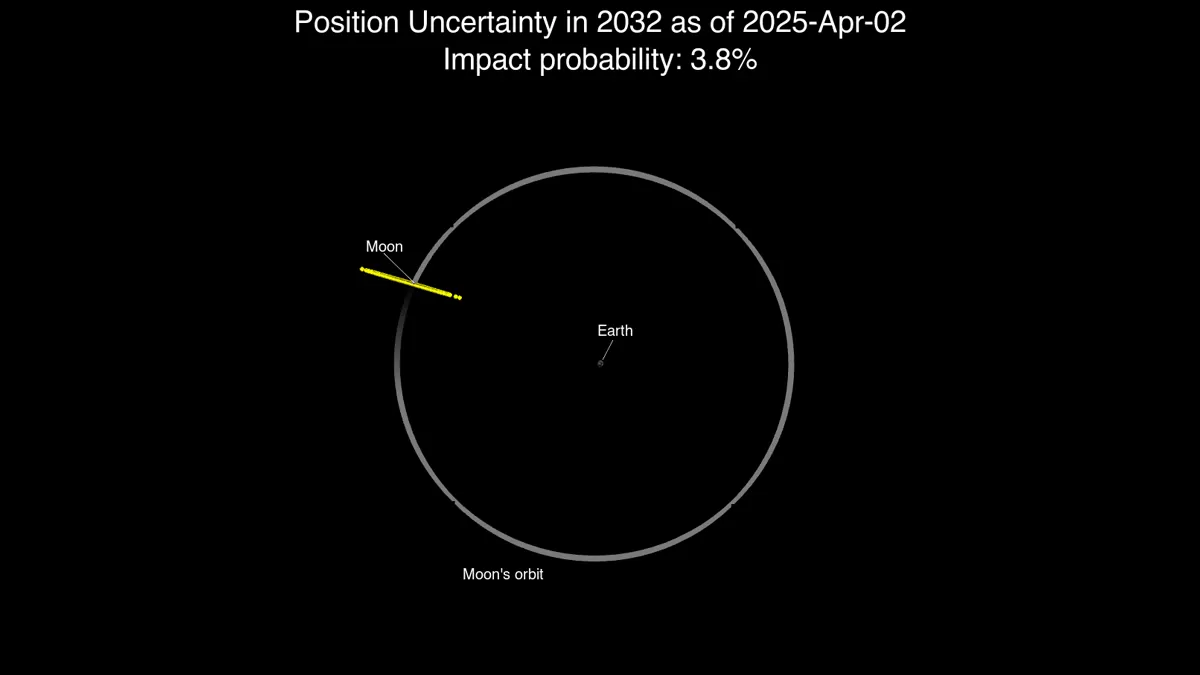 An animation shows the orbits of Earth and the Moon with yellow dots representing the potential path of asteroid 2024 YR4
The range of potential locations for asteroid 2024 YR4 on December 22, 2032, shown by yellow points. As more data was gathered, scientists became more certain of the asteroid’s position, shrinking the range of possible paths.
Why Scientists Are Watching (With Interest)
Even though a 4.3% chance is relatively small, it’s significant enough for scientists to keep a close eye on the asteroid. If 2024 YR4 were to hit the moon, what would happen? Given its size, it wouldn’t destroy the moon, but it would create a new impact crater.
Interestingly, some scientists view this potential lunar impact not as a threat, but as a unique scientific opportunity. Observing a known asteroid hitting the moon would provide invaluable data on how craters form, the energy involved, and the materials ejected. As one professor, Alan Fitzsimmons, put it, “We’ve got our fingers crossed for a moon impact.”
What Comes Next?
Asteroid 2024 YR4 is currently heading away from Earth, moving deeper into the solar system and out of the range of most ground-based telescopes. It is expected to make its next close approach to Earth and the moon in 2028.
NASA anticipates making further observations at that time, potentially using JWST again, to further refine the asteroid’s trajectory and the odds of that possible 2032 moon impact. The ongoing tracking of objects like 2024 YR4 is a critical part of planetary defense efforts, ensuring we understand the paths of near-Earth objects.
To learn more about objects near our planet, explore NASA’s most wanted list of dangerous asteroids. Stay curious!





