
The James Webb Space Telescope (JWST) has peered deeper into the universe’s past than ever before, detecting a galaxy that existed just 280 million years after the Big Bang. This incredible discovery, dubbed MoM z14 by the research team, offers a new glimpse into the universe’s earliest moments and is challenging our understanding of how the first galaxies formed.
Contents
Seeing Further Back in Time
The JWST excels at observing faint light from the most distant objects in the cosmos. Because light takes time to travel across space, looking far away is like looking back in time. This newly discovered galaxy, MoM z14, is so distant that the light we see left it when the universe was incredibly young – a mere 280 million years old. To put that in perspective, sharks have been swimming on Earth for a longer period than the entire age of the universe when this galaxy shone!
Pinpointing such ancient objects relies on a phenomenon called redshift. As the universe expands, the light from distant galaxies is stretched, shifting its wavelength towards the red end of the electromagnetic spectrum. The greater the redshift, the further away – and thus, older – the object is. MoM z14 has a record-breaking redshift of z = 14.44, slightly higher than the previous record holder, JADES-GS-z14-0, which existed about 300 million years after the Big Bang (at a redshift of z = 14.32).
 Artist's illustration of an early galaxy (main) alongside a JWST image of the earliest detected galaxy, MoM z14 (inset)
What MoM z14 Tells Us About the Early Universe
Beyond its record-breaking age, MoM z14 is providing surprising insights into the cosmic dawn. The team, led by Rohan Naidu of MIT, was able to analyze some of the galaxy’s characteristics using the JWST’s powerful instruments. They estimate MoM z14 is relatively small, about 50 times less massive than our own Milky Way galaxy.
Intriguingly, the JWST detected evidence of heavier elements like nitrogen and carbon within MoM z14. This is significant because the very first stars and galaxies in the universe were expected to be composed solely of the simplest elements: hydrogen and helium. Heavier elements, which astronomers sometimes call “metals,” are forged inside stars and dispersed through supernova explosions.
The presence of nitrogen and carbon in MoM z14 suggests it’s not among the absolute first generation of galaxies, but likely part of an early wave of galaxy formation that already contained these elements. This tells us that the process of building up chemical complexity in the universe was already underway surprisingly early.
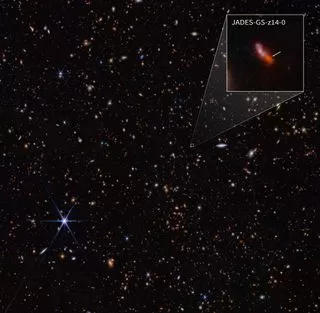 JWST image of JADES-GS-z14-0, the galaxy previously holding the record for earliest detected
The findings from MoM z14, along with observations of other early galaxies by JWST, are starting to paint a picture that differs from what astronomers expected before the telescope launched. There appear to be more relatively bright galaxies in the very early universe than predicted. Some early galaxies also seem to be forming stars unexpectedly rapidly and show hints of less neutral hydrogen gas around them than anticipated, potentially challenging our models of the intergalactic medium’s evolution.
Pushing the Boundaries of Cosmic History
Discoveries like MoM z14 are crucial for understanding how the universe evolved from a hot, dense state after the Big Bang into the complex structure of galaxies, stars, and planets we see today. Each new, incredibly distant galaxy found by JWST acts like a fossil, preserving information about a specific time in cosmic history.
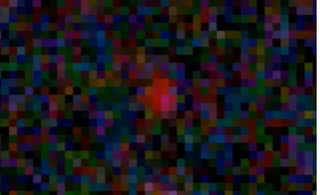 The galaxy MoM z14 as observed by the James Webb Space Telescope, appearing as a distant red dot
Researchers are optimistic that the James Webb Space Telescope hasn’t reached its limit yet. The fact that it’s finding these “cosmic miracles” – objects thought to be beyond its reach at this stage – suggests it could yet discover even earlier galaxies, perhaps pushing our view back to redshifts of z=15 or z=16.
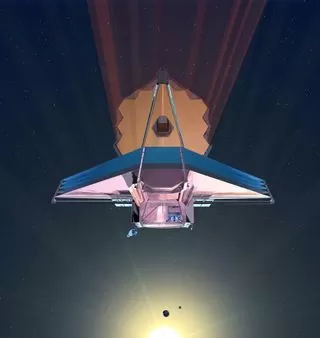 Illustration depicting the James Webb Space Telescope in space with its distinctive gold mirror
The hunt continues for the very first galaxies, the ones that ended the universe’s “dark ages” and ignited the first stars composed purely of hydrogen and helium. MoM z14 is a thrilling step closer to that ultimate goal, reminding us that the universe’s early history is full of surprises waiting to be uncovered by this extraordinary eye in the sky.
This groundbreaking research, currently available in a pre-peer-reviewed version on arXiv, adds another exciting chapter to the JWST’s ongoing exploration of the universe’s distant past.
Want to learn more about the telescope revolutionizing our view of the cosmos? Read more about the James Webb Space Telescope and its incredible discoveries, including how it’s revealing that some early galaxies defy expected rules of star formation.





