
Peering across space, the James Webb Space Telescope (JWST) has given us an unprecedented look at the atmospheres of two giant exoplanets orbiting a distant star called YSES-1. These incredible observations revealed something unexpected: one planet appears to have clouds made of fine sand high in its sky, while another is surrounded by a vast disk rich in a mineral also found in gemstones like peridot here on Earth. This research provides the most detailed atmospheric data yet for a multi-planet system beyond our solar system.
Contents
Getting a direct look at exoplanets – planets outside our solar system – is incredibly challenging. They are vastly far away, small, dim, and often lost in the overwhelming glare of their host stars. While we’ve found nearly 6,000 exoplanets, most are detected indirectly, by how they affect their stars. Only a tiny fraction have been directly imaged.
Why Direct Images Matter
Indirect methods can tell us a lot about a planet’s size and orbit, but seeing the light from the planet itself reveals much more, especially about its atmosphere. Imagine trying to understand someone just by watching their shadow versus seeing them clearly – that’s the difference direct imaging makes. However, capturing that faint light requires an exceptionally powerful telescope.
The YSES-1 system is located about 306 light-years away. It hosts at least two known giant planets: YSES-1b, about 14 times the mass of Jupiter (near the line between a planet and a brown dwarf), and YSES-1c, about 6 times the mass of Jupiter. Previous glimpses hinted at interesting atmospheres, but lacked the power to confirm details.
 An artist’s impression shows the YSES-1 star system, including the two large exoplanets, YSES-1b and YSES-1c, and their potential surrounding structures.
JWST’s Powerful New View
This is where the JWST comes in. Using its NIRSpec instrument, scientists led by astrophysicist Kielan Hoch were able to capture images of the planets across thousands of different infrared wavelengths simultaneously. Think of it like taking a picture that also acts as a super-detailed analysis of all the colors (wavelengths) of light coming from the object.
This light contains vital clues. As light from the planet passes through its atmosphere, specific gases and particles absorb certain wavelengths. This creates “dips” in the light’s spectrum, much like a unique barcode or fingerprint for the materials present. By analyzing these fingerprints, scientists can figure out what the atmosphere is made of.
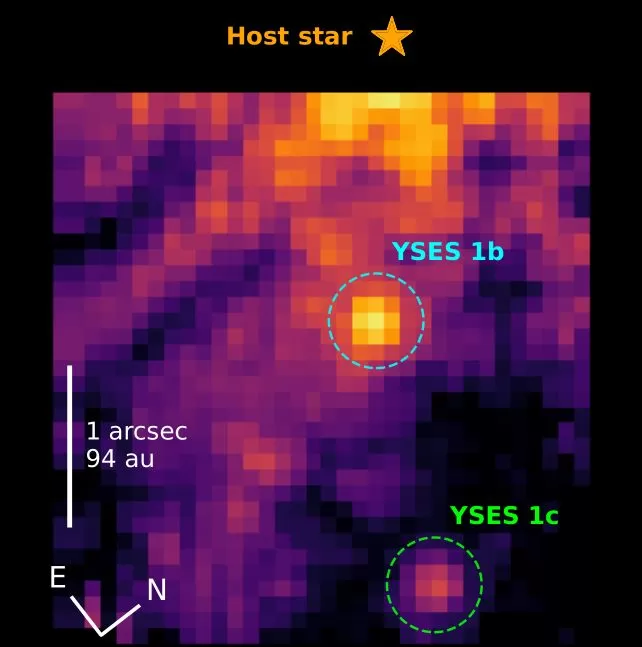 A processed image from the JWST’s NIRSpec instrument clearly shows the faint light from the two exoplanets, YSES-1b and YSES-1c, against the backdrop of distant stars.
Uncovering Alien Skies
The JWST observations provided the most detailed spectral data ever for a multi-planet system. Both YSES-1b and YSES-1c showed signs of common atmospheric components like water, carbon monoxide, carbon dioxide, and methane. But their differences were astounding.
YSES-1c showed a distinct signature at longer wavelengths, indicating the presence of silicate particles. Models suggest these are likely tiny grains of sand drifting high up in the planet’s atmosphere, possibly even mixed with small amounts of iron that could rain down. Imagine clouds, but made of fine sand instead of water!
For YSES-1b, there was no clear sign of silicate clouds. Instead, the JWST detected the signature of small grains of olivine in a vast disk swirling around the planet.
Gemstone Dust in Space?
Olivine is a mineral found on Earth, often created in volcanic conditions. High-quality olivine forms the precious gemstone peridot. While found in meteorites, detecting it as dust in a disk around a relatively old planet (the system is about 16.7 million years old) is surprising. Dust disks like this are expected to settle and disappear much faster, typically within about 5 million years.
This unexpected finding around YSES-1b suggests the olivine dust might be recent debris from a collision between smaller objects orbiting near the planet. If so, the JWST caught the system at a remarkably lucky moment in its cosmic history.
This image displays the spectral data captured by JWST across different infrared wavelengths for the YSES-1 exoplanets, showing how astronomers detect the chemical signatures of atmospheric components and dust.
More Questions Than Answers
These observations are spectacular, offering rare direct insights into distant worlds. The discovery of sandy clouds on YSES-1c matched theoretical predictions for its type, but the specific silicate signature was unique. The detection of the olivine disk around YSES-1b was a complete surprise.
As with all great discoveries, these results raise exciting new questions. What caused the olivine disk around YSES-1b? How do these sandy clouds behave compared to water clouds? And what do these findings tell us about how gas giants form and evolve so far from their stars?
Ongoing studies using JWST and other powerful telescopes will continue to probe the atmospheres of other exoplanets, helping fill in the vast gaps in our knowledge about alien worlds and how common such exotic conditions might be throughout the galaxy. This research, led by early career scientists, highlights the importance of supporting new perspectives in pushing the boundaries of space exploration.
To learn more about these fascinating discoveries and the incredible capabilities of the JWST, explore related articles on exoplanet atmospheres and the latest findings from space telescopes.