
Imagine finding a giant, complex LEGO piece floating in the vast darkness of space. Scientists have just made a similar “cosmic chemistry breakthrough” by identifying the largest organic molecule ever detected in the cold emptiness between stars. This discovery of a complex carbon-based molecule, called cyanocoronene, in deep space is a significant step towards understanding how the chemical ingredients for life might seed new planetary systems. The key takeaway is that complex organic chemistry can occur even in the frigid conditions of space before stars are born.
Contents
What Are These Cosmic Molecules?
The molecule in question, cyanocoronene, belongs to a family of compounds known as polycyclic aromatic hydrocarbons (PAHs). Think of PAHs like tiny pieces of cosmic charcoal or soot. Their structure is like a collection of fused hexagonal rings, similar to a honeycomb, where electrons are shared, giving them unique stability.
Scientists believe PAHs are crucial because they are thought to hold a large portion of the universe’s carbon – an element essential for all known life. These molecules play a key role in the cosmic dust and gas clouds where stars and planets are born. Until now, only smaller PAHs had been spotted far from Earth, but finding one as large as cyanocoronene pushes the boundaries of what we thought was possible for molecule formation in these harsh environments.
 Illustration of cyanocoronene, the largest organic molecule discovered in space, resembling connected hexagonal rings
How Was This Giant Molecule Formed in Space?
The research suggests that cyanocoronene can form surprisingly efficiently in space’s frigid conditions. This happens through reactions between a smaller PAH (coronene) and highly reactive cyanide radicals, even at very low temperatures.
This finding is exciting because it means the complex chemistry needed to build large organic molecules can occur long before stars ignite and warm their surroundings. Such “prebiotic” molecules – the potential chemical precursors to life – might be common ingredients already present in the clouds from which stars and planets condense.
Where Was the Discovery Made?
The detection was made using the Green Bank Telescope (GBT), located in Green Bank, West Virginia. The GBT is the world’s largest fully steerable radio telescope and an essential tool for peering into the cold, dark corners of space where visible light can’t penetrate.
The giant molecule was specifically found in the Taurus Molecular Cloud (TMC-1), a region known to be a cosmic “chemistry lab.” This cloud, located in the constellations Taurus and Auriga, is a nursery for new stars and is rich in diverse and complex molecules.
How Does a Radio Telescope Find Molecules?
Unlike telescopes that capture visible light, the GBT listens for radio waves. Cold, dense regions like TMC-1 emit radio waves as molecules within them tumble and vibrate. Each type of molecule has a unique pattern of radio waves it emits, like a distinct musical fingerprint.
To identify a molecule in space, scientists first measure its specific radio fingerprint in a laboratory on Earth. Then, they point powerful radio telescopes like the GBT at cosmic clouds and look for matching signals. The detection of multiple matching signals for cyanocoronene in the GBT data confirmed its presence in TMC-1 with high certainty.
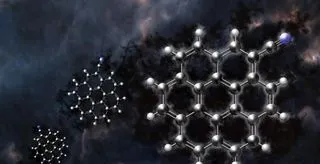 Artist rendering of the cyanocoronene molecule structure found in space
Why Does This Discovery Matter for Understanding Life?
Finding such a large, complex organic molecule in cold interstellar space is a big deal. It shows that the raw materials for life – complex carbon structures – can form under conditions previously thought too harsh. This suggests that planetary systems might be seeded with these building blocks from the very beginning of their formation.
The lead author of the research, Gabi Wenzel, noted that “Each new detection brings us closer to understanding the origins of complex organic chemistry in the universe — and perhaps, the origins of the building blocks of life themselves.”
What’s Next?
This groundbreaking discovery opens up new possibilities for astronomers and astrochemists. They can now search for even larger PAHs and related complex molecules in space. Future research will likely focus on how these large structures behave in the interstellar environment – how they might break apart, grow, or interact under the influence of radiation and other cosmic forces.
By continuing to explore the intricate chemistry of space, scientists hope to piece together the cosmic story of how the chemical soup from which life emerged first came to be. Understanding these fundamental processes takes us one step closer to answering the age-old question: are we alone in the universe?
To dive deeper into the mysteries of space and the search for life beyond Earth, explore more articles on cosmic discoveries.





