
Imagine winding the clock back almost to the very beginning of time itself. For a long while after the Big Bang, the universe was a dark, neutral place, without any stars to light it up. Now, astronomers believe they might have found a way to glimpse this hidden era and potentially uncover the secrets of the very first stars using a faint radio whisper from the deep past. New research reveals how this subtle cosmic signal could hold crucial clues about the size and nature of these pioneering stellar giants.
Contents
Key Takeaways:
- A faint radio signal, known as the 21-centimeter line, comes from neutral hydrogen gas that filled the early universe.
- This signal was likely influenced by the universe’s first stars, potentially encoding information about them.
- New models show how the first stars, including the effects of their death as black holes, would change this signal.
- Future radio telescopes will be able to detect this signal, allowing astronomers to measure properties like the mass of the first stars.
The Cosmic Dark Ages Before Stars
Right after the Big Bang, the universe was a hot, dense soup. As it expanded and cooled, atomic nuclei and electrons combined to form neutral hydrogen and helium gas. Think of it as a thick, dark fog filling everything. For millions of years, there were no stars or galaxies – a period astronomers call the “Cosmic Dark Ages.”
 Artist's concept showing early stars emerging from a dark universe
It’s from this primordial gas that the very first stars eventually coalesced. But finding these first-generation stars is incredibly difficult. Some theories suggest they were absolutely huge, perhaps thousands of times the mass of our Sun, and lived incredibly short, dramatic lives. This makes direct observation challenging.
A Whisper from the Past: The 21-Centimeter Signal
However, the neutral hydrogen gas itself emits a specific, very faint radio wave with a wavelength of 21 centimeters. This “21-centimeter signal” is like a quiet hum coming from the universe during its early, dark phase, just about 100 million years after the Big Bang.
Astronomers believe this signal could be a cosmic Rosetta Stone. As the first stars began to form and emit light (specifically ultraviolet and later, X-rays), their radiation would have interacted with the surrounding neutral hydrogen gas, changing how it emits or absorbs the 21-cm radio waves. These changes would leave a subtle imprint on the signal – like ripples on a pond telling you where a stone was dropped.
Modeling the Signature of the First Stars
To read this cosmic message, astronomers need to know exactly what kind of imprint the first stars would leave. A research team led by astrophysicist Thomas Gessey-Jones at the University of Cambridge and the Kavli Institute for Cosmology took on this challenge. They created detailed computer models of the 21-centimeter signal, factoring in the effects of the first stars.
Crucially, their models included not only the ultraviolet light emitted by these stars but also the powerful X-rays produced when the first massive stars died and collapsed into dense objects like black holes. Previous models often didn’t fully account for these X-ray effects.
“We are the first group to consistently model the dependence of the 21-centimeter signal of the masses of the first stars, including the impact of ultraviolet starlight and X-ray emissions from X-ray binaries produced when the first stars die,” says astronomer Anastasia Fialkov.
Animation depicting matter swirling around a black hole, representing processes after massive stars die
The research showed that the mass of the first stars would have a detectable and measurable effect on the 21-cm signal. Different star masses would create different patterns or “signatures” in the radio whisper. By analyzing these patterns, astronomers could potentially figure out how big the first stars were.
Listening with New Ears
The 21-centimeter signal is incredibly faint due to the vast distances involved. Detecting it requires extremely sensitive radio telescopes. Facilities currently under construction, such as the Square Kilometer Array (SKA) in Australia and South Africa, and the Radio Experiment for the Analysis of Cosmic Hydrogen (REACH) in South Africa, are being built specifically to listen for this elusive signal.
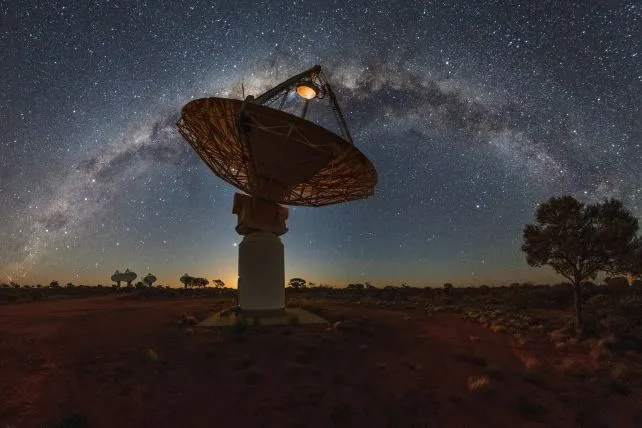 The ASKAP radio telescope array used to listen for faint cosmic signals
This new research provides these future telescopes with a critical tool: a kind of “cheat sheet” showing them what patterns in the 21-cm signal correspond to different properties of the first stars. When the observations from SKA and REACH start rolling in, scientists will have a template to compare them against.
Unlocking the Story of Cosmic Dawn
“The predictions we are reporting have huge implications for our understanding of the nature of the very first stars in the Universe,” says astronomer Eloy de Lera Acedo. “We show evidence that our radio telescopes can tell us details about the mass of those first stars and how these early lights may have been very different from today’s stars.”
This work represents a significant step towards understanding the “Cosmic Dawn” – the pivotal moment when the universe transitioned from dark and neutral to being filled with the light of stars and galaxies. By listening carefully to this faint radio whisper from the past, we may soon unlock the story of how the universe first lit up.
The research was published in the journal Nature Astronomy.





