
High above the quiet, dusty plains of the Red Planet, NASA’s Perseverance rover recently captured a breathtaking image: Mars’ tiny moon, Deimos, shining like a solitary star in the pre-dawn sky. This simple yet profound photograph, taken from the lonely vantage point within Jezero Crater, offers scientists crucial insights into the origins and fate of this mysterious Martian companion. The key takeaway? Even seemingly small observations from space help unlock big secrets about planetary history.
Contents
A Quiet Martian Morning
Imagine the scene: it’s 4:27 am local time on March 1, 2025, on Mars. The only sound is the whisper of the wind. There are no bustling crowds, just the robotic hum of Perseverance. The rover aimed its Left Navigation Camera (Navcam) towards the eastern horizon and held its gaze for a long 52 seconds, capturing the faint light of Deimos against the twilight hues.
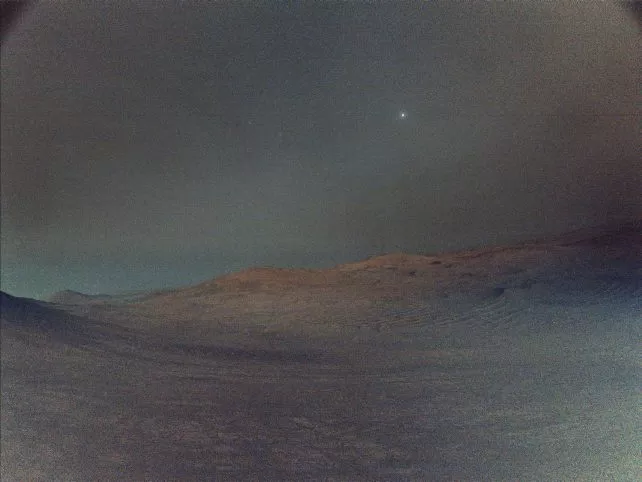 Mars Perseverance rover's view of the moon Deimos shining faintly in the pre-dawn Martian sky above Jezero Crater
Glimpse of a Distant World
Deimos is the smaller and more distant of Mars’ two moons. From Perseverance’s perspective, orbiting an average of 20,000 kilometers (about 12,400 miles) away and measuring just 16 kilometers (10 miles) across, it appears as little more than a bright pinpoint of light. But this tiny speck holds vast scientific interest.
Mars’ Mysterious Companions
Mars is accompanied by two small, irregularly shaped moons: Phobos and Deimos. Named after the sons of the Greek god of war, Ares (the Greek equivalent of the Roman god Mars), their names mean “Fear” (Phobos) and “Dread” (Deimos). Despite these dramatic names, the moons themselves are enigmatic. Scientists are still working to understand where they came from – were they captured asteroids, or did they form alongside Mars?
Contrasting Fates
Adding to the mystery are their vastly different futures. Phobos, which orbits Mars closer than any other moon in the solar system, is on a collision course. Its orbit is shrinking, and simulations predict that Mars’ gravity will eventually tear it apart, potentially forming a faint ring around the planet’s equator.
Deimos, however, is much farther away and likely safe from this destructive fate. Yet, its long-term destiny remains unclear.
Why This Photo Matters
Observations like the one captured by Perseverance are more than just pretty pictures of a distant moon. They are tiny, vital puzzle pieces for scientists. By studying the timing and appearance of Deimos in the Martian sky, researchers can refine models of its orbit, understand its interaction with Mars, and gather clues about its composition and history.
These painstaking investigations, piece by piece, help us build a clearer picture of the Martian system – how it formed, how it evolved, and what its future might hold.
Perseverance continues its mission in Jezero Crater, constantly exploring and observing, sending back data that helps unlock the secrets not just of the Red Planet itself, but of its intriguing companions like the distant moon Deimos.





