
Imagine a creature about the size of a labrador retriever, but with a long tail and big feet, darting around 150 million years ago at the feet of giant dinosaurs like Stegosaurus. Scientists have just revealed that one such fossil, long misidentified, is actually a completely new species: Enigmacursor, meaning “puzzling runner.” This discovery is more than just adding a name to the dinosaur family tree; it’s unlocking secrets about how early, small dinosaurs eventually evolved into the colossal, sometimes bizarre forms we know.
Contents
Key takeaways:
- A small dinosaur fossil previously thought to be Nanosaurus is a new species, Enigmacursor.
- It was about the size of a labrador and lived alongside giant dinosaurs in the Late Jurassic period.
- Unique features in its bones confirmed its new identity.
- This finding helps scientists understand the evolution of dinosaurs from small early forms to large later ones.
- The Enigmacursor will soon be on display at the Natural History Museum in London.
From Old Box to New Identity
For years, the fossil of this little runner sat categorized among others believed to be Nanosaurus, a group of small dinosaurs named back in the 1870s. However, scientists at the Natural History Museum (NHM) in London began to suspect that this particular specimen was different. Palaeontologists, the scientists who study fossils, constantly examine ancient remains to understand prehistoric life. Accurate classification – knowing exactly how many different species existed – is crucial to this work. As Professor Susanna Maidment, a palaeontologist at the NHM, explains, “It’s absolutely foundational to our work to understand how many species we actually have. If we’ve got that wrong, everything else falls apart.”
The Clues in the Bones
What set this fossil apart? The clues were hidden in its very structure. Examining the fossilized bones, the scientists found subtle but significant differences, particularly in the leg bones, compared to other small dinosaurs from the same period.
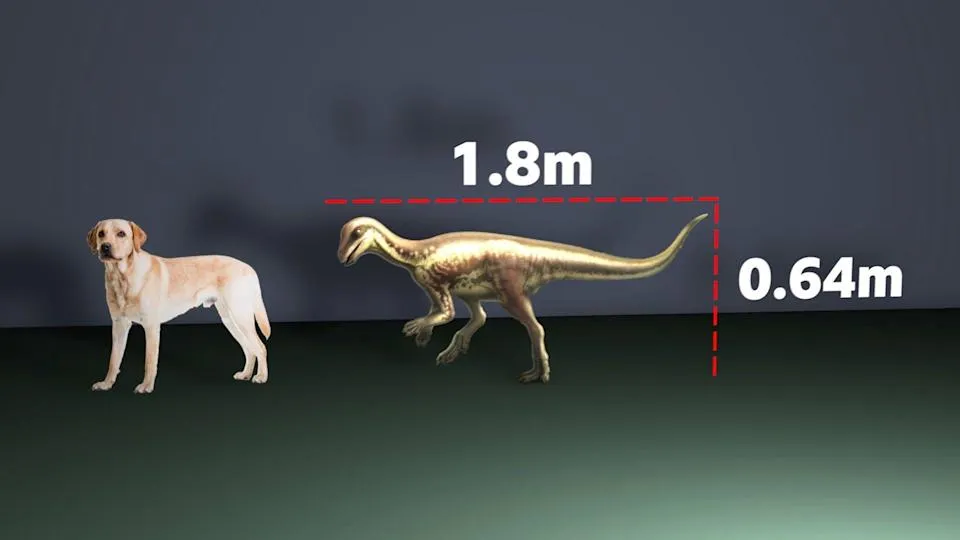 Graphic comparing the size of a labrador dog to the Enigmacursor dinosaur
The Enigmacursor stood about 64 cm tall and was around 180 cm long – roughly the size of a labrador, as shown in the graphic above. But its anatomy points to a different kind of animal. Its hips were solid and dense, suggesting it was built for speed. Its front arms were much smaller and likely held off the ground. Some scientists speculate these tiny hands might have been used for gathering plants to eat. Although it had a relatively small head, hinting it wasn’t the smartest creature around, its unique bone structure confirmed its identity as something new.
Conservators Lu Allington-Jones and Kieran Miles carefully assembled the delicate fossilized bones onto a metal frame for display. This intricate process requires immense skill to protect the ancient remains.
As they worked, conservator Kieran Miles pointed out features like the hips that indicated it was a fast runner.
The Mystery of the ‘Original’ Nanosaurus
To be absolutely sure this was a new species and not just a variation of Nanosaurus, Professor Maidment traveled to the United States to examine the original Nanosaurus specimen – the one all others are compared against. What she found was surprising: the original fossil wasn’t a complete skeleton, but just a rock with impressions where bones once were. It was so incomplete that it could potentially belong to many different small dinosaur species.
 Paleontologist Susanna Maidment holding a dinosaur leg bone while in a lab
In contrast, the NHM’s specimen of Enigmacursor is remarkably complete. This completeness, combined with the unique features Maidment and colleagues identified, provided strong evidence that it was not a Nanosaurus but a distinct species. Based on this research, scientists have formally re-evaluated the Nanosaurus classification, suggesting that many specimens previously assigned to this group might also be different species waiting to be identified.
Why This Small Dinosaur Matters
Finding and correctly identifying small dinosaurs like Enigmacursor is incredibly important for understanding the bigger picture of life millions of years ago. The Late Jurassic period was a time of great diversity, and these smaller creatures were “very close to the origins of the large groups of dinosaurs that become much more prominent later on,” according to Professor Paul Barrett, a palaeontologist at the museum.
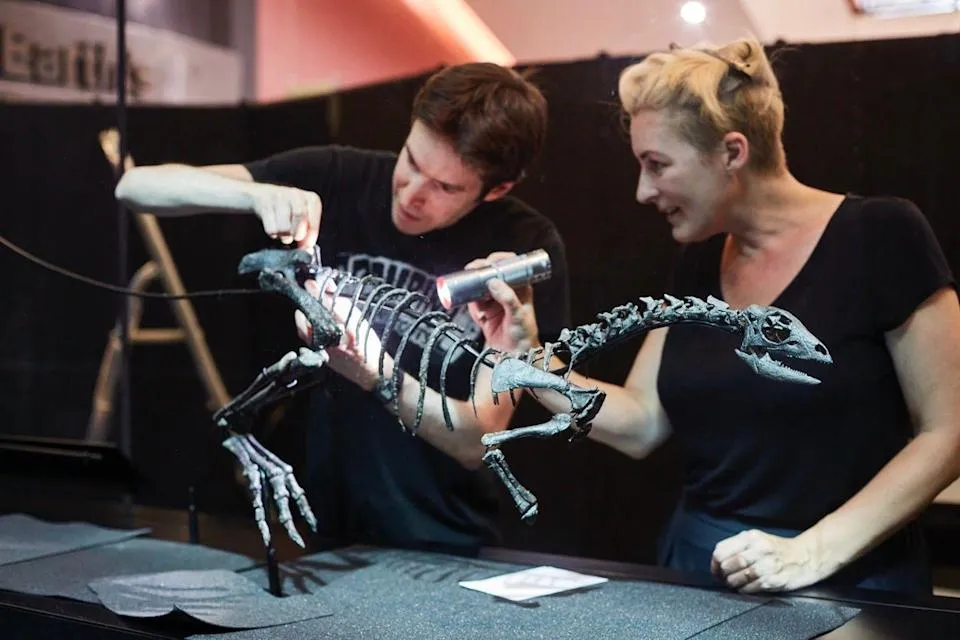 Two conservators standing next to the assembled fossil skeleton of the Enigmacursor dinosaur
Specimens like this exceptionally complete Enigmacursor fossil fill crucial gaps in our knowledge. They help scientists see how different dinosaur groups gradually evolved over time and understand the environmental pressures that led to the emergence of their larger, often more “bizarre” descendants.
See the Puzzling Runner
The public will soon have the chance to see this fascinating new species. The Enigmacursor is set to be displayed at the Natural History Museum in London, marking the first new dinosaur to go on display there since 2014. It will reside near the impressive skeleton of Steph the Stegosaurus, providing a stark contrast in size and highlighting the diverse life forms that shared the Late Jurassic world.
This discovery, published in the journal Royal Society Open Science, reminds us that even in well-studied fossil sites, there are still “puzzling runners” and other hidden secrets waiting to be uncovered, often right under our noses – or rather, close to the ground.
Discoveries like Enigmacursor highlight the ongoing work of paleontologists to piece together the incredible story of life on Earth. What other misidentified fossils might hold the key to understanding ancient ecosystems and evolution?





