
Our solar system is a vast place, home not just to planets but also billions of smaller objects like asteroids and comets. Recently, astronomers spotted a new dwarf planet far beyond Neptune, and its strange orbit is making scientists rethink ideas about a possible hidden “Planet Nine.”
Contents
Unpacking Our Cosmic Neighborhood
Beyond the familiar inner planets, our solar system extends into fascinating, icy frontiers. Imagine our sun as the center of a giant dartboard. Close in are the rocky planets, then the gas giants. Further out lie distinct regions holding the leftovers from the solar system’s birth.
The Asteroid Belt, nestled between Mars and Jupiter, is like a dusty ring filled with irregularly shaped rocks. It’s the smallest and innermost of the large debris disks.
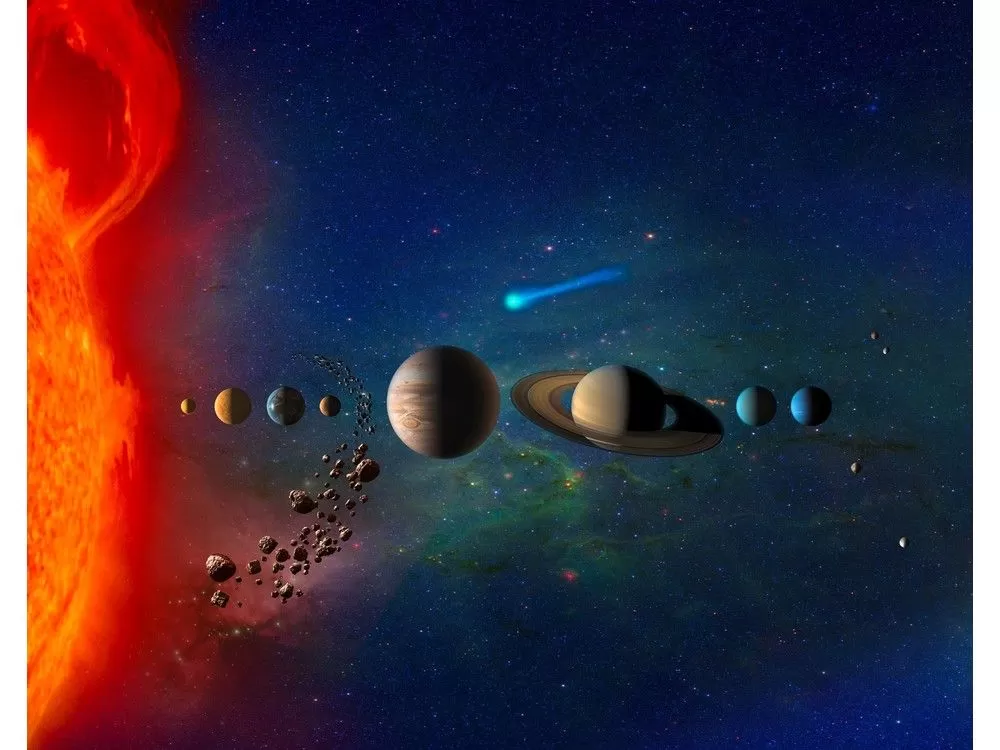 Illustration of the solar system showing planets orbiting the sun with the asteroid belt between Mars and Jupiter, and a band of icy bodies beyond Neptune representing the Kuiper Belt.
Further out, past Neptune, is the Kuiper Belt. Think of this as a much larger, donut-shaped realm populated by millions of icy bodies, including many dwarf planets like Pluto. It’s significantly wider and more massive than the asteroid belt. Discovered in recent decades, it’s a treasure trove of clues about the early solar system.
The Mysterious Oort Cloud
Even farther still, shrouding the entire solar system like a giant, diffuse bubble, lies the Oort Cloud. This immense, spherical region is thought to contain trillions of icy fragments. It extends incredibly far out – up to 200,000 times the distance from the Earth to the sun! Objects here are remnants that were flung outward billions of years ago by the gravity of the giant planets.
Introducing 2017 OF201: A New Resident
Astronomers have recently announced the discovery of a new object orbiting our sun in the frigid darkness beyond Neptune. Dubbed 2017 OF201, this rocky body is estimated to be about 700 kilometers wide – roughly one-third the size of Pluto.
This distant traveler was found by analyzing years of data collected by powerful telescopes like the Canada-France-Hawaii Telescope and the Dark Energy Camera Legacy Survey. Based on its size and orbit, 2017 OF201 has been classified as a new dwarf planet. This adds one more object to the growing list of dwarf planets officially recognized by the International Astronomical Union, joining others like Pluto, Eris, and Makemake.
A Very Strange Orbit
What makes 2017 OF201 particularly interesting is its extreme orbit. It’s currently located three times farther from Earth than Neptune. It takes this dwarf planet about 25,000 years to complete just one trip around the sun! Because of this incredibly long orbit, we can only see it from Earth for a brief period every few millennia.
Its path is also highly eccentric, meaning it’s not a nice circle but a stretched-out oval. At its closest point to the sun (perihelion), it comes in to about 45 times the Earth-sun distance (45 AU – an AU, or astronomical unit, is the average distance between Earth and the sun, about 150 million km), similar to Pluto. But at its farthest point (aphelion), it swings out to a staggering 1,690 AU – putting it well within the inner edge of the distant Oort Cloud.
The Puzzle of Planet Nine
For years, astronomers have noticed something peculiar about the orbits of several icy objects far beyond Neptune. These Trans-Neptunian Objects (TNOs) seemed to have orbits that were strangely clustered together and tilted in similar ways.
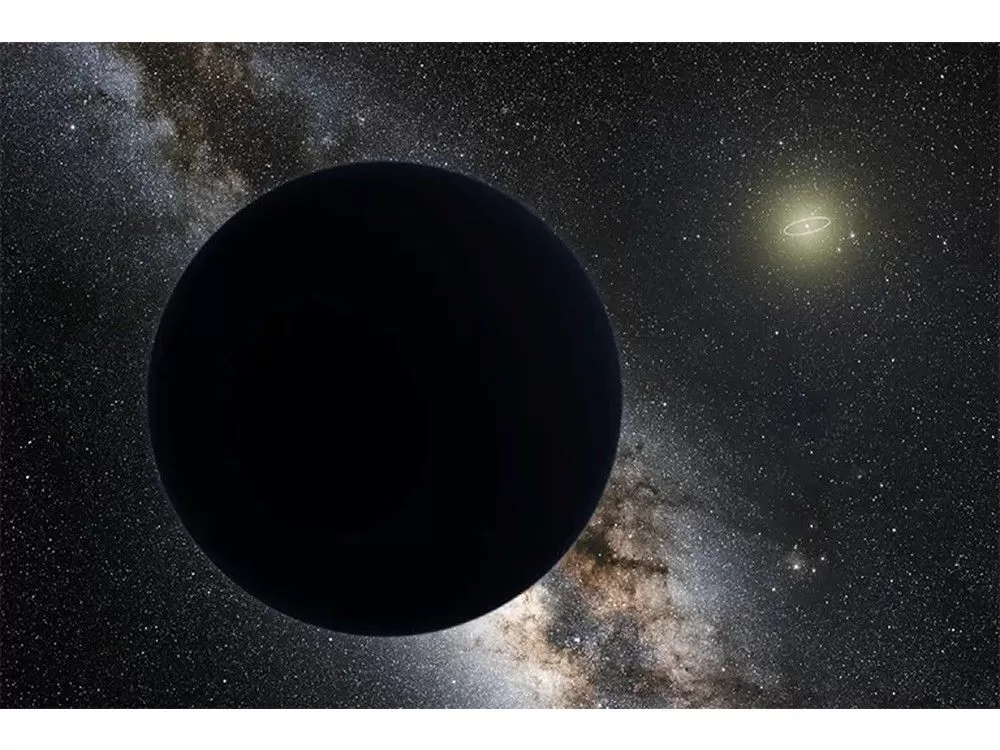 Artist's impression of a hypothetical Planet Nine in the outer solar system, with Neptune's orbit shown closer to the sun.
This clustering led to an exciting idea: perhaps a large, unseen object – maybe a planet up to 10 times the mass of Earth – was gravitationally nudging these objects into alignment. This is the hypothesis of Planet Nine, a potential ninth planet lurking in the outer solar system, captivating scientists and the public alike.
How 2017 OF201 Challenges the Idea
Now, here’s where the new discovery gets tricky for Planet Nine enthusiasts. While many distant TNOs seem to line up, the orbit of 2017 OF201 doesn’t fit this pattern. Its highly eccentric path is different from those objects that suggested Planet Nine’s existence.
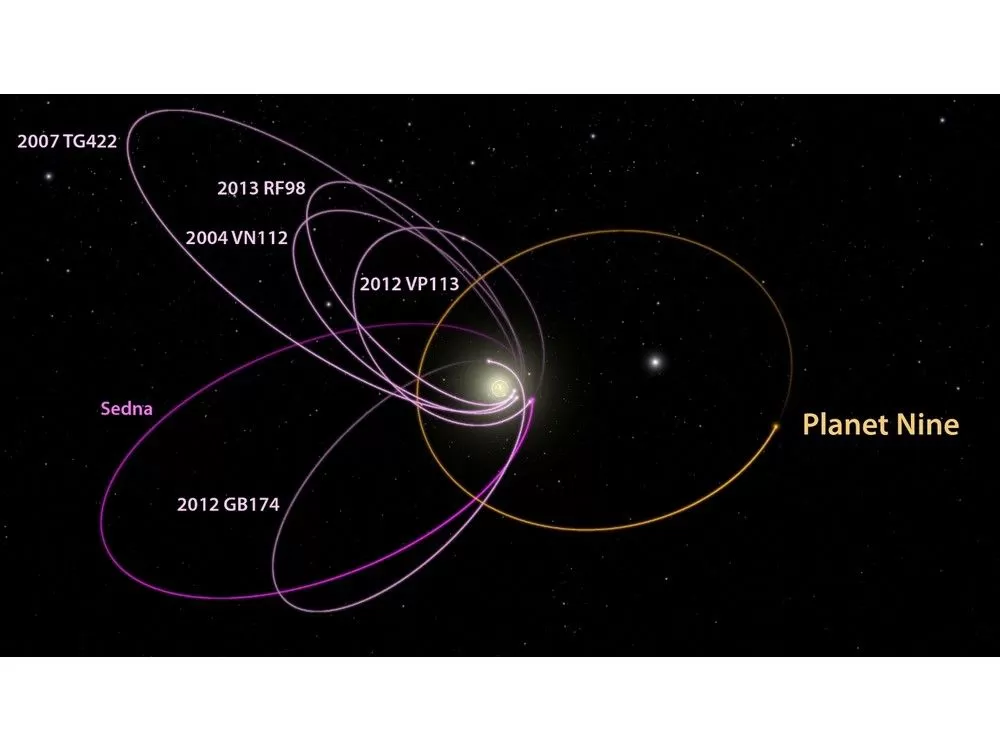 Diagram showing the orbits of six known distant objects in the solar system beyond Neptune, depicted in magenta, which appear to be clustered and aligned in a similar direction, contrasting with the orbit of 2017 OF201.
Researchers admit it’s possible that 2017 OF201 could have originally been part of that clustered group, but a close encounter with a large, unseen object (like Planet Nine, if it exists) might have flung it into its current, much wider orbit.
However, some calculations suggest that if a massive Planet Nine were out there, its gravity would likely have ejected 2017 OF201 from its current path within about 100 million years. This raises questions about how 2017 OF201 could stay on this unique trajectory if Planet Nine is indeed pulling on other nearby objects.
The Future of the Search
The discovery of 2017 OF201 hints that there could be many more, perhaps hundreds, of these distant TNOs on unusual orbits between the Kuiper Belt and the Oort Cloud. While it doesn’t definitively disprove Planet Nine, its different orbit does add complexity and some doubt among astronomers who’ve been searching for the elusive planet for decades without success.
The hunt isn’t over, though. Future observations with incredibly powerful new tools, like the James Webb Space Telescope and the upcoming Vera C. Rubin Observatory in Chile, might one day find Planet Nine – if it’s out there. Regardless of whether Planet Nine is ever found, the discovery of 2017 OF201 confirms that the outer solar system is full of surprises, and we’re sure to find many more fascinating icy worlds waiting to be explored.





