
Astronomers have detected a puzzling object in our galaxy, named ASKAP J1832-0911, that sends out powerful pulses of radio waves every 44 minutes. What makes this cosmic source even stranger is that it also appears to flash in high-energy X-rays at the same time, a combination that doesn’t fit neatly with our current understanding of celestial bodies. This mysterious cosmic object challenges existing theories about dead stars and stellar evolution, opening a new window into the universe’s weirdest phenomena.
Contents
The Cosmic Blink: A Strange Radio Signal
For years, scientists have detected rapid pulses of radio waves from distant parts of the universe. These often come from pulsars, dense remnants of exploded stars that spin incredibly fast, sweeping a beam of radio waves across space like a cosmic lighthouse. But recently, astronomers have found objects that flash much slower, over minutes or even hours, a newly identified class called “long-period transients.”
ASKAP J1832-0911, found by a team from Australia’s national science agency, CSIRO, using the ASKAP radio telescope, is one such object. Its 44-minute pulse is unusually long compared to typical pulsars. While other long-period transients have been found, what causes them remains a major mystery.
Unexpected X-ray Flashes
Adding to the enigma, researchers correlated the radio pulses from ASKAP J1832-0911 with observations from NASA’s [Chandra X-ray Observatory]. Coincidentally, Chandra had been looking at the same patch of sky and detected powerful X-ray pulses originating from the same location and flashing at the same time.
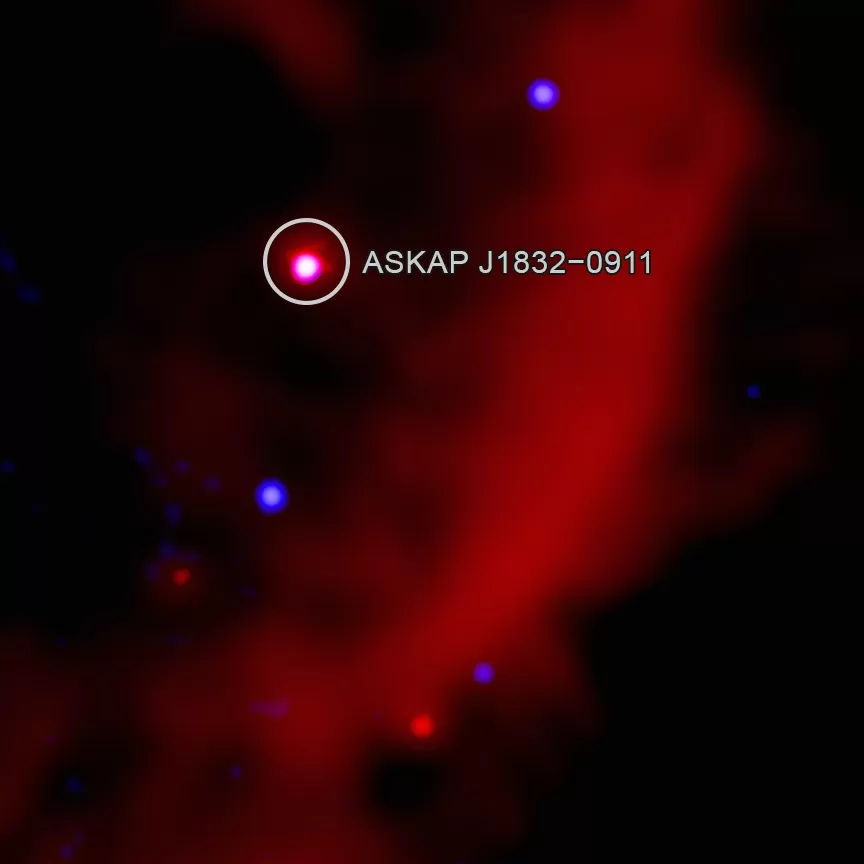 Combined image showing the mysterious cosmic object ASKAP J1832-0911 emitting in both radio waves and X-rays.
Detecting both regular, long-period radio and X-ray flashes from a single source is extremely unusual. It raises new questions about the physical processes powering these cosmic objects and why their signals turn on and off with such regularity over long intervals.
A Sudden Awakening
Even more puzzling, the team couldn’t find any trace of the object in past observations of the region. This suggests something dramatic happened relatively recently that caused it to “switch on.” The object became particularly active in early 2024, brightening dramatically in radio waves to levels rarely seen from cosmic sources.
Located about 15,000 light-years away within our own Milky Way galaxy, ASKAP J1832-0911 doesn’t easily fit into known astronomical categories.
Challenging Our Cosmic Models
Scientists have proposed several possibilities for what ASKAP J1832-0911 could be. It might be a magnetar, a type of dead star with incredibly strong magnetic fields. Another idea is that it could be a pair of stars, like a highly magnetised white dwarf (a low-mass star at the end of its life) orbiting another star.
However, even these explanations don’t fully account for the unique combination of long-period radio and X-ray flashes observed from this object. Its strange behavior could be a sign of a completely new type of cosmic object, a rare phase in the life of a star, or even require rethinking some fundamental physics governing these extreme environments.
What This Discovery Means
Finding one object that flashes in both radio waves and X-rays suggests that others might exist and perhaps many long-period transients could have hidden X-ray emissions. This discovery provides crucial new clues that could help astronomers finally understand what powers these mysterious cosmic blinkers.
More observations of ASKAP J1832-0911 and other similar objects, especially across different types of light like X-rays, are needed to gather more data and solve this cosmic riddle. As researchers continue to hunt for more clues and similar objects, discoveries like this remind us how much we still have to learn about the universe. Finding such a profound mystery isn’t frustrating; it’s the thrilling part of scientific exploration.
The study detailing this discovery has been published in the journal Nature.





