
Astronomers using NASA’s IXPE telescope have captured first-of-its-kind data from a magnetar — a dead star with the most powerful magnetic field in the universe — as it threw a massive energy tantrum. These observations mark the first time scientists have measured the polarization of X-rays coming from a magnetar during one of its unpredictable outbursts, offering crucial new clues about how these extreme stellar objects work and generate their intense energy.
Contents
What Did Scientists See?
The target of this observation was a magnetar known as 1E 1841-045, located roughly 28,000 light-years away within the ghostly remains of a supernova called Kes 73. On August 20, 2024, this distant magnetar suddenly flared up, catching astronomers’ attention.
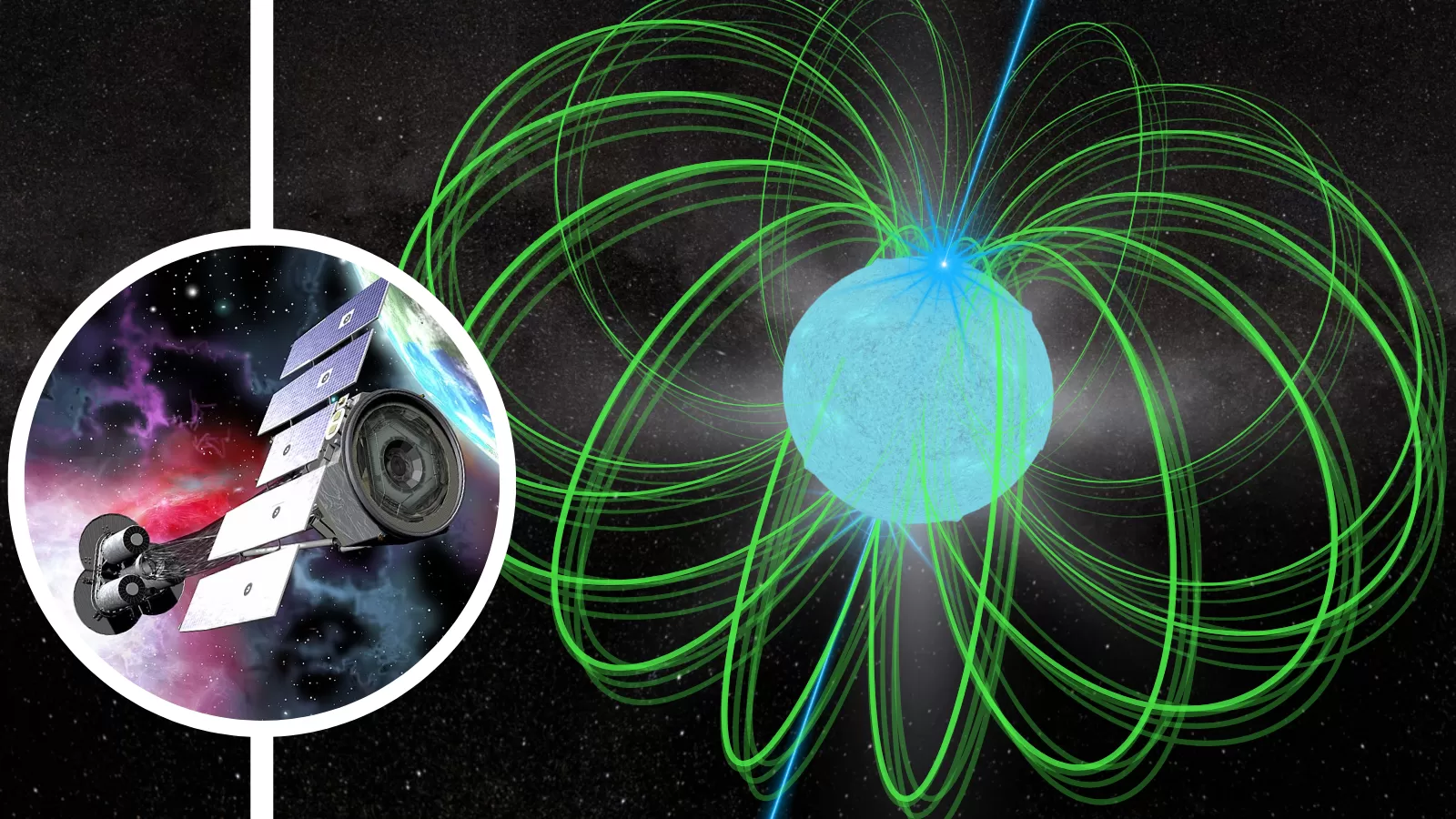 Illustration showing an erupting magnetar (a super magnetic neutron star) next to NASA's IXPE telescope, which observed its X-ray light.
Using the Imaging X-ray Polarimetry Explorer (IXPE) spacecraft, the team was able to measure the polarization of the X-rays emitted during this energetic event. Polarization is essentially the alignment of light waves; think of it like waves on a string vibrating up-and-down or side-to-side. Measuring this alignment gives scientists insights into the environment where the light originated, especially powerful magnetic fields.
“This is the first time we have been able to observe the polarization of a magnetar in an active state, and this has allowed us to constrain the mechanisms and geometry of emission that lie behind these active states,” said team leader Michela Rigoselli, a researcher at Italy’s National Institute for Astrophysics (INAF).
Why is This Observation Important?
Magnetars are already fascinating because they are a type of neutron star — the incredibly dense core left behind after a massive star explodes in a supernova. But magnetars take things to an extreme, boasting magnetic fields trillions of times stronger than Earth’s. Studying these fields directly is impossible, so scientists study the light they emit, particularly X-rays, which are heavily influenced by such extreme magnetic environments.
Observing a magnetar when it’s in a relatively calm, or “quiescent,” state provides some data, but these stars periodically enter incredibly active phases, releasing vast amounts of energy in sudden bursts. Understanding what triggers and powers these powerful outbursts is a major puzzle in astrophysics. Measuring the X-ray polarization during an outburst provides a direct probe of the magnetic field’s structure and behavior when the magnetar is most active.
What is a Magnetar Anyway?
Magnetars are born from the dramatic death of stars much more massive than our sun. When these stars run out of fuel, their cores collapse with incredible speed, triggering a supernova explosion. What remains is a super-dense core, typically only about 12 miles (20 kilometers) across, but containing more mass than our sun.
The material in a neutron star is so packed together that a single teaspoon would weigh about 10 million tons on Earth – that’s roughly the weight of 85,000 adult blue whales!
 Comparison illustrating the extreme density of neutron star matter: a single teaspoon could weigh as much as 85,000 blue whales.
During the core collapse, the star’s original magnetic field lines get squeezed together into an incredibly small space. This compression amplifies the magnetic field to astonishing strengths, making neutron stars possess the strongest magnetic fields known in the universe. Magnetars are the champions even among these, with fields perhaps a thousand times stronger than typical neutron stars.
The Mystery of Magnetar Outbursts
While powerful, magnetars in their quiet phase are relatively predictable. However, they periodically undergo violent outbursts, releasing up to 1,000 times the energy they normally do. These events involve rapid changes in their magnetic fields, often accompanied by bursts of X-rays and gamma-rays.
 Artist's concept depicting a powerful X-ray outburst erupting from the surface of a magnetar, highlighting its intense magnetic activity.
Scientists suspect these outbursts are caused by “starquakes” on the rigid crust of the neutron star or by sudden reconfigurations (“reconnections”) of the incredibly tangled magnetic field lines. But the exact mechanisms are still unclear. Observing the polarized X-rays during such an event offers a unique window into this extreme physics.
What the Polarization Data Revealed
The IXPE observations of 1E 1841-045 revealed that the X-rays emitted during the outburst became increasingly polarized at higher energy levels. Surprisingly, however, the angle of this polarization remained consistent across different energy ranges.
This finding suggests that the different components of the X-ray emission produced during the outburst are connected in some way, likely influenced by the magnetar’s powerful magnetic field. It also indicates that the highest-energy X-rays, which are the hardest to study, are strongly controlled by the magnetic field structure.
This research, published in The Astrophysical Journal Letters, provides critical data points for refining theoretical models of magnetar behavior.
What’s Next?
With this unprecedented observation of a magnetar outburst’s X-ray polarization, astronomers have a new benchmark. The next step is to continue monitoring 1E 1841-045. Michela Rigoselli noted that observing the magnetar again once it returns to its quiet state will be crucial “to monitor the evolution of its polarimetric properties.”
Comparing the polarization data from the active and quiescent states will help scientists understand how the magnetic field and emission mechanisms change during an outburst, getting closer to unlocking the secrets of these ultra-dense, super-magnetic cosmic engines. This work contributes to our broader understanding of extreme matter and energy in the universe.
Learn more about these fascinating objects:





