
Peering into the vastness of space, astronomers have captured an unprecedented view of the Andromeda galaxy, our nearest spiral galactic neighbor. This new composite image, weaving together data from numerous powerful telescopes, offers a breathtaking and revealing look at the structure and activity within this cosmic giant, enhancing our understanding of galaxies much like our own Milky Way.
Contents
Seeing Andromeda in New Light
Imagine trying to understand something complex, not just by looking at it, but by experiencing it with all your senses at once. That’s a bit like what scientists have done with the Andromeda galaxy. This isn’t a single photograph; it’s a masterful blend of data collected in different kinds of “light” – wavelengths beyond what our eyes can see, like X-rays, combined with visible light.
Collected by NASA and international space partners, this image merges observations from over a dozen telescopes, including NASA’s Chandra X-ray Observatory and the European Space Agency’s XMM-Newton spacecraft. Each type of light acts like a different sense, revealing unique features of the galaxy that would remain hidden otherwise. For example, X-ray data highlights incredibly hot gas and energetic events, while visible light shows the grand spiral arms of stars.
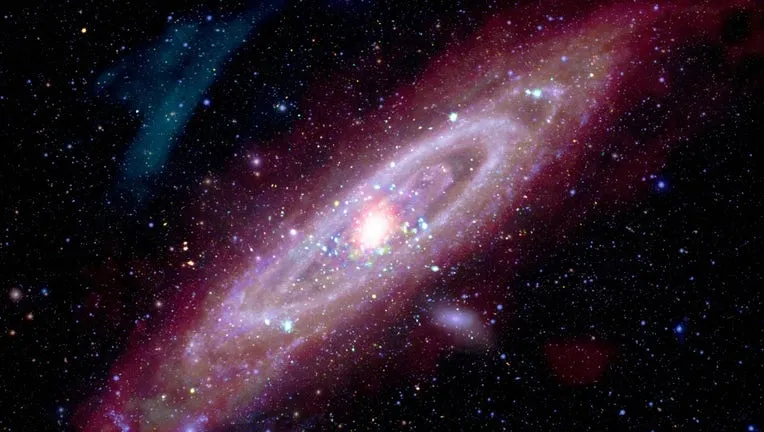 Composite image of the Andromeda galaxy (M31), our closest spiral galactic neighbor, revealing combined views across multiple wavelengths.
Why Study Andromeda?
The Andromeda galaxy, also known as Messier 31 or M31, sits relatively close to us – a mere 2.5 million light-years away. While that sounds incredibly far, on a cosmic scale, it’s practically next door. This proximity makes it a prime target for study. Even more importantly, Andromeda is a large spiral galaxy, very similar in size and shape to our own Milky Way.
Studying Andromeda is like looking at a twin sibling from a distance. Because we are inside the Milky Way, our view of our own galaxy is often obscured by dust and gas. But from our vantage point, we can see Andromeda laid out before us, offering a clearer picture of how spiral galaxies form, evolve, and function. Astronomers like Edwin Hubble began focusing on Andromeda nearly a century ago, laying the groundwork for the detailed studies possible today.
Unveiling Galactic Mysteries
The new composite image provides richer detail than ever before. The X-ray data, in particular, pinpoints sources of high-energy radiation. This includes a brilliant glow around the supermassive black hole lurking at Andromeda’s core – a common feature at the center of most large galaxies, including our own. The X-rays also reveal numerous other dense, compact objects scattered throughout the galaxy, such as neutron stars and stellar black holes pulling in matter.
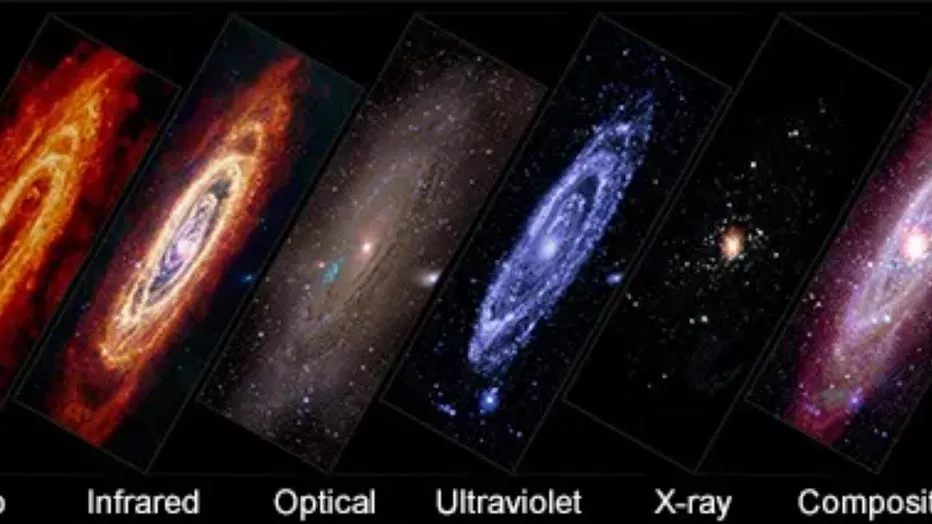 Comparison showing the Andromeda galaxy (M31) as seen in different types of light, such as X-ray, infrared, and visible light.
However, even with this stunning new view, Andromeda holds onto many secrets. The nature and distribution of dark matter, an invisible substance making up most of the galaxy’s mass, remain largely mysterious. Scientists are also still working to understand its interactions with smaller cosmic structures around it. And while Andromeda is estimated to contain hundreds of billions of stars, potentially hosting trillions of planets, our current technology cannot yet resolve individual stars or planets within it across such vast distances.
What’s Next for Andromeda
Our quest to understand Andromeda and galaxies like it is far from over. Future missions promise to build upon the insights gained from this new composite image. One exciting tool on the horizon is NASA’s upcoming Nancy Grace Roman Space Telescope, set to launch in 2027.
Named after NASA’s first chief astronomer, the Roman telescope will have a field of view dramatically larger than Hubble’s, allowing it to capture vast swathes of the sky in exquisite detail. This capability will be particularly powerful for studying large structures like Andromeda and potentially shedding more light on its secrets, including the mysteries of dark matter and the myriad objects within its spiral arms. Each new observation brings us closer to understanding our place in the cosmic neighborhood.





