
Our solar system just got a little bigger, or at least, we’ve officially recognized another large, distant minor planet residing at its frozen frontier. This newly cataloged ice world, known as 2017 OF201, is one of the largest minor planets found so far and boasts an orbit so extreme it stretches the imagination, offering fresh clues about the mysterious outer solar system. Key takeaways include its significant size, its incredibly distant and unusual orbit, and its potential role in the ongoing search for a hypothesized distant giant planet.
Contents
Discovering a Distant Oddball
Astronomers are constantly scanning the vast emptiness beyond Neptune, a region populated by icy bodies known as the Kuiper Belt and beyond. It’s here that researchers, led by Sihao Cheng at the Institute for Advanced Study, first spotted 2017 OF201. While initially seen in older telescope images, this object was recently added to the official catalog of minor planets by the International Astronomical Union’s Minor Planet Center.
So, what is this new world? It’s classified as a minor planet, but don’t let the name fool you. Estimates place its diameter somewhere between 290 and 510 miles (470 and 820 kilometers). To put that in perspective, the upper end of that size range brings it close to Ceres, the largest asteroid in the main asteroid belt between Mars and Jupiter, which measures about 592 miles across. This makes 2017 OF201 a substantial object for the distant reaches of the solar system.
An Orbit Like No Other
What truly sets 2017 OF201 apart is its astonishing orbit around the Sun. While Earth orbits at an average distance of 1 Astronomical Unit (AU), and Neptune resides much farther out at about 30 AU, this new minor planet ventures to mind-boggling distances. At its farthest point, 2017 OF201 travels out to a staggering 838 AU from the Sun! That’s nearly 30 times the distance of Neptune itself, which is already 30 times farther than Earth. Even at its closest approach, it still remains about 45 AU away.
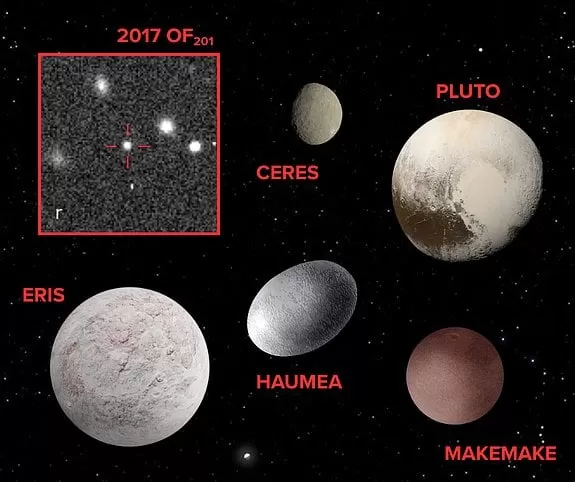 Illustration comparing known dwarf planets with the faint discovery image of distant minor planet 2017 OF201, a newly cataloged trans-Neptunian object.
This incredibly elongated path earns 2017 OF201 a special classification: an extreme trans-Neptunian object (ETNO). These ETNOs are more than just distant rocks; their peculiar orbits are sparking intense interest among scientists because they might hold the key to understanding gravitational influences in the far outer solar system that we haven’t yet identified.
Hunting for Planet Nine
The existence and strange clustering of many ETNOs fuel one of the most exciting ongoing searches in astronomy: the hunt for Planet Nine. This hypothetical giant planet is theorized to exist far beyond the known planets, its gravity subtly shaping the paths of smaller, icy bodies like 2017 OF201.
While other explanations for the ETNO clustering exist, such as the combined gravitational pull of many small objects or even the possibility of a primordial black hole, the idea of a hidden giant planet captures the public imagination like nothing else. If Planet Nine exists, scientists estimate it could be over six times the mass of Earth and take thousands of years to complete one orbit around the Sun.
2017 OF201 isn’t large enough to be Planet Nine itself – it’s a minor planet, not a gas giant or ice giant. However, its discovery is crucial. Each new distant object found and tracked adds another data point, helping astronomers map the gravitational landscape of the outer solar system. Objects with unusual orbits, like this new minor planet, are particularly valuable clues.
Just recently, another slow-moving object beyond Neptune was found, initially considered a Planet Nine candidate before being ruled out as it was in the wrong location based on predictions. These continuous discoveries, even of objects that aren’t Planet Nine, refine our understanding of the outer solar system and bring us closer to either finding the elusive planet or explaining the mysterious orbital patterns through another mechanism.
The Solar System’s Hidden Depths
The official cataloging of 2017 OF201 is a reminder that our solar system still holds many secrets, especially in its cold, dimly lit outer regions. This large, distant minor planet, with its incredibly elongated orbit, adds another piece to the cosmic puzzle scientists are trying to solve. While not the massive Planet Nine many are searching for, its existence and extreme path provide valuable data points that could help us uncover the gravitational forces at play billions of miles away and deepen our understanding of how our solar system formed and evolved.
Discoveries like this keep the excitement alive as we continue to explore the solar system’s distant frontiers.





