
For years, astronomers have tracked the Andromeda galaxy, our closest large galactic neighbor, predicting an inevitable head-on collision with our own Milky Way galaxy. New research suggests this dramatic cosmic event is less certain and further in the future than previously calculated, offering a revised perspective on the fate of our galactic home. This study, utilizing advanced observations, shifts the odds and pushes the potential merger much further down the cosmic timeline, highlighting the dynamic and uncertain nature of the universe on vast scales.
Contents
The Formerly Inevitable Crash
Previous studies, based on earlier astronomical data, pointed towards a near-certain, head-on collision between the Milky Way and Andromeda within the next 5 billion years. This dramatic event was envisioned as a destructive merger, reshaping both spiral galaxies into a single, larger elliptical galaxy, sometimes nicknamed “Milkomeda.” The idea painted a picture of our galactic future being dramatically altered relatively soon, on cosmic timescales.
A New Angle on Galactic Motion
Understanding the future dance between galaxies is like trying to predict the path of countless intertwined dancers across a vast floor. It requires knowing their current position, speed, and direction, as well as the gravitational pull they exert on and receive from each partners, both large and small. A Finnish-led team of scientists, using the latest data from powerful observatories like NASA’s Hubble Space Telescope and the European Space Agency’s Gaia spacecraft, took a fresh look at the movements and gravitational influences shaping the Milky Way and Andromeda.
By incorporating more precise measurements and factoring in the gravitational tug of other nearby galaxies, such as the Triangulum galaxy and the Large Magellanic Cloud, the researchers could run more sophisticated simulations. Imagine refining the dancers’ positions and accounting for subtle pushes and pulls from others nearby. These detailed calculations changed the predicted trajectories.
The results were surprising: instead of a guaranteed collision, the simulations showed a wider range of possibilities. The probability of a direct merger between the Milky Way and Andromeda within the next 10 billion years dropped significantly compared to earlier estimates.
Revising the Cosmic Odds
The new study puts the chance of a collision within 10 billion years at about 50-50 – essentially a coin flip. While this is still a significant possibility, it’s a far cry from the near certainty predicted before. This revised forecast pushes the timeline much further out and introduces considerable uncertainty about the exact nature of the encounter.
As lead author Till Sawala noted, this means previous “proclamations of the impending demise of our galaxy seem greatly exaggerated.” It’s good news for the Milky Way’s current structure, at least in the near cosmic future.
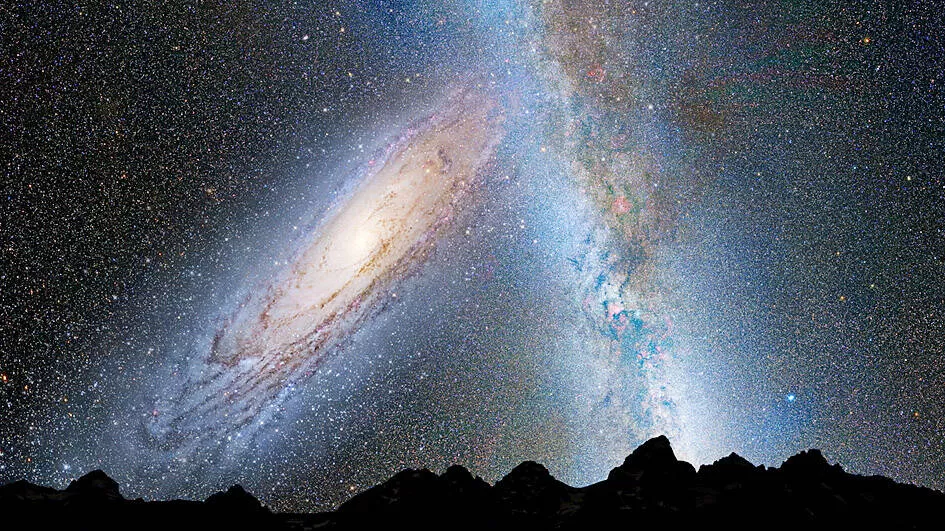 An artistic illustration shows two large spiral galaxies appearing to interact or merge in a distant night sky view.
If a full collision were to happen eventually, it would dramatically transform our galaxy from its familiar flat disk shape, visible as the ‘milky band’ across the night sky, into a more rounded, diffuse “milky blob.” However, a “harmless flyby,” where the galaxies pass close but don’t merge, could leave the Milky Way’s stellar disk largely intact.
What This Means (and Doesn’t Mean) for Us
While the revised galactic forecast is fascinating, its practical implications for humanity are moot. Our Sun, already over 4.5 billion years old, is expected to run out of fuel and expand into a red giant in about 5 billion years, long before any potential galactic collision. This solar expansion would likely engulf the inner planets, including Earth, or at least render it uninhabitable.
Moreover, as Sawala wryly pointed out, humanity’s own future is highly uncertain and could easily end long before any astrophysical event like a galactic collision or the Sun’s death becomes relevant. So, while the fate of our galaxy is a captivating cosmic drama, our immediate concerns lie much closer to home.
The Continuing Galactic Mystery
The Milky Way’s long-term fate remains uncertain, a subject of ongoing study for astronomers around the world. The new findings, while providing a more nuanced picture, also highlight how much more there is to learn about the complex gravitational interactions shaping the universe.
Further research into the precise positions, motions, and masses of galaxies in our local group will help refine these predictions even more. This work not only helps us understand the potential future of our galactic home but also provides vital insights into the evolution and dynamics of galaxies across the cosmos.
Want to learn more about our place in the universe? Explore articles on galactic evolution or the future of our solar system.





