
Students in Whitehorse recently traded modern life for a hands-on history lesson, embarking on an overnight canoe trip to experience the world of 17th-century Canadian voyageurs and First Nations. This unique project offers a glimpse into the past, teaching valuable lessons about history, resilience, and the impact of early exploration and colonization.
Contents
A Journey on the Waterways
Imagine stepping into a time machine powered by paddles. That’s essentially what Grade 9 students from Wood Street Centre School’s Plein-Air et Sciences Experientielles (PASE) class did. Their mission: to live like the fur traders who navigated Canada’s vast waterways centuries ago, and to understand the perspectives of the First Nations peoples who guided and interacted with them.
Under the guidance of teacher Karine Belanger, the students prepared diligently. They didn’t just read about history; they crafted their own gear, making satchels and wooden eating utensils by hand, just as voyageurs would have done. They also honed their paddling skills, essential for navigating the currents of the Yukon and Takhini rivers.
Dressing the Part and Setting Sail
On the day of departure, students and teachers fully embraced the voyageur spirit. They donned historical clothing, complete with the iconic long red toques and colourful sashes cinched at the waist, painting a vivid picture of the past. Loading their canoes with supplies, they set off from Whitehorse.
Their journey wasn’t a cross-continent trek, but a significant historical simulation. They paddled about 20 kilometres downstream to Egg Island, where they camped overnight. This relatively short distance still provided a profound sense of the physical effort and coordination required for river travel before modern technology.
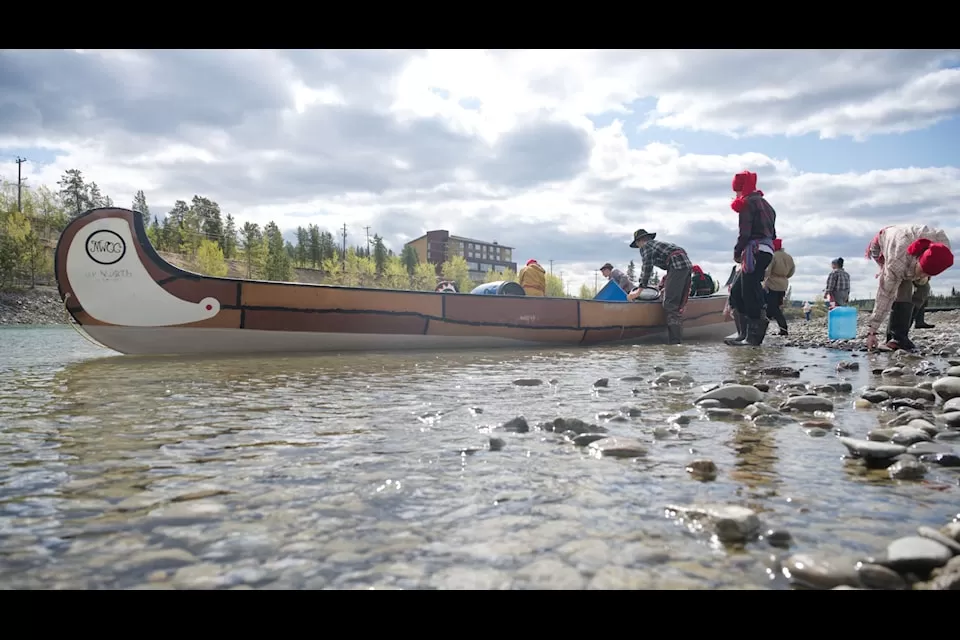 Grade 9 students dressed in historical clothing pack supplies into a large canoe for a voyageur simulation trip on the Yukon River.
Connecting History to Today
The canoe trip is a core part of a social studies curriculum that explores the complex history of colonization in Canada and its deep impact on First Nations peoples. Belanger highlighted that while figures like Alexander Mackenzie and Simon Fraser are often celebrated for their explorations, their journeys relied heavily on the knowledge and assistance of Indigenous communities who understood the land and rivers intimately.
By experiencing the environment and modes of travel firsthand, students gain a deeper appreciation for the challenges faced by everyone involved in the fur trade era. The project aims to move beyond names and dates, fostering an understanding of daily life, survival skills, and the critical relationships between voyageurs and First Nations.
Beyond the Paddle: Filming the Past
The learning extends beyond paddling. Students are also working on historical films based on their research and experiences. These films delve into the factual history of French explorers in the 16th and 17th centuries, crucially incorporating different perspectives on the effects of colonization.
Ethan Janes, one of the students participating, expressed his excitement, noting, “We’re living like voyageurs for a night and we’re working on films related to different French explorers throughout the 16 and 1700s. It’s a really fun class.” This blend of physical activity, historical research, and creative expression provides a multi-faceted approach to learning.
An Annual Tradition of Experiential Learning
This immersive voyageur canoe trip is an annual highlight of the PASE program, demonstrating a commitment to experiential learning. By stepping outside the traditional classroom and engaging directly with history in a realistic setting, students connect with the curriculum in a powerful and memorable way.
The project underscores how understanding history isn’t just about memorizing facts, but about empathy – walking (or paddling) a mile in someone else’s moccasins to truly grasp their world. It’s a living history lesson on the waters that shaped a nation.





