
Who knew that something as humble as penguin poop could play a role in shaping the climate? New research from Antarctica reveals that the ammonia released from penguin guano helps create cloud-seeding particles, potentially helping to cool the local environment and protect vital sea ice. This surprising discovery highlights the intricate ways ecosystems are connected and how even animal waste can influence atmospheric processes and climate change mitigation.
Contents
The Unexpected Power of Penguin Poop
It sounds bizarre, but penguin poop, scientifically known as guano, contains a lot of ammonia. And ammonia, it turns out, is quite reactive in the atmosphere.
Scientists discovered that when this ammonia from large penguin colonies mixes with certain gases released by tiny marine plants called phytoplankton in the surrounding ocean, it creates tiny airborne particles. You can think of these particles like microscopic “seeds.” Water vapor in the air likes to stick to these seeds, which is the essential first step in forming clouds.
These tiny particles are called aerosols, and the process is known as aerosol formation. Basically, penguin poop and ocean life team up to put more cloud-making ingredients into the Antarctic air.
How Clouds Help Fight Warming
Why are clouds important in the context of climate change? In places like Antarctica, clouds can act like a protective blanket. They reflect some of the sun’s energy back into space and trap some warmth closer to the surface, influencing local temperatures.
By increasing cloud formation, the ammonia from penguin guano could help insulate the region, potentially preventing the sea ice from melting as rapidly. This is a crucial function in Antarctica, where the stability of ice is vital for both local ecosystems and global sea levels.
Scientists Follow the Scent
To figure this out, researchers from the University of Helsinki’s Institute for Atmospheric and Earth System Research, led by Matthew Boyer, spent two months near a colony of 60,000 Adelie penguins at Marambio Base in Antarctica.
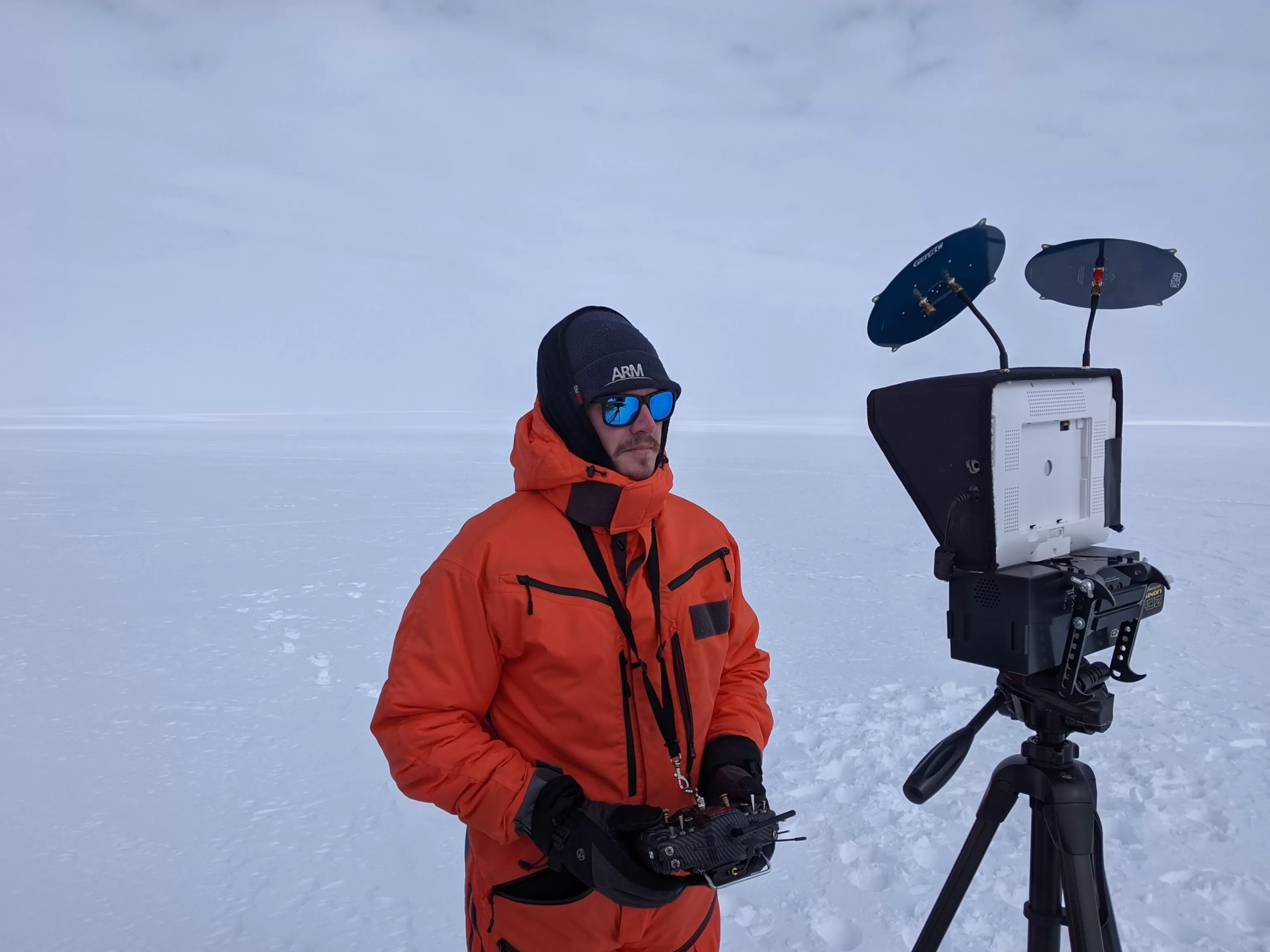
Researcher Matthew Boyer using a drone to collect atmospheric data near a penguin colony in Antarctica.
They measured the concentration of ammonia in the air. What they found was staggering: when the wind blew from the direction of the penguin colony, ammonia levels in the air skyrocketed – over a thousand times higher than background levels! Even after the breeding season ended and the penguins left, the poop left behind continued to release ammonia, keeping concentrations high.

Gentoo penguins near a weather station on the Antarctic Peninsula, illustrating the environment studied for airborne ammonia.
Further measurements confirmed that these high ammonia levels directly correlated with a sharp increase in the number and size of aerosol particles. The scientists even observed a fog forming that seemed directly linked to this increase in particles when winds came from the colony – a real-world example of cloud formation in action.

Adelie penguins stand on snow heavily covered in guano (poop) at a colony in Antarctica, a source of atmospheric ammonia.
A Connected World: Why Antarctic Ecosystems Matter Globally
This study reveals a fascinating and direct link between the health of marine ecosystems (phytoplankton) and land-based ones (penguins) and the very atmosphere above them. Protecting these native species and their habitats isn’t just about preserving biodiversity; it’s about safeguarding natural processes that can influence regional, and potentially global, climate systems.
Antarctica plays a critical role in regulating the Earth’s climate, from driving ocean currents to acting as a massive carbon sink. However, it’s also one of the regions most vulnerable to climate change, with rapid melting already impacting ice shelves like the one containing the ominous “Doomsday Glacier.”

Adelie penguins walking along the rugged coastline of Antarctica, highlighting the species studied for their role in cloud formation.
Understanding these complex connections, like the one between penguin poop and cloud formation, is vital. As lead author Matthew Boyer notes, “What we have demonstrated is that there is a deep connection between ecosystem processes… and atmospheric processes that can have an impact on the local climate.” Studying these local interactions helps scientists predict how changes in one part of the world, like Antarctica, could influence climate systems globally. It’s a powerful reminder that every part of an ecosystem, even the smelly bits, can play a crucial role.





