
When the New Horizons spacecraft flew past Pluto and its moon Charon in 2015, it sent back stunning images that showed surprisingly complex worlds and hints of an active atmosphere on Pluto. These snapshots completely changed our view of this distant dwarf planet system. Now, new observations from the powerful James Webb Space Telescope (JWST) are showing that Pluto’s atmosphere is even more unique than we thought – controlled by something unexpected: its own hazy particles.
Contents
This discovery, based on JWST data from 2022 and 2023, reveals that Pluto’s atmosphere behaves differently from any other known atmosphere in our solar system. Here’s why that matters and what scientists learned.
A Unique Atmosphere Far From the Sun
Pluto’s thin atmosphere is a mix of nitrogen, methane, and carbon monoxide. Images from New Horizons showed a complex, layered haze hanging high above its surface. Scientists knew this haze existed, but they didn’t fully understand its role.
Typically, on planets with atmospheres, the temperature is primarily regulated by gas molecules absorbing or emitting heat. Think of how greenhouse gases in Earth’s atmosphere trap warmth. However, an idea proposed in 2017 suggested something different might be happening at Pluto.
Astronomer Xi Zhang theorized that the haze particles themselves might be the main controllers of Pluto’s atmospheric temperature. It was a “crazy idea” at the time because this mechanism hadn’t been observed on other solar system bodies. But if true, it meant the haze should be emitting strong mid-infrared radiation as it cools.
Webb Confirms a Bold Prediction
Inspired by this prediction, a team led by Tanguy Bertrand used the James Webb Space Telescope’s sensitive instruments to look at Pluto. JWST is perfect for this kind of observation because it can detect the faint infrared light emitted by cold objects like Pluto.
Observations in 2022 focused on Pluto and Charon, but specific measurements targeting Pluto’s atmosphere were made in 2023 using JWST’s MIRI instrument, which is designed to see in the mid-infrared range. This allowed scientists to get a clearer picture of the atmospheric conditions.
The results confirmed the hypothesis: the haze particles are indeed the dominant factor in controlling how Pluto’s atmosphere gains and loses heat. Instead of gas molecules dictating the energy balance, the haze takes the lead. This is what makes Pluto’s atmosphere so different.
“We were really proud, because it confirmed our prediction,” said Zhang. “In planetary science, it’s not common to have a hypothesis confirmed so quickly, within just a few years.”
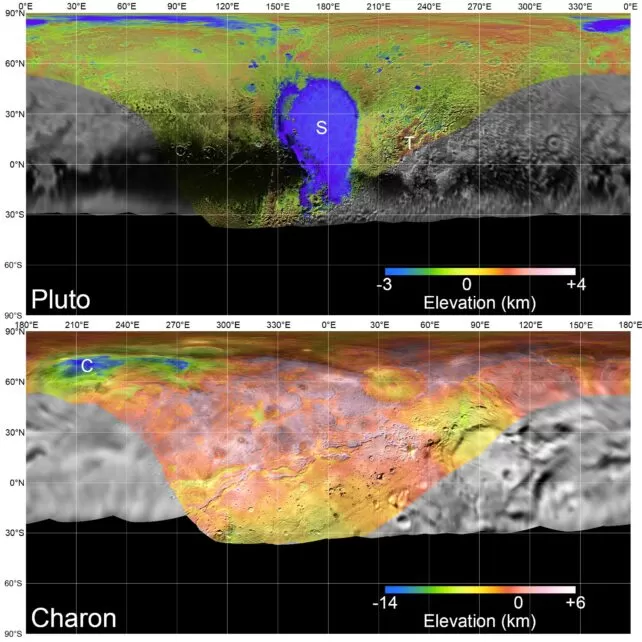 Global mosaics of Pluto and Charon captured by New Horizons
Beyond the Haze: Ice on the Move
The JWST observations also provided valuable data about the surface temperatures of both Pluto and Charon as they rotate. By comparing these observations to thermal models, the researchers could determine properties like thermal inertia (how well a surface stores heat) and emissivity (how well it radiates heat) for different regions.
These thermal properties are crucial because they influence how ices like nitrogen, methane, and carbon monoxide behave on Pluto’s surface. Pluto experiences extreme seasonal cycles, causing volatile ices to transition between solid and gas phases. This leads to a fascinating phenomenon: ice deposits literally migrate across the surface over time.
In a process scientists are still working to fully understand, some of this material is even transported from Pluto and deposited onto Charon. This kind of large-scale ice migration and material transfer between a dwarf planet and its moon appears to be unique in our solar system.
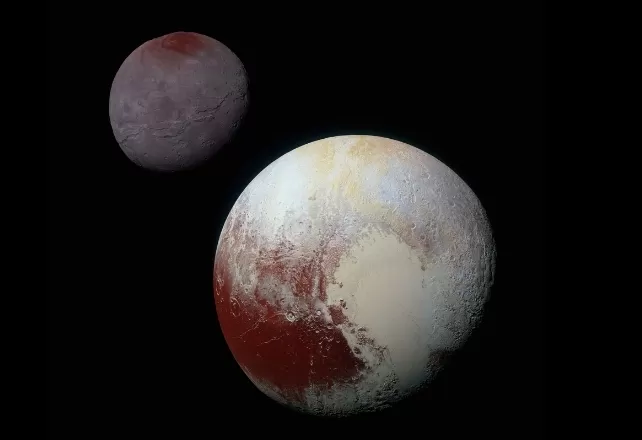 Composite image showing enhanced colors of Pluto and Charon from New Horizons
Why Pluto’s Haze Matters
Understanding Pluto’s atmosphere offers insights far beyond this distant world. This unique haze-controlled cooling mechanism provides scientists with a natural laboratory to study how atmospheres can behave in extreme conditions.
Furthermore, studying the chemistry and behavior of Pluto’s atmosphere might offer clues about early Earth. Billions of years ago, Earth’s atmosphere was mostly nitrogen and contained hydrocarbons, much like the components found in Pluto’s haze.
“By studying Pluto’s haze and chemistry, we might get new insights into the conditions that made early Earth habitable,” Zhang explained.
Pluto isn’t the only icy world with a thick, hazy atmosphere. Saturn’s moon Titan and Neptune’s moon Triton also have similar nitrogen and hydrocarbon-rich atmospheres filled with haze particles. The findings at Pluto suggest scientists might need to re-evaluate the role of haze in controlling the climates on these other fascinating moons as well.
The JWST observations are just the beginning of unraveling the complex interactions within Pluto’s atmosphere and how they contribute to the dynamics of the entire Pluto-Charon system.
To learn more about other fascinating moons with atmospheres, check out our articles on Titan’s mysterious methane lakes and Triton’s unusual, active surface.