
For decades, scientists believed that the brain’s signals triggered by experience and those that happen spontaneously shared the same communication points within neurons. But new research from the University of Pittsburgh has overturned this long-held assumption, revealing that the brain uses separate sites for these two types of signaling. This surprising discovery offers a deeper understanding of how the brain balances constant background activity with the crucial ability to learn and adapt, potentially shedding light on neurological conditions.
Contents
Key Takeaways:
- The brain uses distinct spots within synapses for spontaneous and evoked communication.
- These two types of signals develop and are regulated differently.
- This separation allows the brain to be both stable and flexible, crucial for learning and brain health.
The Brain’s Complex Conversation
Neurons, the brain’s fundamental units, communicate at tiny junctions called synapses. It’s here that one neuron releases chemical messengers, or neurotransmitters, to influence another. Think of it like one person passing a message to another: the synapse is the hand-off point.
This communication happens in two main ways:
- Spontaneous signals: These are like random bits of chatter happening in the background, not triggered by any specific input.
- Evoked signals: These are specific messages sent in response to sensory information or activity, like reacting to seeing something or learning a new skill.
Scientists previously thought both spontaneous and evoked signals used the exact same “hand-off points” within the synapse.
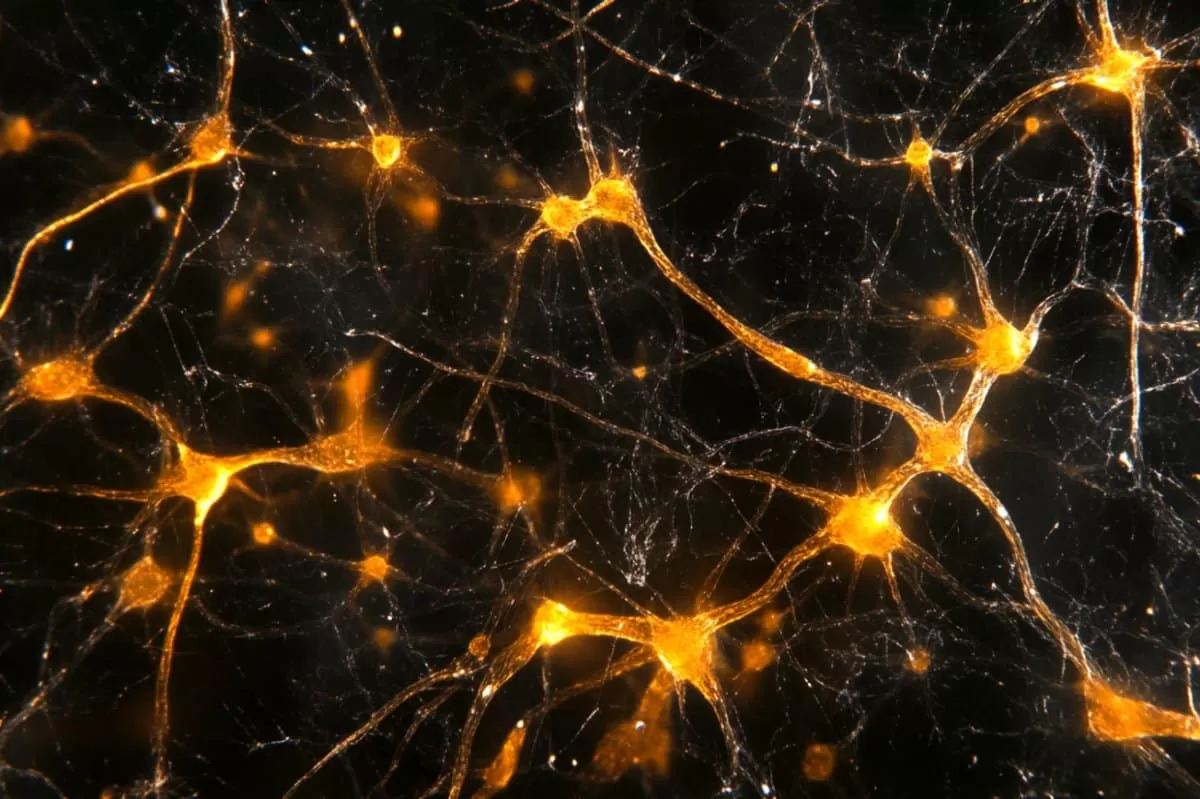 Detailed view of brain synapses showing complex connections, illustrating how different signaling pathways might be organized for learning and stability.
A Surprise in the Synapse
Working with a mouse model, the Pitt research team focused on the visual cortex, the brain area that first processes what we see. They expected both types of signals to grow and change in similar ways as the mice developed their vision.
Instead, they found something unexpected. As the mice began to see and process visual information:
- Evoked signals, tied to the incoming visual experience, grew stronger and stronger.
- Spontaneous signals, the background chatter, leveled off and remained stable.
This difference in how they developed suggested they might not be using the same machinery after all.
Different Jobs, Different Spots
To confirm this, the researchers performed experiments that specifically boosted spontaneous activity without affecting evoked signals. This provided strong evidence that the two types of transmissions were operating through functionally distinct sites within the synapse.
Imagine the synapse isn’t just one simple hand-off point, but rather has two parallel communication channels. This separation allows the brain to manage two critical tasks simultaneously:
- Maintain stability: The spontaneous channel keeps a steady baseline level of activity, essential for overall brain function (related to what scientists call homeostasis).
- Enable learning: The evoked channel, which can be strengthened by experience, is free to adapt and change based on what we sense and do (following rules similar to Hebbian plasticity, or “neurons that fire together wire together”).
This clever organization means the brain can constantly learn and build new connections through evoked signals without disrupting the essential, stable background activity provided by spontaneous signals.
Why This Matters for Your Brain
This discovery changes a fundamental understanding of how synapses work. By showing that spontaneous and evoked transmissions have their own distinct homes and rules, it opens up new avenues for research.
Abnormalities in synaptic signaling are linked to various neurological and psychiatric conditions, including disorders like autism, Alzheimer’s disease, and issues related to addiction. Understanding the brain’s normal strategy—how it separates and regulates these different types of signals—is crucial for pinpointing what goes wrong in these diseases.
This finding lays the groundwork for future studies to explore exactly how these separate synaptic sites function, how they interact, and how their disruption might contribute to brain disorders. It brings us one step closer to understanding the intricate balance required for a healthy, adaptable brain.