
We know Jupiter is the undisputed king of our solar system, a true giant. But new research suggests that early Jupiter wasn’t just big – it was significantly larger, perhaps twice the volume, and boasted a magnetic field 50 times stronger than today. This surprising discovery, unveiled by scientists studying Jupiter’s smallest moons, provides crucial clues about the chaotic birth of gas giants and how our planetary neighborhood took shape.
Contents
Key takeaways from this research:
- Early Jupiter was much larger (up to 2.5 times current volume).
- It had a significantly stronger magnetic field.
- This finding supports the core accretion model for giant planets.
- The insights come from studying the orbits of tiny moons, Amalthea and Thebe.
- It helps us understand the history and architecture of the entire solar system.
Clues From Tiny Moons
Instead of massive telescopes or complex simulations alone, researchers Konstantin Batygin of Caltech and Fred Adams of the University of Michigan took an unexpected approach: they looked at Jupiter’s smallest, innermost moons, Amalthea and Thebe. These tiny, irregularly shaped companions orbit unusually close to the gas giant, and their orbits are tilted relative to Jupiter’s equator.
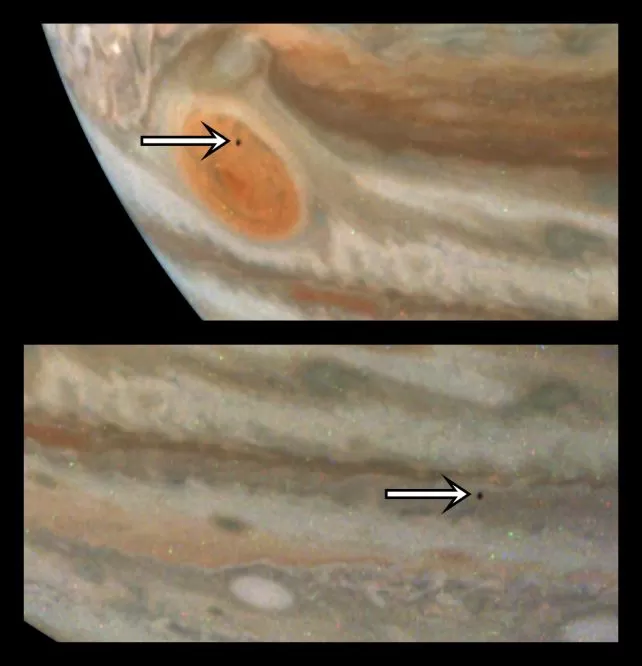 Jupiter and its small moon Amalthea, whose tilted orbit helped scientists understand Jupiter's early history.
Think of these moons’ orbits like fossil records or growth rings on a tree. Over billions of years, Jupiter’s gravitational pull, especially from its changing shape and magnetic field, would have subtly influenced these orbits. By carefully modeling these tilts, the scientists could reverse-engineer Jupiter’s state in the distant past. It’s astonishing that even after 4.5 billion years, enough clues remain to let us reconstruct Jupiter’s physical state at the dawn of its existence.
A Giant, Rapidly Growing Planet
What did these tiny lunar clues reveal? The models indicated that very early in the solar system’s history – specifically, just 3.8 million years after the first solid materials began clumping together – Jupiter was a much different beast. It wasn’t just massive in terms of weight (mass), but significantly larger in size, potentially boasting a volume two to two-and-a-half times greater than it does today.
Alongside this inflated size, the research suggests its magnetic field was astonishingly powerful, up to 50 times stronger than its current field. This super-strong magnetic field likely played a key role in pulling in vast amounts of gas and dust from the surrounding solar nebula, fueling a period of incredibly rapid growth at a rate of around 1.2 to 2.4 Jupiter masses per million years.
Rewriting Jupiter’s Birth Story
How do planets like Jupiter form? There are a couple of leading theories. The “core accretion” model suggests rocky planets (like Earth, Mars) grow slowly from dust and rocks sticking together. Gas giants like Jupiter are thought to start the same way, building a solid core. Once that core is heavy enough (around 10 times Earth’s mass), its gravity becomes strong enough to quickly vacuum up vast amounts of gas from the surrounding cosmic disk. An alternative, less favored for our solar system, is disk instability, where gas simply collapses directly into a giant planet. This new research, particularly the evidence for rapid gas accumulation fueled by a strong magnetic field around a growing core, strongly supports the core accretion story for Jupiter.
Shrinking Giant and Cosmic Importance
As the swirling disk of gas and dust around the young Sun eventually dissipated, Jupiter’s rapid growth phase ended. Without that external pressure pushing material onto it, the planet began to contract under its own immense gravity, like a massive balloon slowly deflating. This contraction is why its volume decreased over time, even while its mass remained roughly constant. Jupiter actually continues to shrink today, albeit at an incredibly slow pace, as it cools and settles.
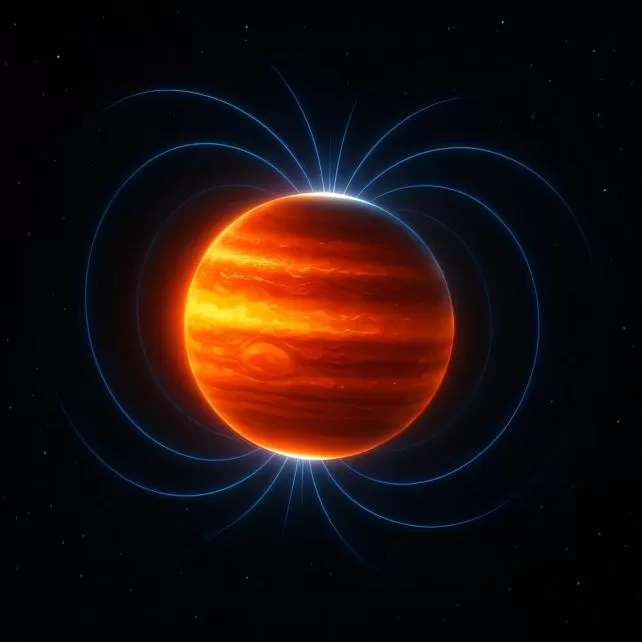 Illustration showing Jupiter and its powerful magnetic field, which was significantly stronger in its early history.
While the early Jupiter was colossal in volume, it was never close to becoming a star. It would need to be at least 85 times its current mass – a truly staggering difference – to ignite the nuclear fusion needed to shine like a star. So, no failed star here, just a remarkably large planet! Why is understanding all this so important? Jupiter isn’t just a big ball of gas; its immense gravity likely played a crucial role in shaping the entire solar system, influencing the orbits of other planets and potentially even creating the conditions that allowed life to emerge on Earth. This study gives us a vital “snapshot” of that critical early period.
This innovative approach, using tiny moons as cosmic detectives, provides a valuable benchmark for understanding the tumultuous first few million years of our solar system. By reconstructing Jupiter’s early state, scientists gain a clearer picture of how gas giants form and, by extension, how the entire planetary architecture we see today came to be. It opens up exciting possibilities for using similar methods to probe the past of other planets or even moons. Understanding our cosmic origins is a massive puzzle, and pieces like this bring us closer to seeing the full picture.





