
For decades, scientists have debated if Venus, our closest planetary neighbor, is a geologically dead world. While Earth constantly reshapes its surface with shifting tectonic plates, Venus appears static, its surface relatively untouched for hundreds of millions of years. However, new analysis of decades-old data from NASA’s Magellan mission suggests that Venus might be hiding ongoing tectonic-like activity beneath its surface, hinting at a more dynamic planet than previously thought and potentially offering clues about early Earth.
Contents
Using gravity and topography data collected by Magellan before its mission ended over 30 years ago, researchers have found evidence of active geological processes at specific features on Venus called coronae. This groundbreaking study indicates that internal heat is still driving surface renewal on Venus, even without Earth-style plate tectonics.
Earth’s Twin? The Tale of Two Planets
Often called Earth’s “twin” because of its similar size and composition, Venus is vastly different in many ways. Its crushing atmosphere, extreme temperatures, and lack of liquid water make it seem alien. One of the biggest differences is how the planets refresh their surfaces. Earth uses plate tectonics – giant slabs of crust slowly moving, colliding, and separating. Venus lacks these plates. Scientists have long wondered how its surface changes over time. Volcanism has been suspected, and recent studies using Magellan data confirmed evidence of active volcanoes. But is there more?
Enter the coronae. These large, ring-like geological features are unique to Venus (or perhaps existed on early Earth before plate tectonics fully formed). They range from small (60 km) to enormous (up to 2,500 km) and are thought to form when plumes of hot material from deep within the planet’s mantle push upwards towards the crust.
“Coronae are not found on Earth today; however, they may have existed when our planet was young and before plate tectonics had been established,” says study lead Gael Cascioli.
Unlocking Secrets from Decades Past
To understand what’s happening at these coronae, scientists looked back at the treasure trove of data from the Magellan mission, which mapped Venus extensively in the early 1990s using radar. They focused on 75 specific coronae, combining Magellan’s measurements of their elevation (topography) and their gravitational pull (which reveals density variations beneath the surface).
The team developed sophisticated computer models simulating different ways a rising mantle plume could interact with Venus’s rocky outer layer, the lithosphere. These interactions could involve material from the lithosphere sinking back into the mantle (like “dripping” rock) or being pushed down at the edges (a form of subduction). Both processes recycle surface material, contributing to surface renewal.
 Mosaic showing four large, rounded features on Venus, known as coronae: Artemis, Quetzalpetlatl, Bahet, and Fotla.
Using an algorithm, they compared their models to Magellan’s data. By analyzing the topography and gravity signals, they could infer which interaction scenarios were most likely happening at each corona and whether the feature was in an early, active, or inactive stage.
Signs of Life Beneath the Surface
The results were surprising and significant. Out of the 75 coronae studied, the researchers found evidence that 52 of them appear to be actively interacting with mantle plumes. This suggests ongoing geological processes are shaping Venus’s surface right now, driven by heat from its interior.
“Coronae are abundant on Venus. They are very large features, and people have proposed different theories over the years as to how they formed,” says coauthor Anna Gülcher. “The most exciting thing for our study is that we can now say there are most likely various and ongoing active processes driving their formation. We believe these same processes may have occurred early in Earth’s history.”
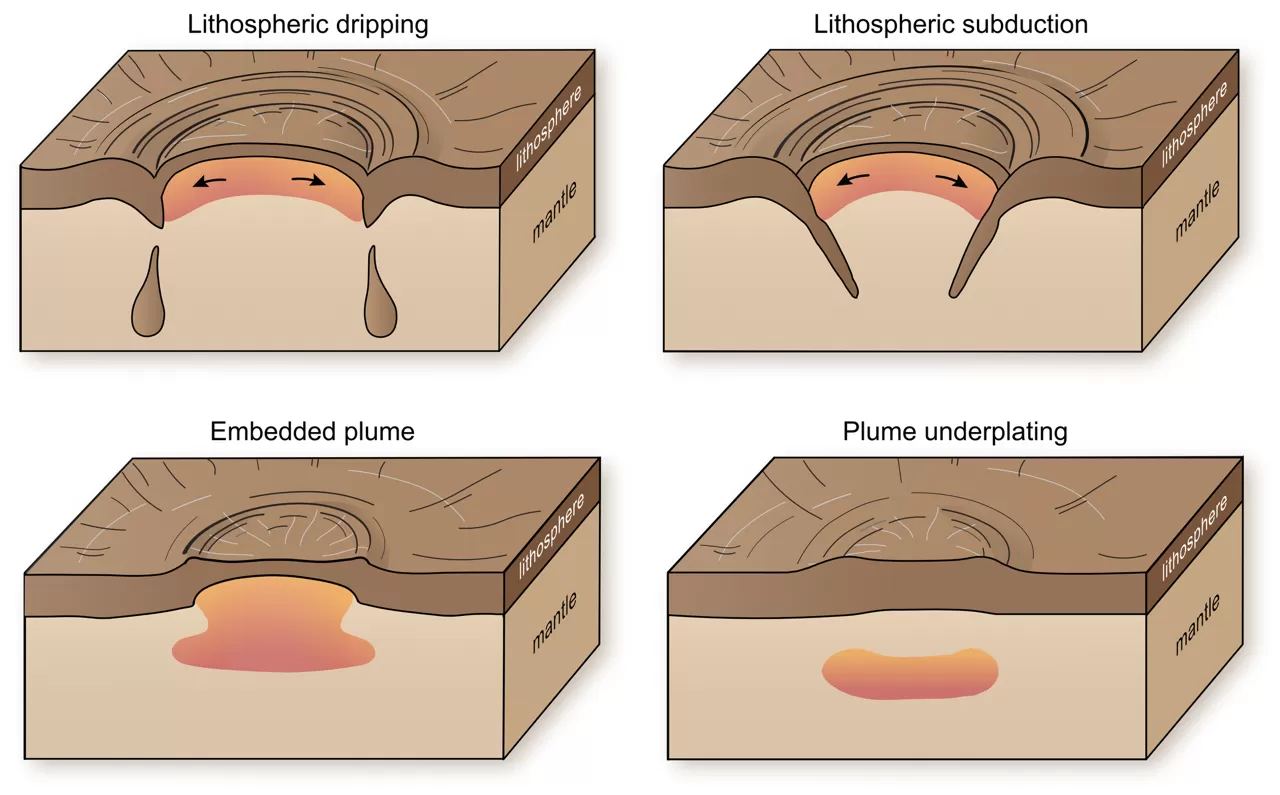 Illustration depicting potential tectonic processes on Venus. A hot plume rises from the mantle, interacting with the lithosphere to create features like coronae, possibly involving sinking or subduction of crustal material.
The study highlights the power of old data. Magellan completed its mission in 1994, deliberately plunging into Venus’s atmosphere. Yet, its detailed radar maps and gravity data continue to provide new insights into the planet’s mysteries three decades later.
The Future is Even Brighter
While the study analyzed 75 coronae, this is only a fraction of the over 740 known features on Venus. Magellan’s gravity data, while revolutionary for its time, had limitations in resolution. Only the largest coronae could be studied in detail using this method.
This is where future missions come in. Two new missions are planned for Venus: NASA’s VERITAS (Venus Emissivity, Radio Science, InSAR, Topography and Spectroscopy) and the European Space Agency’s EnVision. Both will carry instruments designed to create much higher-resolution maps of Venus’s surface and gravity field.
The scientists behind the current study specifically looked at what VERITAS could achieve. They determined that the mission will be able to study 427 known coronae, with significantly more detail than Magellan. This higher resolution and lower noise data will provide an unprecedented look at Venus’s subsurface activity.
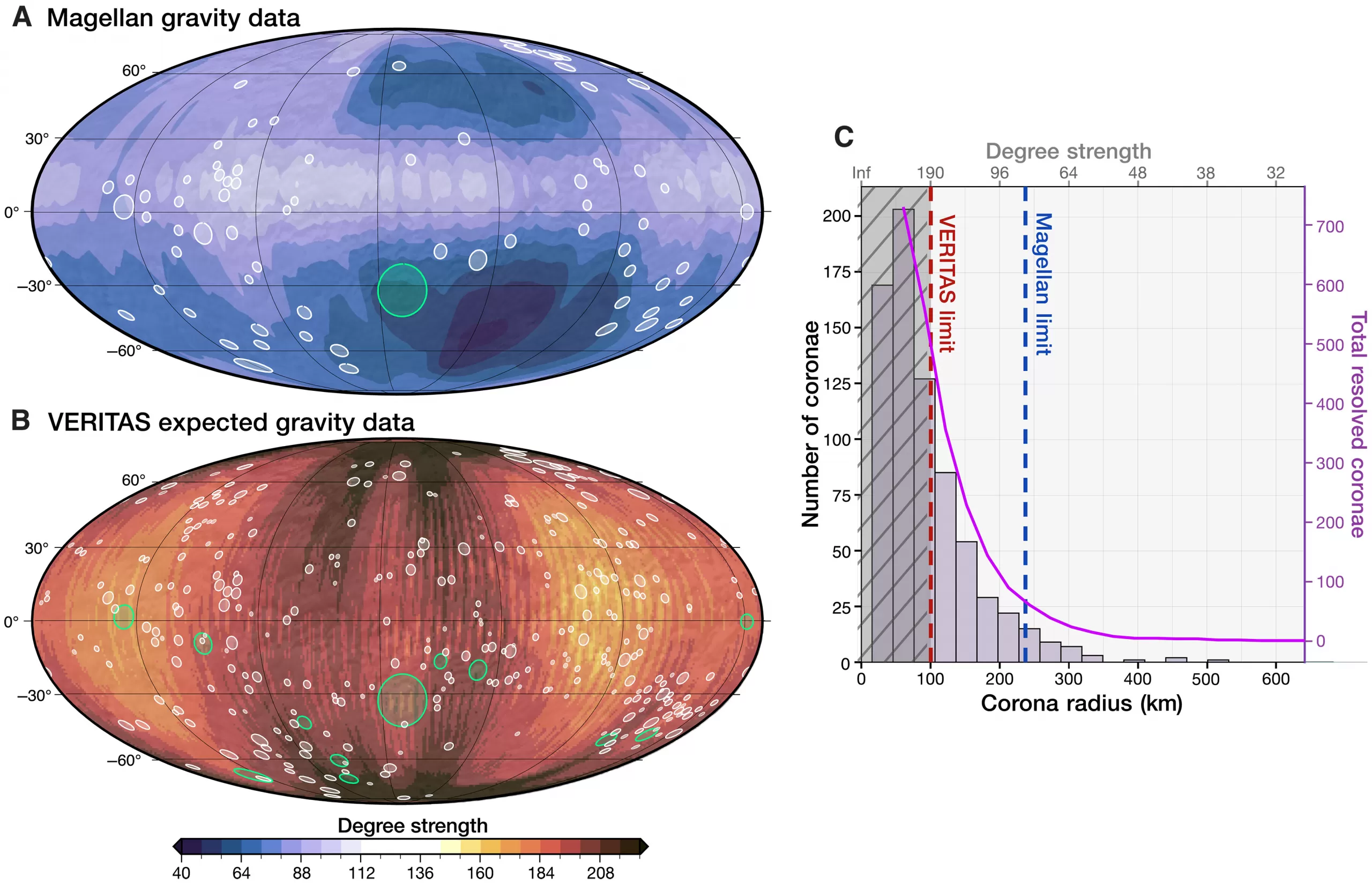 Comparison showing the visibility of coronae in Magellan (A) versus anticipated VERITAS (B) gravity datasets, indicating higher resolution for future missions. Chart (C) displays the distribution of coronae sizes.
“The VERITAS gravity maps of Venus will boost the resolution by at least a factor of two to four, depending on location — a level of detail that could revolutionize our understanding of Venus’ geology and implications for early Earth,” says study coauthor Suzanne Smrekar, principal investigator for VERITAS.
This new research, published in the journal Science Advances, turns our perception of Venus on its head. It shows that old data can still reveal astonishing secrets and sets the stage for future missions to truly unravel the active geological story of our enigmatic twin planet.
Discover more about the dynamic geology of planets and moons: Geology





