
Get ready for a celestial spectacle! On the morning of June 19, 2025, the Moon will appear remarkably close to two gas giants, Saturn and Neptune, offering a fantastic opportunity for early risers to witness a cosmic lineup in the eastern sky. This isn’t a true physical alignment, but rather a beautiful grouping visible from our perspective here on Earth, making it a great chance to spot distant worlds.
Contents
This guide covers when and where to look, what you’ll need to see all three, and what makes this event special.
When and Where to Catch the Cosmic Trio
The moment the Moon, Saturn, and Neptune are closest in our sky occurs late on June 18, but they will be below the horizon for many. The best time to actually see them will be in the early morning hours of June 19, as they rise in the east before dawn. For instance, in New York City, this will happen around 1:30 am EDT.
The exact timing depends on your location, so it’s always a good idea to consult a reliable astronomy app or website for precise rise times in your area. Look towards the eastern horizon during the hours before sunrise on June 19.
Measuring distances in the night sky can be tricky, but astronomers use degrees. At their closest point, these three will be separated by just over 2.5 degrees – roughly the width of two fingers held at arm’s length. While this “closest approach” happens when they’re not easily visible, they will still appear quite close together when they rise in the hours after.
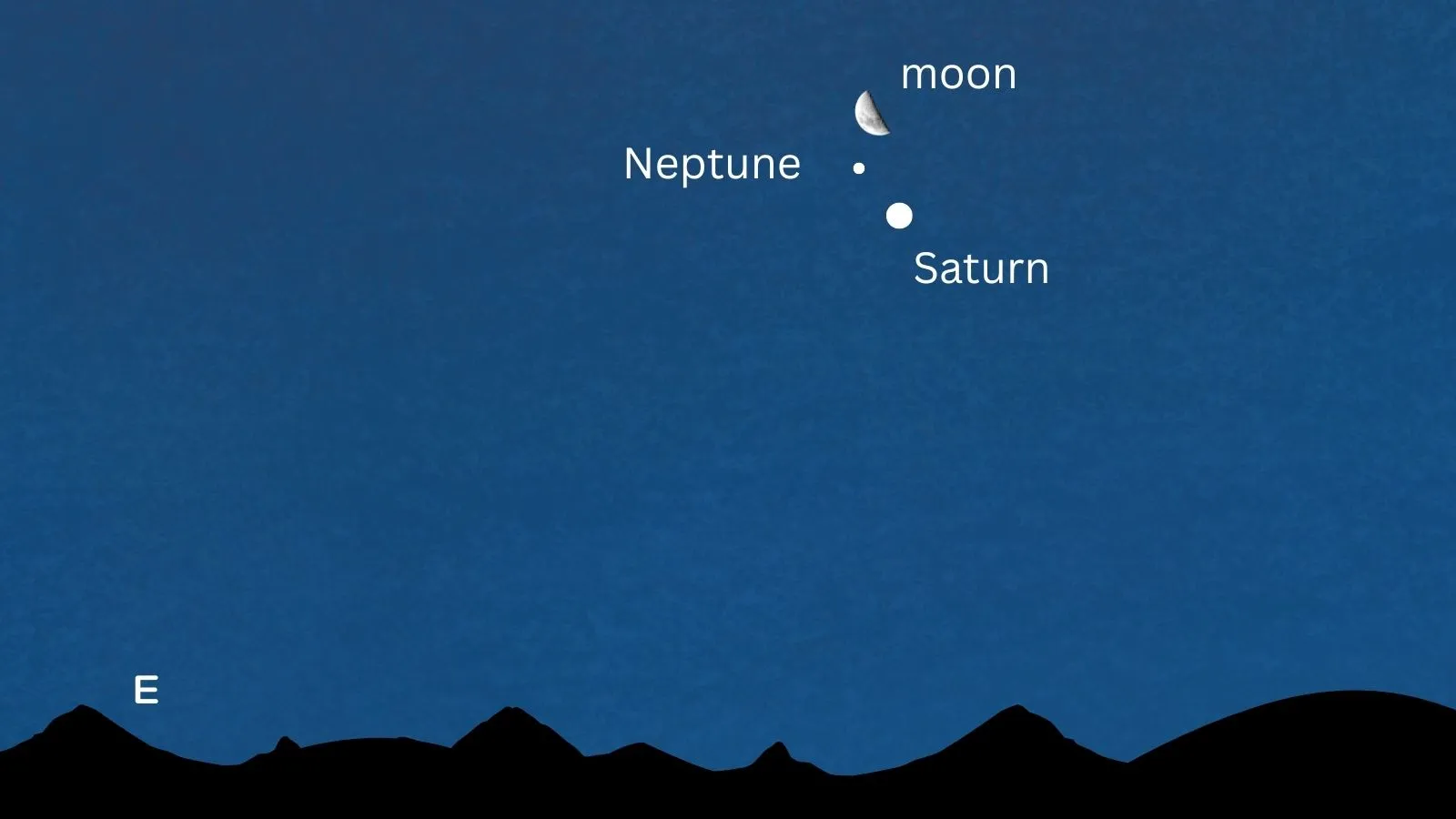 Illustration of the Moon, Saturn, and Neptune aligned in the early morning sky
What You Can Expect to See
As they emerge from the eastern horizon, the Moon will be the first to appear, showing its half-illuminated third quarter phase. Following closely behind will be the ringed planet Saturn, easily visible to the naked eye as a bright, steady light (unlike twinkling stars) positioned a few degrees below and to the right of the Moon. You might even see Saturn’s yellowish tint.
Neptune, the distant blue ice giant, will be located about a degree above and to the left of Saturn. However, unlike the bright Moon and prominent Saturn, Neptune is far too faint to be seen without optical aid. It requires a telescope with an aperture of at least 8 inches (200 mm) to be visible as a tiny, bluish dot.
Spotting Neptune is a fun challenge for telescope users and a reminder of how vast our solar system truly is, with planets stretching far beyond what our eyes can see.
Beyond the Alignment: What’s Next?
After their brief alignment in the pre-dawn sky on June 19, the Moon will continue its journey across the sky, moving further away from the giant planets. Its crescent shape will thin out as it heads towards its new moon phase around June 25.
Saturn and Neptune, however, will remain relatively close to each other in the Earth’s sky over the coming months. This means if you have a telescope capable of spotting Neptune, you’ll have more opportunities later in the year to find these two distant worlds near each other.
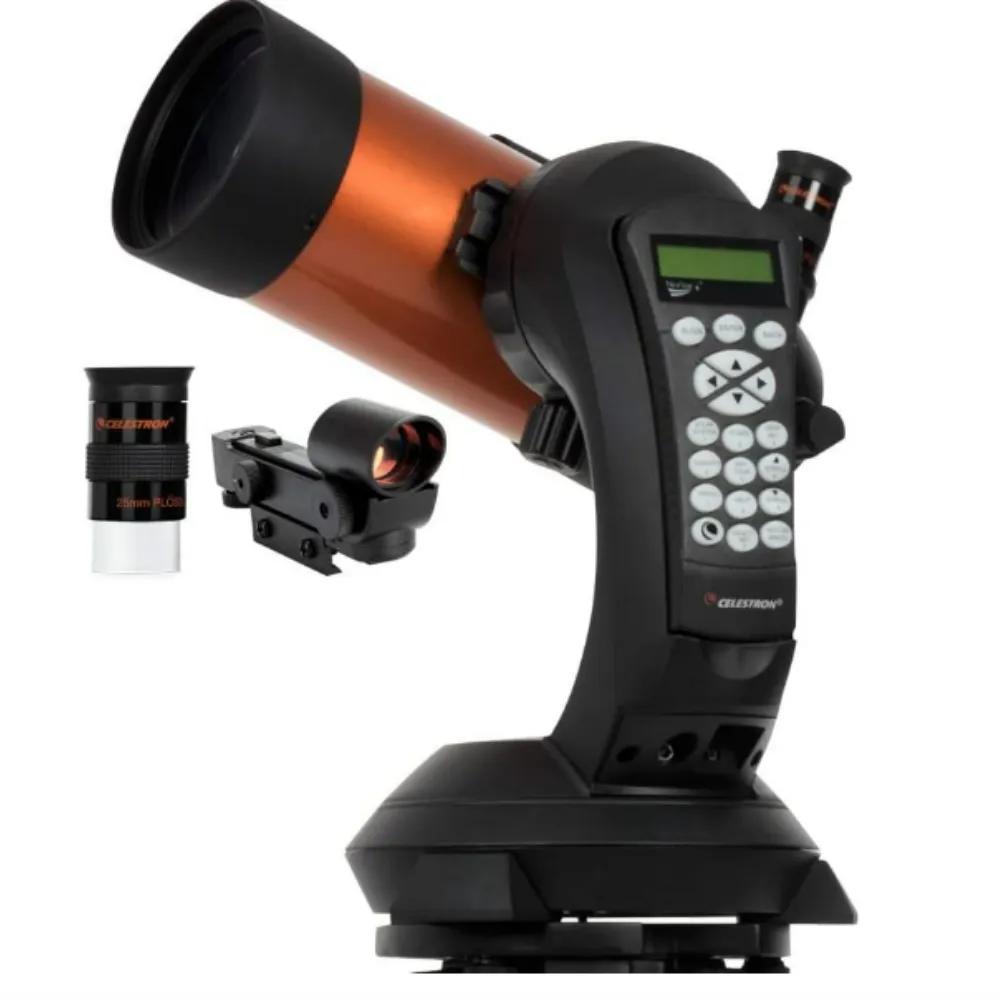 A Celestron NexStar 4SE telescope shown on a white background
For those inspired to explore the wonders of the night sky further, investing in a good pair of binoculars or a telescope can open up a whole new universe. Binoculars are great for wide-field views and spotting fainter objects, while a telescope will allow you to see details like Saturn’s rings or spot distant planets like Neptune.
Look Up and Connect with the Cosmos
The grouping of the Moon, Saturn, and Neptune on June 19 offers a lovely visual treat and a simple reminder of our place in the vast cosmic dance. While only two of the three will be visible to the naked eye, knowing that distant Neptune is also part of the picture adds an extra layer of wonder.
So, set your alarms, find a spot with a clear view of the eastern horizon, and take a moment to connect with these celestial travelers as they make their appearance in the early morning sky. You might just spark a deeper curiosity about the universe around us.





