Growing fresh food in space could be a game-changer for astronauts on long missions, providing vital nutrition and a psychological boost. But here’s a surprising challenge: watering plants becomes incredibly complicated when gravity isn’t there to pull water down. NASA scientists are tackling this “unearthly plumbing” problem aboard the International Space Station (ISS), paving the way for future space farms.
On Earth, gravity makes watering simple – water flows down into the soil. In the weightlessness of space, however, water doesn’t behave so predictably. Bubbles don’t rise, droplets float around, and liquids can form unstable blobs and streams. Imagine trying to water a potted plant with a watering can, but the water just sprays everywhere and sticks to things instead of going into the pot!
This is why NASA initiated the Plant Water Management (PWM) experiments. The goal is to find ways to reliably get water and nutrients to plant roots in microgravity, specifically using hydroponics (growing plants in water) and ebb and flow systems (where water is periodically flowed over roots).
The latest experiments, PWM-5 and PWM-6, involve specially designed hardware built largely from 3D-printed parts on Earth and assembled by astronauts on the ISS. This setup includes pumps, tubes, valves, and containers designed to test different ways of moving liquids and gases together.
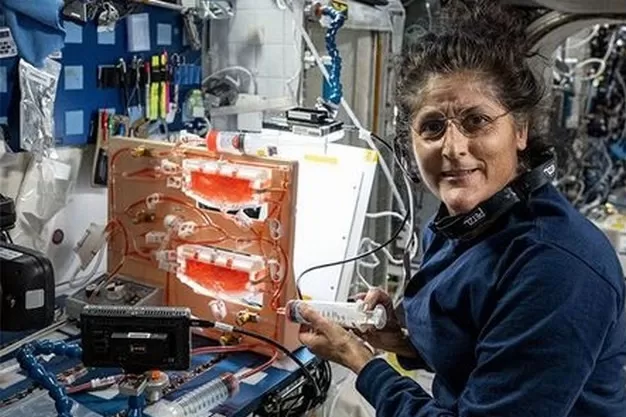 Astronaut Sunita Williams operates Plant Water Management-6 hardware on the International Space Station
Instead of relying on gravity, the NASA system uses clever engineering principles like surface tension and wetting – how liquids stick to surfaces – and the specific shapes of the tubes and containers. Think of how water climbs up a narrow straw, defying gravity on Earth; the space system uses similar principles on a larger scale.
One key challenge is separating air bubbles from the water flow. On Earth, gravity does this naturally. In space, bubbles can get stuck in the watering system, causing blockages. The PWM hardware includes innovative, “no-moving-parts” devices that act like passive traffic cops for liquids and gases.
For instance, a passive aerator creates tiny oxygen bubbles, which are then directed into a bubble separator that routes them away from the water supplying the plant roots. Any stray water is caught by a water trap, and any bubbles that make it further are guided by the channel’s shape to exit the system. It’s a bit like designing a maze that only lets water through one path and air through another, all based on how they interact with the walls of the maze.
These successful demonstrations with PWM-5 and -6 proved that it’s possible to create reliable, passive watering systems for space using these non-gravitational forces. They showed how to manage water and nutrient flow with different types of engineered root models, flow rates, and system configurations.
While these experiments successfully used artificial root models, the next crucial step is testing the system’s performance with real, growing plants. How live roots interact with the water flow in microgravity is the final piece of the puzzle.
Solving the “unearthly plumbing” problem is essential for future space exploration. Reliable water management isn’t just about growing food; it’s critical for many other spacecraft systems, including life support (like air conditioning) and fuel lines. The lessons learned from watering plants in space could have wide-ranging applications, making longer missions to the Moon, Mars, and beyond possible.