
A pioneering mini solar telescope attached to the International Space Station (ISS) has captured its first images, revealing subtle, never-before-seen details within the sun’s outer atmosphere, known as the corona. These initial observations from NASA’s CODEX instrument promise to unlock secrets about the mysterious solar wind and improve our ability to predict space weather.
Contents
Peering into the Sun’s Hazy Crown
Imagine trying to study a faint glow right next to a blinding spotlight. That’s the challenge of studying the sun’s corona, which is far dimmer than the sun’s bright face. To overcome this, CODEX acts like a miniature, permanent solar eclipse. It uses a small disc to block out the sun’s intense light, allowing its sensitive instruments to focus solely on the ethereal atmosphere surrounding it. This design, called a coronagraph, mimics how the moon temporarily reveals the corona during a total solar eclipse here on Earth.
The Coronal Diagnostic Experiment, or CODEX, is a compact telescope fixed to the exterior of the ISS. It arrived in November 2023 aboard a SpaceX Dragon and was installed onto the station’s hull shortly after.
The First Glimpse: Unveiling Temperature and Speed
The first images from CODEX were publicly released in June 2024. These initial glimpses include footage showing how temperatures fluctuate within the outer corona over several days and a stunning photo capturing giant “coronal streamers” — massive structures of solar material extending millions of miles outwards.
“The CODEX instrument is doing something new,” stated Jeffrey Newmark, a heliophysicist at NASA Goddard Space Flight Center and the principal investigator for CODEX. “These are brand new observations that have never been seen before, and we think there’s a lot of really interesting science to be done with it.”
 Image from CODEX telescope showing bright coronal streamers extending from the sun's blocked disk.
While previous instruments have measured the density of the material in the corona, CODEX is uniquely designed to measure the temperature and speed of the solar wind as it streams away from the sun.
Unlocking the Secrets of the Solar Wind
One of the biggest puzzles in solar physics is understanding the solar wind – a constant flow of charged particles emitted by the sun that fills our solar system. Scientists want to know exactly how this wind is accelerated to such incredible speeds and heated to temperatures soaring up to 1.8 million degrees Fahrenheit (1 million degrees Celsius) – far hotter than the sun’s surface itself.
CODEX tackles this by observing the corona through four specific filters: two sensitive to temperature and two to speed. By comparing the brightness seen through these different filters, researchers can determine the temperature and speed of the coronal solar wind in various regions.
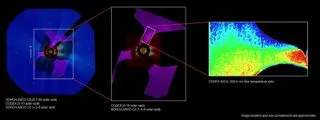 Sequence of solar corona images demonstrating the detailed views captured by the CODEX instrument.
Why This Matters for Earth
Understanding the behavior of the solar wind is not just academic; it’s crucial for predicting space weather. Just like terrestrial weather can impact daily life, space weather events — triggered by powerful solar activity like flares, coronal mass ejections, or streams from coronal holes — can affect technology here on Earth.
Fast solar wind streams, particularly those emanating from “coronal holes,” can cause geomagnetic storms when they hit Earth’s magnetic field. These storms can disrupt satellite communications, navigation systems like GPS, power grids, and even expose astronauts and high-altitude flights to increased radiation.
The timing of CODEX coming online is particularly interesting. The sun is currently in or near the peak of its roughly 11-year cycle of activity, known as solar maximum. While this peak may be subsiding, the sun’s behavior, particularly in the region where magnetic fields rearrange, is expected to remain complex and potentially unpredictable for some time. This period, sometimes called the “solar battle zone,” makes having new tools like CODEX to monitor the solar wind incredibly valuable.
Recent weeks have seen significant geomagnetic activity, including events in June 2024 that triggered auroras visible across parts of the United States, highlighting the direct impact of solar activity on Earth.
Looking Ahead
These first images from CODEX mark a significant step forward in observing our star. By providing novel data on the temperature and speed of the solar wind directly from the source region in the corona, CODEX offers scientists new insights into the fundamental processes driving solar activity and space weather.
These unprecedented observations are expected to help scientists build better models of the sun’s behavior, leading to more accurate forecasts of space weather events that could affect our technology and infrastructure on Earth. The mission promises exciting discoveries as it continues to watch the dynamic sun from its unique vantage point on the International Space Station.
To explore related topics about the sun’s fascinating and powerful activity, read more about powerful solar telescopes, artificial solar eclipses from space, or the first views of the sun’s south pole.





