
Summer nights offer a spectacular opportunity to connect with the cosmos. From brilliant planets gracing the dawn and dusk skies to the sweeping beauty of our own galaxy and exhilarating meteor showers, Summer 2025 is packed with celestial events. This guide highlights the key astronomical sights you can look forward to, helping you plan your perfect stargazing adventures.
Contents
Welcoming Summer: The Solstice and Longest Days
Summer officially kicks off with the Summer Solstice, occurring in the Northern Hemisphere on June 20 or 21, 2025, depending on your location (at 2:42 UTC on June 21). This moment marks when the Sun reaches its highest point in the sky for the year, giving us the longest period of daylight.
While June 21st is typically the single longest day, the exact timing of the solstice can mean that June 20th and 21st share almost the exact same amount of daylight in some regions, essentially giving you two “longest days” to enjoy the summer sun before turning your gaze to the night sky.
A Planetary Parade: What Planets to Spot
Throughout Summer 2025, several bright planets will be visible, shifting between the morning and evening skies like celestial dancers.
Early risers in June can find Venus and Saturn glowing in the eastern predawn sky. Venus, often called the “morning star,” will remain a prominent fixture in the east each morning throughout the summer.
For those who prefer evening viewing, Mercury and Mars will start the season visible in the western sky just after sunset. While Mercury dips out of view in early July by getting too close to the Sun, Mars will continue to shine in the west, albeit getting lower towards the horizon each evening.
Saturn, the ringed jewel, will become visible earlier each night as the season progresses. It’s on a journey towards its “opposition” in September, when Earth passes directly between the Sun and Saturn. This makes Saturn closest to us and brightest for the year.
Jupiter, the king of planets, which may have disappeared from the evening sky earlier in the year, returns to visibility in mid-July. You’ll need to set your alarm, though, as it will first appear in the morning sky before sunrise and gradually rise earlier.
Mark your calendars for a spectacular planetary close approach in the predawn sky around August 12th. Jupiter and Venus will appear incredibly close, almost touching from our perspective – a stunning sight even without a telescope.
 Astronomical simulation showing Jupiter and Venus appearing very close together in the predawn sky in mid-August 2025.
Keep an eye on the Moon throughout the summer, as it frequently passes by these planets, offering beautiful photo opportunities. Look for the Moon near Venus in the predawn sky on June 22 and near Mars in the evening on June 29. In July, the Moon will visit Saturn on the 16th, swing past Venus and Jupiter from the 21st to 23rd (predawn), and meet up with Mars again on the 28th (evening). Similar conjunctions repeat in August and September.
The peak of Saturn’s visibility arrives around September 21st. On this night of “Opposition,” Saturn is closest and brightest, making it an ideal target for binoculars or a telescope to view its magnificent rings.
Earth’s Farthest Point: Aphelion
Did you know Earth is actually farthest from the Sun during the Northern Hemisphere’s summer? This point in our orbit is called aphelion, and in 2025, it occurs on July 3rd at 3:55 p.m. EDT.
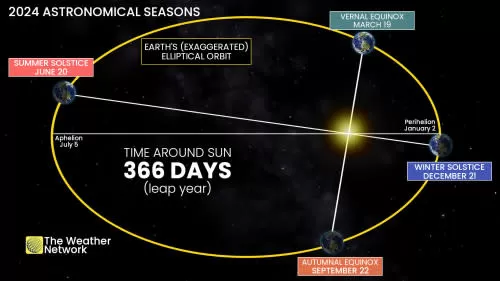 Diagram illustrating Earth's elliptical orbit around the sun and how axial tilt causes the seasons, including aphelion in summer.
We’ll be about 152 million kilometers away – roughly 2.5 million km farther than our average distance. It’s a fascinating reminder that our seasons are caused by Earth’s tilt on its axis, not our distance from the Sun. Interestingly, 2025’s aphelion is one of the closest we’ve experienced in decades due to the subtle gravitational tugs of other planets affecting Earth’s orbit.
Summer’s Full Moons
Summer 2025 features three full moons, each with traditional names tied to the season’s natural rhythms:
- July 10-11: The Buck Moon (when deer antlers are in full growth)
- August 8-9: The Sturgeon Moon (named after fish easily caught this time of year)
- September 7-8: The Corn Moon (corresponding to the corn harvest)
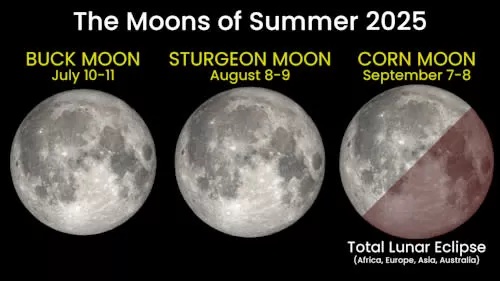 Visual representation of the three average-sized full moons appearing during Summer 2025: Buck, Sturgeon, and Corn moons.
These full moons will appear “average” in size, unlike the “micromoons” of spring or the upcoming “supermoons” of fall. While there’s a total lunar eclipse on the September full moon, it won’t be visible from North America in 2025.
DON’T MISS: Why does the Moon look so big? What is the mysterious Moon Illusion?
The Spectacle of Meteor Showers
Summer brings two of the most anticipated meteor showers of the year, caused by Earth plowing through dusty trails left behind by comets. These tiny bits of cosmic debris burn up in our atmosphere, creating fleeting streaks of light we call meteors or “shooting stars.”
The Southern Delta Aquariids run from mid-July to late August, peaking around July 31st to August 1st. These meteors appear to radiate from the constellation Aquarius. While not as prolific as the Perseids, they can still offer a good show, especially in the hours after midnight when their radiant is higher in the sky. Interestingly, the comet associated with this shower, 96P/Machholz, has an unusual composition that some scientists suggest could indicate it originated outside our solar system.
The second, and arguably most famous, summer shower is the Perseids. Active from mid-July to late August, the Perseids peak on the night of August 12-13. Produced by debris from Comet 109P/Swift-Tuttle, the Perseids are known for their high rates (potentially up to 100 meteors per hour under ideal conditions) and a higher chance of producing bright “fireballs” – meteors brighter than Venus.
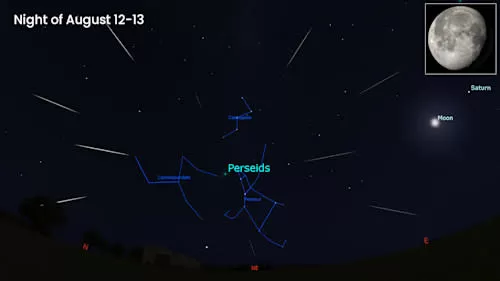 Simulation showing the radiant point of the Perseid meteor shower in the constellation Perseus, with the moon phase inset.
For 2025, the Perseids peak falls just after the Full Moon, meaning moonlight will wash out many dimmer meteors. However, the Delta Aquariids peak around the First Quarter Moon, which sets earlier. This makes the night of July 31st to August 1st potentially one of the best nights to watch, as you can catch meteors from both showers after the moon sets, creating a crisscrossing display across the dark sky.
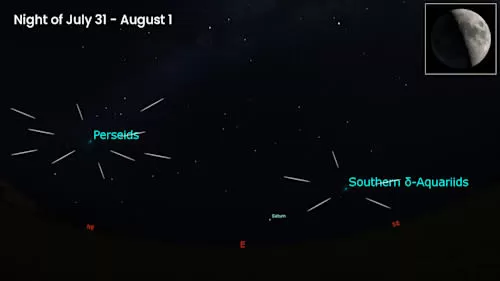 Simulation showing the radiant points for both the Southern Delta Aquariid and Perseid meteor showers active simultaneously in the night sky.
To maximize your meteor shower viewing, find a location away from city lights, allow your eyes time to adjust to the dark, and keep the Moon out of your direct line of sight if possible.
READ MORE: How to get the most out of meteor showers and other night sky events
Glimpsing Our Home: The Galactic Core
Summer is the prime time to see the breathtaking central core of our own Milky Way galaxy. From a location away from light pollution, you can witness it as a hazy, luminous band stretching across the night sky.
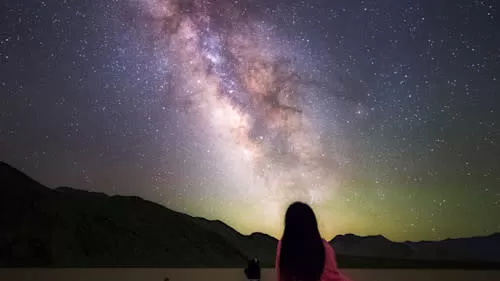 Stunning astrophotograph showing the bright central core of the Milky Way galaxy as a hazy band stretching across a dark night sky.
This isn’t a distant galaxy, but rather the view from within our spiral galaxy, looking towards its dense, star-filled center. Finding a designated dark sky preserve or simply driving away from urban lights can unveil this stunning cosmic river flowing above you.
Bidding Adieu to Summer: The Fall Equinox
Summer officially concludes with the Fall Equinox on September 22nd (at 2:19 p.m. EDT). This is the moment the Sun crosses the celestial equator, marking the astronomical start of autumn and bringing roughly equal hours of daylight and darkness. It also heralds the beginning of the busy fall meteor shower season!
Summer 2025 promises a wealth of astronomical sights. Whether you’re tracking planets, wishing on shooting stars, or simply admiring our galactic home, there’s something for everyone to discover overhead. So, keep an eye on the weather, find a comfortable spot, and prepare to be amazed by the universe unfolding above you.





