
Imagine trying to gaze at the distant stars, only to have your view spoiled by bright streaks of light from satellites whizzing overhead. This growing issue, known as satellite light pollution, is a major challenge for astronomers worldwide. But now, scientists have developed a revolutionary super-black paint for satellites that promises a simple, affordable fix to make these orbiting bright spots virtually disappear. This new coating could significantly reduce the light reflected by satellites, protecting crucial astronomical research and preserving our view of the cosmos.
Contents
The Growing Problem in the Sky
Over the past few years, thousands of new satellites have been launched into low-Earth orbit, creating vast networks called megaconstellations. Companies aim to provide global services like internet access, but their satellites, even small ones, can be surprisingly bright. Reflecting sunlight back to Earth, they appear as moving stars or long streaks in telescopic images.
This isn’t just a minor annoyance. For major observatories designed to map the universe with unprecedented detail, like the upcoming Vera Rubin Observatory, these streaks could ruin a significant portion of observations. Experts predict up to 40% of images from Rubin could be degraded by satellite trails, jeopardizing years of scientific effort and investment.
 Satellite streaks cross a photo of the Milky Way galaxy, illustrating light pollution.
Astrophysicist Noelia Noël from the University of Surrey highlights this concern, noting that the rise of satellites has forced observatories to change their observing strategies. Protecting the dark sky isn’t just for professional astronomers; it’s about preserving a natural wonder accessible to everyone.
A New Hope: Introducing Vantablack 310
Recognizing the urgency, a collaboration formed between the University of Surrey and Surrey NanoSystems, a company specializing in ultra-black coatings. Their goal: create a coating specifically designed for space that is both incredibly light-absorbent and tough enough to withstand the harsh orbital environment.
The result is a new material called Vantablack 310. It’s not just black; it’s super-black, engineered to absorb as much light as possible across visible and near-infrared wavelengths.
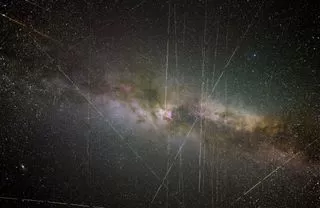 Multiple bright satellite streaks appear in a long-exposure photograph of the night sky, a challenge for astronomers.
Previous versions of Vantablack were incredibly effective at absorbing light (absorbing over 99.9%!), but they relied on delicate structures like carbon nanotubes that could be damaged by even a touch. This made them difficult to use in satellite manufacturing facilities.
How This “Blacker-Than-Black” Works
Unlike its predecessors, Vantablack 310 uses a proprietary blend that includes carbon black – think of it as a very fine, light-absorbing soot – combined with special binders. Kieran Clifford, a materials scientist at Surrey NanoSystems, explains that this new formula makes the paint significantly more robust and easier for satellite engineers to apply and handle without losing its anti-reflective properties.
Tests simulating three years in orbit showed Vantablack 310 maintained its performance with negligible wear, while competitor coatings eroded. Crucially, Vantablack 310 reflects only about 2% of incoming light, compared to 5% or more for other dark space paints on the market. This difference could be key to making satellites much less visible.
Previous attempts by satellite operators, like SpaceX’s “DarkSat” experiments, had mixed results, sometimes leading to satellites overheating due to absorbed light. The developers believe Vantablack 310’s formulation will avoid such issues while significantly reducing brightness. Clifford estimates satellites coated with Vantablack 310 could appear as faint as magnitude 7, potentially invisible to the naked eye, compared to the much brighter magnitude 3 to 5 of current satellites (remember, in astronomy, lower magnitude numbers mean brighter objects).
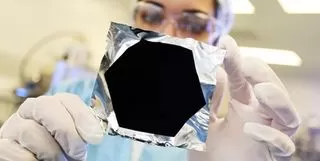 A sample of the new super-black Vantablack 310 paint, designed for easy application and durability on satellites.
Testing the Blackness in Orbit
The next step is a real-world test in space. The Vantablack 310 coating will be applied to a student satellite called Jovian 1, set to launch next year. A section of the satellite’s solar panel will be coated, and scientists will monitor its brightness from the ground as the satellite rotates. This will provide crucial data on how the paint performs in the vacuum and radiation of low-Earth orbit.
What This Means for the Cosmos
The potential impact of this new super-black paint is significant. By making satellites much fainter, it could drastically reduce the problem of light pollution in astronomical images, preserving the ability of telescopes like Vera Rubin to conduct their vital surveys of the universe.
This simple, affordable paint offers a practical way for satellite manufacturers to mitigate the negative impact on astronomy. Scientists involved hope that the effectiveness and ease of use of Vantablack 310 will encourage wider adoption across the industry and potentially inspire future policy changes to protect the dark sky for science and for all of us who simply enjoy gazing at the stars.