
From navigating vast landscapes to finding a meal or a mate, the sense of smell is a superpower for countless creatures. But when we ask, “Which animal has the best sense of smell?” we’re diving into a surprisingly complex mystery. The truth is, naming a single smell champion is scientifically tricky because ‘best’ depends entirely on what you’re sniffing for.
Contents
Why Finding the “Best” Smeller is Harder Than It Smells
Imagine trying to compare a bloodhound tracking a person to a moth finding a mate miles away. They’re incredible at different things. According to Matthias Laska, a zoologist at Linköping University in Sweden, there are millions of odor molecules, which can mix in infinite ways. Since scientists have only tested a tiny fraction of these odors across different species, a blanket statement about who smells ‘better’ is unscientific.
Part of the challenge lies in the nature of smell itself. Unlike sight or sound, odors are volatile, disperse unpredictably, and are hard to measure or control in experiments. This makes studying olfaction far more difficult than other senses.
How Scientists Search for Smell Superstars
Despite the challenges, researchers use different approaches to gauge an animal’s sniffing prowess.
The Gene Game: Counting Smell Receptors
One method is counting the number of olfactory receptor genes. These are the DNA instructions in an animal’s nose that code for proteins designed to detect different odor molecules.
In a 2014 study comparing mammal species, African elephants topped the list with an astounding 1,948 olfactory receptor genes. Humans have only 396, dogs have 811, and rats have 1,207. This makes sense when you consider how elephants rely on smell to find food, recognize family, avoid danger, and find mates. However, this study only looked at 13 mammal species, leaving out contenders like bears, known for their powerful noses.
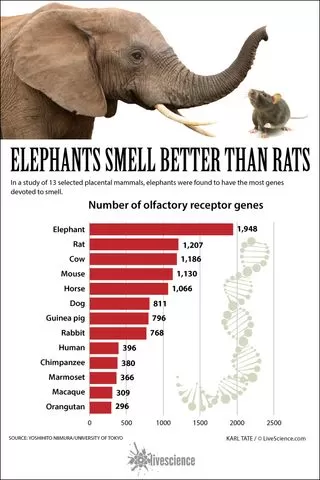 Infographic comparing the number of olfactory receptor genes in various mammals, highlighting elephants.
Brain Power: The Olfactory Bulb
Another clue can be found in the brain’s olfactory bulb, the area that processes smells. Dogs, famous for their tracking abilities, have much larger olfactory bulbs than humans. Among birds, turkey vultures are renowned for their keen sense of smell, allowing them to detect carcasses from incredibly high altitudes.
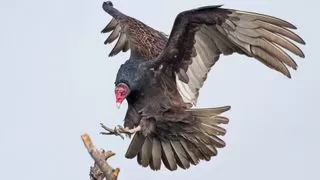 A turkey vulture perched on a branch, known for its keen sense of smell used to locate carrion.
However, the size of the olfactory bulb might not be the whole story. Some research suggests the number of neurons within the bulb is fairly consistent across species, regardless of size, raising questions about using bulb size as a sole measure.
Masters of Specific Scents
Sometimes, an animal’s smelling power is measured by its ability to detect specific odors with extreme sensitivity. African pouched rats are one example. Tobias Ackels from the University of Bonn notes these rats can be trained to find landmines and have even been used to sniff out tuberculosis in human patients.
In the insect world, male silk moths might be the sensitivity champions. Neuroethologist Gabriella Wolff explains that male moths can find a mate over 2.8 miles away by detecting tiny amounts of female pheromones. Some can react to just a single molecule!
Sharks also possess an exceptionally sharp sense of smell vital for hunting and mating. While they can detect chemicals in water at incredibly low concentrations (as little as one part per 10 billion), the popular myth about smelling a single drop of blood across an entire ocean is not accurate.
You might be surprised to learn that humans, despite having fewer smell receptors than dogs, are actually better at detecting certain fruit-related odors. Laska suggests this is because detecting ripe fruit was more important for our primate ancestors than for a carnivore like a dog.
The Real Smell Story: Specialists, Not Just One Champion
Ultimately, it’s less about who has the “best” sense of smell overall and more about who is the best specialist. As Ackels puts it, different animals have senses of smell perfectly tuned to their unique ecological niche and what’s behaviorally relevant for their survival.
So, while an elephant might win the gene count, a moth might win for long-distance pheromone detection, and a pouched rat for finding specific chemical traces. Each is a champion in its own world of scent.
To learn more about the fascinating world of animal senses, explore why cats make a weird face after smelling something or why dogs sniff each other’s butts.





