
Imagine your favorite song traveling billions of miles beyond Earth, echoing among the stars. That’s exactly what the European Space Agency (ESA) recently made happen with The Blue Danube, the famous waltz by Johann Strauss II. This unique event sent a beloved piece of music, often called the ‘anthem of space’, on an interstellar journey, celebrating two important milestones: ESA’s 50th anniversary and the 200th birthday of the “King of Waltz” himself.
Contents
On May 31st, a live performance of The Blue Danube wasn’t just heard in concert halls on Earth; it was beamed into the vastness of space. This was more than just a celebration; it was a beautiful blend of human culture and cutting-edge space technology.
How Music Reached the Cosmos
To send the waltz into the Universe, ESA teamed up with the Vienna Tourist Board. The performance by the Wiener Symphoniker (Vienna Symphony Orchestra) in Vienna was digitized – turned into a radio signal.
This signal was then transmitted from ESA’s powerful Cebreros deep space antenna in Spain. Think of this antenna as a giant loudspeaker connected to a global network of ground stations called Estrack. Estrack usually communicates with distant spacecraft like Jupiter Icy Moons Explorer (Juice) or BepiColombo, which is currently orbiting Mercury. For this special occasion, it was used to send music.
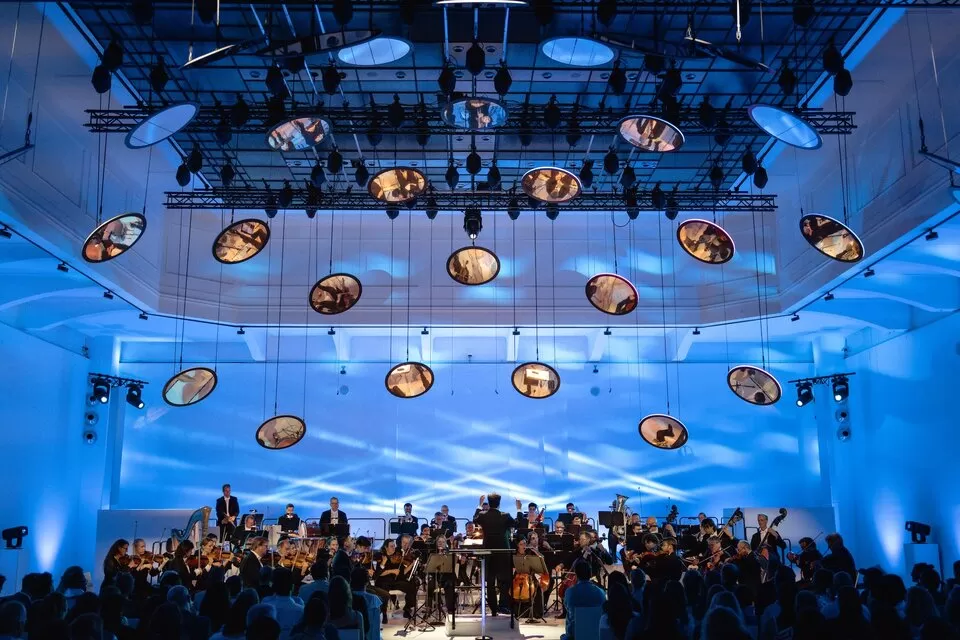 Vienna Symphony Orchestra performs The Blue Danube waltz on stage
Beyond the live concert and transmission, there was also an interactive project called SpaceNotes. Music lovers worldwide could “adopt” one of the waltz’s 13,743 individual musical notes. The name of each patron was transmitted into space alongside their chosen note. This showed just how many people wanted to be part of this cosmic musical journey, with participants from 92 countries claiming every note in less than two months.
 People gather at an outdoor event screening the Waltz into Space concert
Aiming for the Edge of Our Solar System
The transmission wasn’t just sent randomly; it was precisely aimed. The signal was directed towards the location of NASA’s Voyager 1 probe. Launched in 1977, Voyager 1 is the farthest human-made object in existence, currently over 25 billion kilometers (that’s 15.5 billion miles!) away from Earth.
Voyager 1 famously carries the Golden Record, a kind of cosmic time capsule containing sounds and images meant to tell any potential extraterrestrial life about Earth and its cultures. While The Blue Danube wasn’t on the original Golden Record, it has now caught up in spirit, traveling at the speed of light.
 People watch a screen showing the concert event at the Madrid Planetarium
The signal carrying the waltz reached Voyager 1’s current distance in under a day. Now, it will continue its journey endlessly through the interstellar medium. It will take over four years just to reach the Alpha Centauri star system, our closest stellar neighbor! This means The Blue Danube is truly on its way to becoming an interstellar melody.
 People gather to watch a large screen showing the concert event in Bryant Park, New York City
ESA Director General Josef Aschbacher highlighted the significance, saying this event shows that technology can transmit not just data, but also human art across vast distances. It’s a powerful reminder of how music, like space exploration, connects all of humanity.
Why The Blue Danube and Space?
The Blue Danube has a special connection to space exploration, largely thanks to its memorable use in Stanley Kubrick’s iconic film 2001: A Space Odyssey, where it accompanied a spacecraft docking sequence. Because of this, the waltz has become almost synonymous with humanity’s ventures into the cosmos.
This symbolic mission by ESA and the Vienna Tourist Board honors both this rich cultural heritage and our enduring dream of reaching for the stars. It’s a beautiful thought: a classic Viennese waltz, now echoing endlessly through the Universe, a testament to human creativity and our drive to explore the unknown.
Want to see how the transmission began? You can rewatch the WALTZ INTO SPACE concert online.





