
Where did some of the universe’s earliest ingredients go? Scientists are still searching for an answer to the puzzling cosmological lithium problem, a discrepancy between the amount of lithium-7 predicted by Big Bang models and what we observe in ancient stars. A new study using data from the International Space Station has eliminated one potential hiding place for this missing element, proving it’s not lurking in large quantities within cosmic rays. This means researchers must continue the hunt elsewhere, potentially by re-examining our models of the early universe or how we interpret stellar observations.
Contents
Lithium: A Peculiar Cosmic Ingredient
Unlike most elements, lithium has a unique cosmic history. It’s thought to be forged in at least three ways:
- During the first few minutes after the Big Bang.
- Inside stars through nuclear reactions.
- When high-energy cosmic rays collide with heavier atomic nuclei in space.
Scientists study the universe’s composition to understand its history. By looking at the oldest stars, which formed from the pristine material left over from the Big Bang, they can estimate the abundance of elements like lithium-7 created back then. However, these observations consistently show significantly less lithium-7 than our best models of the Big Bang predict. This gap is the cosmological lithium problem, and it challenges our fundamental understanding of the universe’s formation.
Hunting for Clues in Cosmic Rays
One theory proposed that the “missing” lithium-7 might be hiding in cosmic rays – high-energy particles that zoom through space. Cosmic rays are known to contain significant amounts of both lithium-6 and lithium-7. If a large portion of the Big Bang’s lithium-7 ended up in these cosmic travelers, it could potentially explain the observed shortage in old stars.
To test this idea, an international team of scientists turned to a powerful instrument: the Alpha Magnetic Spectrometer (AMS) on the International Space Station. The AMS is a unique space-based detector capable of measuring the properties of cosmic rays with unprecedented precision.
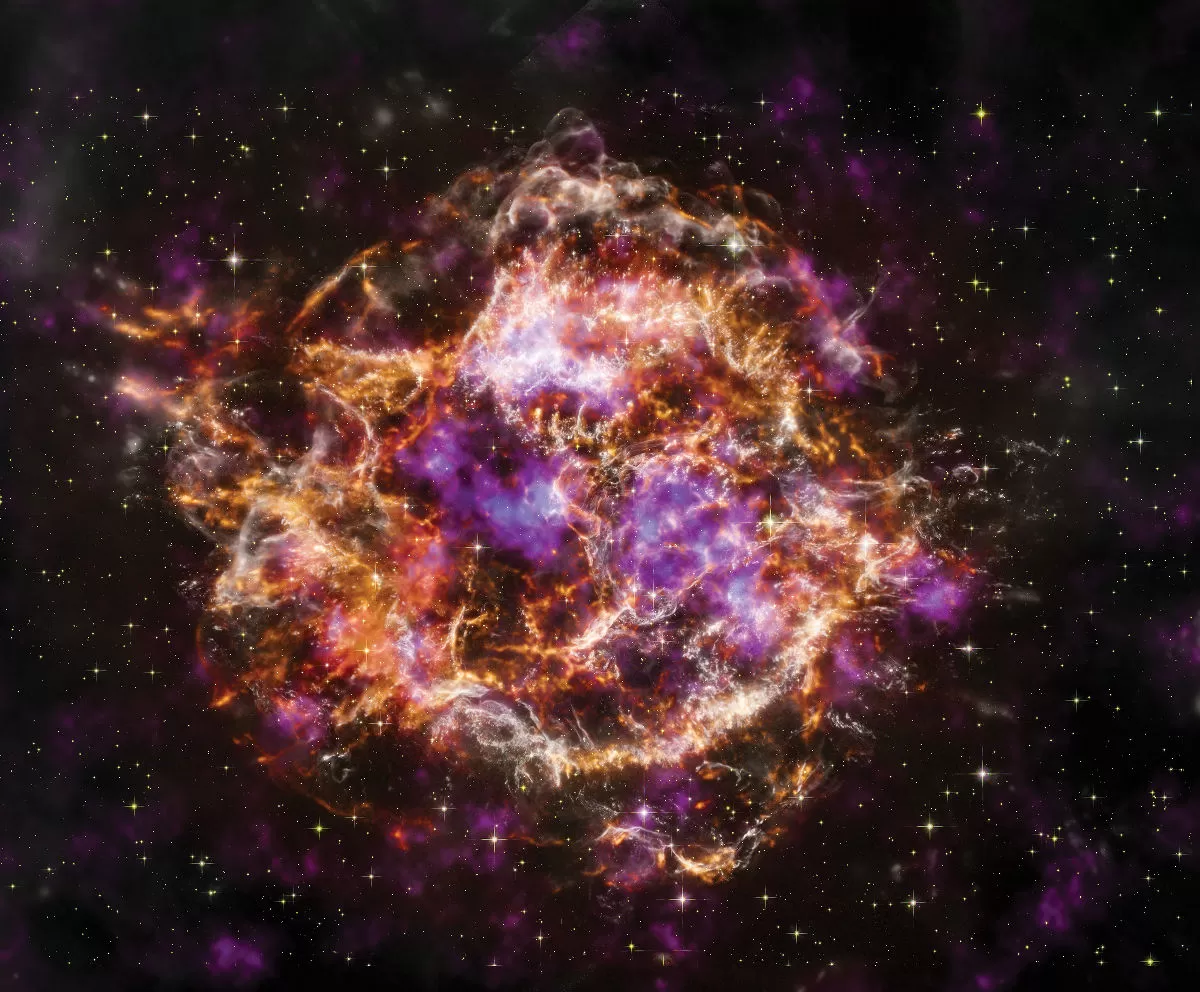 Vibrant image of supernova remnants Cassiopeia A, illustrating a potential source of cosmic rays that carry lithium through space.
What the Space Station Found
Over 12 years, the AMS collected data from 2 million lithium nuclei zipping through space. This extensive dataset allowed the researchers to make highly accurate measurements of the ratio of lithium-6 to lithium-7 in cosmic rays across a wide range of energies.
The results were conclusive and surprising to some. The teams analyzing the data all reached the same conclusion: the amount of lithium-6 and lithium-7 in high-energy cosmic rays is roughly equal, and this ratio remains constant. This is key because if cosmic rays were carrying a significant hidden stash of the Big Bang’s lithium-7, scientists would have expected to see a much higher proportion of lithium-7 compared to lithium-6.
As Katharina Lodders, a cosmochemist not involved in the study, commented, this analysis “eliminates one possibility of where the ‘missing’ 7Li could be hiding.” The study, published in Physical Review Letters (Phys. Rev. Lett. 2025, DOI: 10.1103/PhysRevLett.134.201001), provides strong evidence that the cosmological lithium problem cannot be solved by simply finding the missing lithium-7 in cosmic rays.
The Mystery Continues
This precise measurement, the first of its kind using a space-based magnetic spectrometer with velocity detection, confirms that cosmic rays aren’t the answer to the lithium puzzle. For astrophysicists like Brian Fields, who was already skeptical of the cosmic ray hypothesis based on other observations, the result wasn’t unexpected. Data, he notes, is the ultimate judge in science, and the AMS data is “super gorgeous” in its clarity.
So, where does the missing lithium-7 hide? Or is it missing at all? With the cosmic ray possibility largely ruled out, scientists must now look elsewhere. This could mean:
- Our models describing the first few minutes after the Big Bang need refinement.
- There’s something we don’t fully understand about how lithium is processed (created or destroyed) within the ancient stars we observe.
- Perhaps a different exotic process is at play in the early universe.
The cosmological lithium problem remains one of the most significant unresolved issues in cosmology. This new, precise measurement hasn’t solved it, but by confidently eliminating one potential solution, it sharpens the focus on where the true answer might lie, pushing scientists to rethink fundamental aspects of the universe’s earliest moments. The quest to balance the cosmic books of lithium continues.





