
Our bodies are full of surprising quirks – why do humans uniquely have a chin? And why are human testicles sized so differently compared to our primate cousins? Scientists studying the intricate paths of human evolution are beginning to find answers to some of these fascinating questions, revealing that understanding why we evolved specific features often depends on how many times that feature appeared across the tree of life. The key takeaway: studying features that evolved multiple times can unlock secrets about the evolutionary pressures that shaped us.
Contents
Climbing the Evolutionary Tree
Think of the history of life as a vast, branching tree. Every living species, including us, sits on a twig at the very end of one of these branches. As we trace our lineage back down the trunk, we visit older, wider branches representing the groups we share ancestry with. We were animals before becoming vertebrates, mammals before becoming primates, and so on.
Following this twisting path tells us the order in which our body parts appeared. Having a basic body plan and a gut (inventions of the animal branch) came long before backbones and limbs (the vertebrate branch). Milk and hair (mammals) evolved much earlier than fingernails (primates). This helps us understand the “how” – the sequence of evolutionary additions.
But figuring out the “why” – the evolutionary reason a feature emerged or took a specific form – can be trickier. One powerful tool for solving these “why” questions is when a particular trait evolves more than once, independently, in different branches of the tree of life.
The Power of Repeated Evolution
This independent evolution of similar traits is called convergent evolution. While it can sometimes confuse scientists trying to figure out which species are closely related, it offers a unique advantage: it’s like nature running the same experiment multiple times. If a trait appears repeatedly in different groups, scientists can look for common environmental pressures or behaviors shared by those groups.
A classic example comes from the surprisingly varied size of testicles among primates and other mammals. Consider two types of monkeys, the Abyssinian black and white colobus monkey and the bonnet macaque. Adult males of both species are roughly the same size.
Yet, their testicles are vastly different. Colobus monkey testicles weigh only about 3 grams, while macaque testicles can weigh a whopping 48 grams. This difference, like the variation seen between humans, gorillas, and chimpanzees, isn’t random.
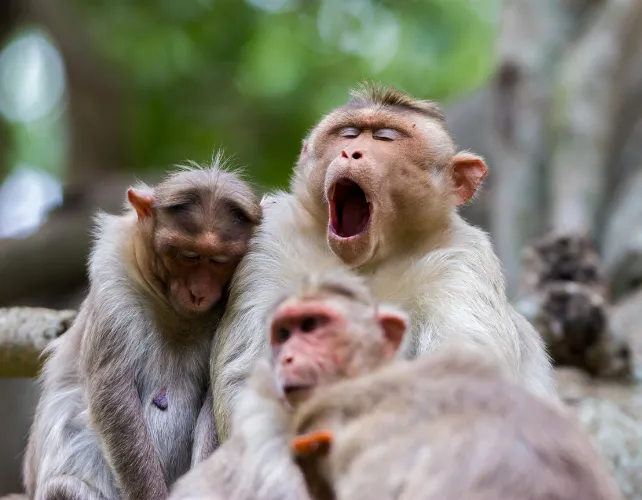 Three Bonnet macaques sitting together, illustrating a primate species with large testicles and promiscuous mating habits
The Case of the Curious Testicles
Several ideas might pop to mind to explain this difference. Maybe larger testicles are simply more attractive to females, like a peacock’s tail. However, a more plausible explanation relates to their mating habits.
A male colobus monkey typically defends a harem of females, meaning he is usually the only male they mate with. In this scenario, the competition for reproduction happens before mating – the strongest male wins exclusive access. Once he has the harem, he only needs to produce enough sperm to get the job done; there’s no competition between sperm from different males.
Macaques, on the other hand, live in larger, mixed groups where mating is more communal. Males and females mate with multiple partners – it’s a different approach to love centered on social bonding as much as reproduction. For a male macaque, the real competition happens after mating, inside the female reproductive tract, as his sperm battles the sperm of other males who have also mated with her.
In this “sperm competition” scenario, making more sperm increases a male’s chance of fathering offspring. And producing more sperm requires bigger testicles.
Is this explanation correct? This is where convergent evolution provides the answer. When scientists look across the whole mammal branch of the tree of life, they see this pattern repeated again and again. Promiscuous species consistently have larger testicles relative to their body size, while species with more exclusive mating systems have smaller ones.
A silverback male gorilla, who commands sole access to his group’s females, has small testicles. Highly promiscuous chimpanzees and bonobos have much larger ones. Dolphins, with potentially the biggest mammalian testicles relative to body weight (up to 4%), engage in complex mass mating events. Thanks to these multiple natural experiments across different mammal groups, we can be confident that testicle size is strongly linked to mating strategy. And for humans? Our testicle size falls somewhere in the middle – make of that what you will!
But What About the Human Chin?
Now consider the human chin. Unlike testicle size which varies but is present in many mammals, the prominent, bony chin jutting from the front of the jaw is unique to Homo sapiens. It is found in no other mammal, not even our closest extinct relatives like the Neanderthals.
This anatomical singularity has made the chin fertile ground for arguments among scientists about its purpose. Was it to strengthen the jaw for ancient chewing needs? Perhaps it evolved to make a manly beard look more impressive. One intriguing idea suggests it’s simply a by-product of changes in jaw structure due to softer cooked food – a leftover bump on a receding tide of jawbone.
Why Uniqueness Makes it Hard
While we have these plausible hypotheses, the uniqueness of the human chin presents a scientific challenge. Because it only evolved once, in our lineage alone, we lack the multiple independent examples that convergent evolution provides. We can’t compare chin presence and size across various mammal groups with different diets or social structures to see if a consistent pattern emerges.
Without these natural, repeated experiments, it’s incredibly difficult to definitively test which of the proposed explanations for the human chin’s evolution is correct. It remains one of those fascinating parts of human anatomy whose why is still shrouded in mystery.
So, while convergent evolution provides powerful clues about traits like testicle size across mammals, unique features like the human chin remind us that some parts of the story of human evolution are still waiting to be fully understood. Dive deeper into the mysteries of animal evolution or explore more about our primate cousins to uncover more surprising connections!





