The Moon, our closest cosmic neighbor, is the most familiar sight in the night sky. While we see its face change night after night, there’s more to a full moon than just being fully lit. For centuries, people have observed the full moon and given it unique names, connecting celestial events to the rhythm of life on Earth. These full moon names offer a glimpse into how ancient cultures tracked time and understood their world through the sky.
Contents
The Moon orbits Earth, and its phases – from a sliver to a full disk and back again – are caused by our perspective as the Sun lights different parts of its surface. When the Moon is directly opposite the Sun in the sky, it’s fully illuminated, presenting us with a full moon.
Observing the Moon: Phases and Features
While a full moon is a stunning sight, it’s not always the best time for astronomers using telescopes. When the Moon is fully illuminated, sunlight hits its surface directly. This flattens the appearance of craters and mountains, making the surface look quite two-dimensional – like circles on a circle.
For detailed observation of lunar terrain, the best time is around the terminator. This is the dividing line between the lit and unlit sides of the Moon. Here, sunlight hits features at an angle, creating long, dramatic shadows that highlight mountains, valleys, and crater rims, making the landscape pop with three-dimensional detail.
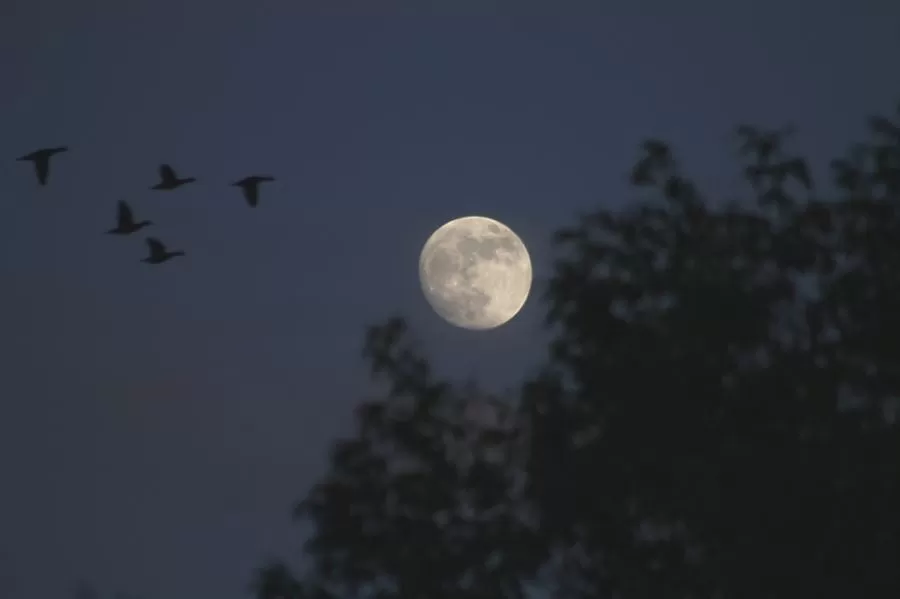 Two geese silhouetted against a large, bright full moon rising above trees
Why Do Full Moons Have Different Names?
The tradition of giving specific names to each month’s full moon dates back hundreds of years. Many early Native American tribes used the Moon as a calendar, with each full moon marking the passage of a month and reflecting the natural events or activities happening during that time of year. These names were passed down and are still commonly referenced today, notably in publications like the Farmer’s Almanac.
These names tell a story of the seasons and the life they supported. For example, a name might refer to when certain animals were hunted, crops were harvested, or weather patterns occurred.
Here are some of the traditional full moon names:
- January: Full Wolf Moon (referencing hungry wolves howling)
- February: Full Snow Moon (due to heavy snows)
- March: Full Worm Moon (as earthworms begin to appear)
- April: Full Pink Moon (after ground phlox, an early spring flower)
- May: Full Flower Moon (when flowers bloom abundantly)
- June: Full Strawberry Moon (marking the ripening of strawberries)
- July: Full Buck Moon (when male deer grow new antlers)
- August: Full Sturgeon Moon (referencing fish populations)
- September: Full Corn or Harvest Moon (time for gathering crops)
- October: Full Hunter’s Moon (time for hunting after harvest)
- November: Full Beaver Moon (time to set beaver traps before waters freeze)
- December: Full Cold Moon (marking the onset of winter)
Special Lunar Events: Blue Moons and Super Moons
Sometimes, the calendar lines up in a unique way, leading to special terms for the full moon.
A Blue Moon isn’t actually blue! It refers to the rare occurrence of a second full moon within the same calendar month. Since a lunar cycle is about 29.5 days, and months have 30 or 31 days (except February), occasionally a full moon early in a month will be followed by another full moon towards the end. This happens roughly every two and a half years.
A Super Moon is a more recent term, coined by an astrologer in 1979. It describes a full moon that happens when the Moon is also at its closest point to Earth in its elliptical orbit. The Moon’s orbit isn’t a perfect circle; it varies in distance by about 50,000 kilometers. When a full moon coincides with this closest approach (called perigee), it can appear up to 14% larger and 30% brighter than a full moon that occurs when the Moon is farthest away (at apogee).
 Close-up view of the moon's surface, showing numerous craters and the contrast between lit and shadowed areas near the terminator
Connecting with the Cosmos
Because of a phenomenon called tidal locking, we always see the same side of the Moon from Earth. So, the next time you look up at a full moon – whether it’s the Wolf Moon in January or the Harvest Moon in September – remember that you are seeing the exact same familiar face that people have gazed upon and named for centuries. These names serve as a reminder of humanity’s long-standing connection to the cosmos and the cycles of nature.
The study of the Moon continues to reveal new wonders, but appreciating the rich history behind its observation adds another layer of depth to our view of the night sky. Keep looking up!