
More than a century ago, a colossal explosion ripped through the sky over Siberia, flattening forests for miles around. It remains the largest cosmic impact event in recorded history. Today, recent satellite images from NASA offer a unique perspective on this enigmatic site, reminding us of the power of space rocks and humanity’s efforts to prepare.
Contents
This article delves into the mystery of the Tunguska event, explores why scientists believe it was an airburst without a crater, and highlights how this historical event fuels modern efforts to track and potentially deflect dangerous near-Earth objects.
The Day the Sky Exploded Over Siberia
Imagine the morning of June 30, 1908. In the remote taiga forest of Eastern Siberia, the quiet is shattered. A fiery ball streaks across the heavens at incredible speed. Eyewitnesses, though far from the epicenter, described a terrifying sight: the sky splitting open, a light brighter than the sun, followed by deafening bangs and a blast of heat that knocked people off their feet.
One chilling account tells of the northern sky appearing “covered with fire.” Another describes heat so intense it felt like clothing had caught fire, followed by a “mighty crash” and a tremor that shook the earth. People ran for cover, fearing stones falling from the sky. Windows were blown out, and buildings sustained damage miles away.
This was the Tunguska event, a blast powerful enough to decimate over 830 square miles of forest. Yet, unlike other large impacts, scientists found something puzzling when they finally reached the remote site nearly two decades later: no crater.
The Mystery of the Missing Crater
Expeditions to the Tunguska site found a scene of devastation: millions of trees were flattened radially outward from a central point, like spokes on a wheel. Curiously, trees directly at the center remained standing but were stripped bare of branches and bark. The pattern suggested an explosion high above the ground.
Scientists now widely believe the Tunguska event was caused by an asteroid or comet that exploded in a massive “airburst” several miles above the surface. The object, estimated to be around 50 meters (about 164 feet) in diameter, disintegrated before hitting the ground, releasing energy equivalent to dozens of megatons of TNT – enough to level a modern city.
 NASA satellite image showing the 1908 Tunguska event blast site in the Siberian forest
Why an airburst? Because the object broke apart in the atmosphere due to immense pressure and heat. This distributed the energy across a wider area high above the ground, causing the widespread tree-flattening but preventing a concentrated impact that would dig a crater. Evidence supporting this theory includes microscopic particles found in tree resin decades later, suggesting extraterrestrial material. Some researchers still debate if a lake in the area might be a small crater from a fragment, but no definitive proof exists.
Remarkably, over a century later, satellite imagery obtained last summer by NASA’s Operational Land Imager (OLI) on Landsat 8 shows the vast scale of the affected area, yet with no obvious scar of an impact crater visible from space – a lasting testament to the airburst phenomenon.
From Mystery to Modern Watchfulness
The Tunguska event, despite its remoteness, became a stark global reminder: our planet is not immune to cosmic visitors. While statistically rare, impacts, especially airbursts like Tunguska or larger, pose a potential threat. This awareness led to the recognition of June 30 as International Asteroid Day, promoting education and international cooperation in planetary defense.
Scientists today are actively scanning the skies for near-Earth objects (NEOs) – asteroids and comets whose orbits bring them close to Earth’s path. NASA’s catalog of known near-Earth asteroids now numbers over 38,000 and is growing rapidly thanks to advanced telescopes. The new Vera C. Rubin Observatory, with its massive digital camera, is expected to find hundreds of thousands, possibly millions, more.
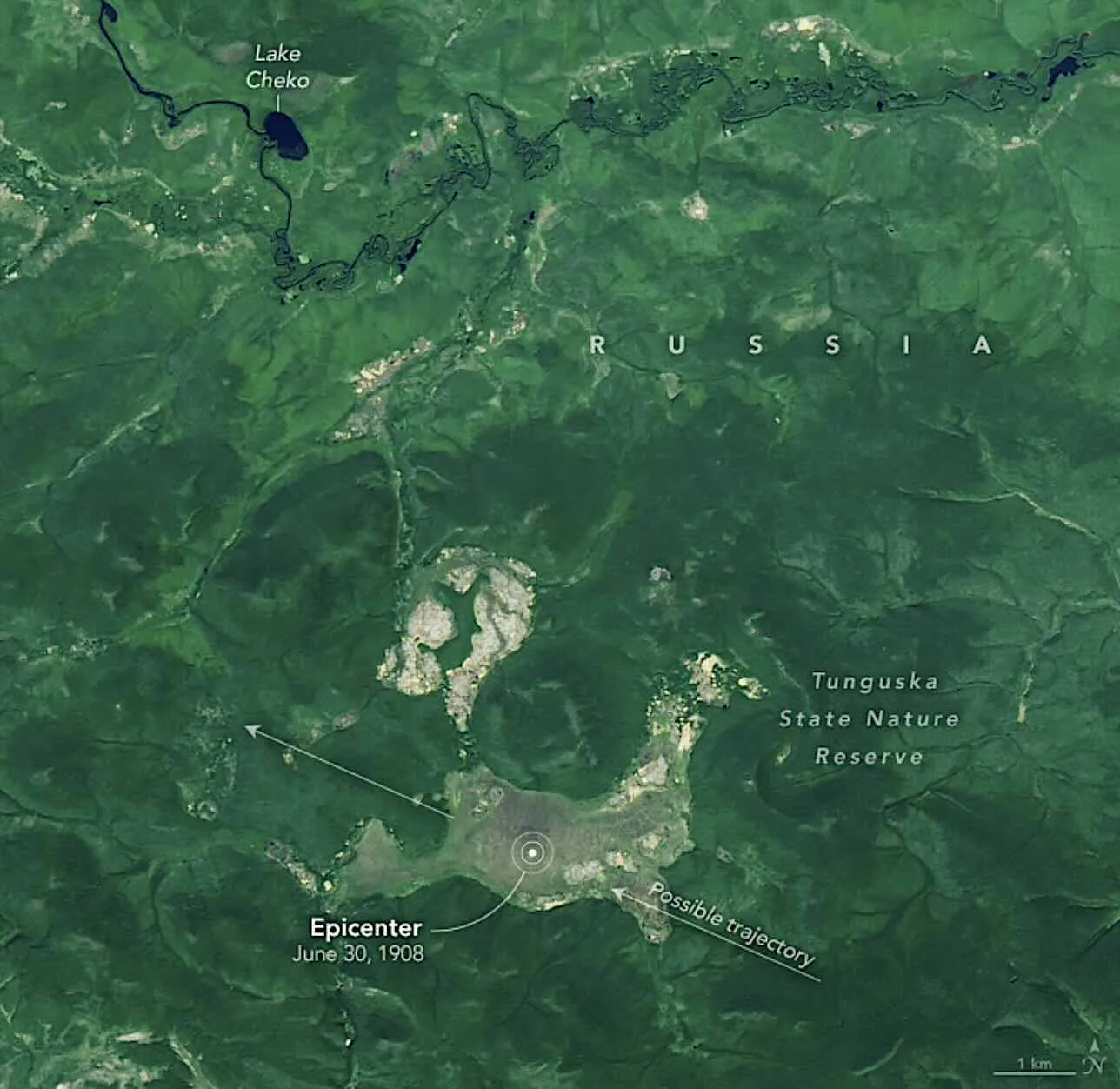 Detailed map overlaying the area surrounding the 1908 Tunguska blast site with landmarks
While most NEOs pose no danger, identifying those that could potentially threaten Earth is crucial. This led NASA to create the Planetary Defense Coordination Office (PDCO) in 2016. Their mission: to detect, track, and characterize potentially hazardous NEOs and coordinate responses.
This work gained urgency after the 2013 Chelyabinsk event over Russia. A smaller asteroid created an airburst far less powerful than Tunguska but still incredibly forceful – estimated to be 33 times stronger than the Hiroshima atomic bomb. It caused widespread damage and injuries, proving that even relatively small objects can pose a significant local threat.
Working Together to Protect Earth
Events like Tunguska and Chelyabinsk underscore the need for global collaboration. Space agencies and organizations worldwide are working together. The UN’s Office for Outer Space Affairs (UNOOSA) supports initiatives like the International Asteroid Warning Network (IAWN) and the Space Mission Planning Advisory Group (SMPAG). These groups facilitate sharing information about potential threats and coordinate planning for response, including crisis communication.
Although detecting and tracking NEOs is a continuous process, the lessons from the 1908 Siberian blast are clear: vigilance is key. By understanding past events like Tunguska and investing in modern detection and defense systems, humanity is taking steps to protect our planet from one of space’s most unpredictable dangers.
Curious to learn more about threats from space? Check out these related articles:
- Was Mars Ever Home to Alien Life? NASA Unveils Groundbreaking Insights on How Mars Became Uninhabitable
- NASA Earth Observing Satellite Mission Spots Mysterious Impact Structure in Remote Australian Outback





