
Imagine structures so vast they dwarf entire galaxy groups. These are Giant Radio Galaxies, the largest individual objects known to exist in the cosmos. Now, astronomers using Australia’s ASKAP telescope have discovered a remarkable collection of 15 new ones, providing crucial clues about how these titans grow to such incredible sizes.
Contents
This discovery, made within a region of space called the “Sculptor Field,” reveals examples spanning from 3.7 million up to a staggering 12.4 million light-years across. To put that into perspective, our own Milky Way galaxy is only about 100,000 light-years wide. The largest new galaxy found, designated ASKAP J0107–2347, is more than 117 times wider than our galactic home!
What Makes a Radio Galaxy “Giant”?
At the heart of most large galaxies lies a supermassive black hole. When these black holes actively consume surrounding gas and dust, they form a bright, energetic region called an Active Galactic Nucleus (AGN). This process can launch powerful jets of charged particles moving at near-light speeds out from the galaxy’s core.
 A depiction of a supermassive black hole with jets
These jets travel millions of light-years into intergalactic space, interacting with the sparse gas there and creating vast “lobes” that emit strong radio waves. Radio galaxies are common, but what sets Giant Radio Galaxies apart is the sheer scale of these lobes, stretching over 2.3 million light-years and sometimes much, much further.
The mystery is: How do these lobes get so big?
Unlocking Cosmic Secrets with ASKAP
Understanding the growth of Giant Radio Galaxies requires sensitive telescopes that can see these faint, extended structures. This is where the ASKAP (Australian Square Kilometre Array Pathfinder) telescope array excels. Located in Western Australia, ASKAP uses advanced technology to capture incredibly detailed, wide-field radio images of the sky.
ASKAP’s unique receivers allow it to survey vast areas of the cosmos much faster than previous telescopes. “Each image produced by ASKAP is a treasure trove!” says Baerbel Silvia Koribalski, team leader and researcher at Western Sydney University.
 The array of CSIRO ASKAP radio telescopes in Western Australia
The study focused on a deep field around the nearby Sculptor galaxy (NGC 253), revealing not just the 15 new Giant Radio Galaxies, but also offering detailed views of their shapes and structures.
Clues from Nested Lobes
One particularly fascinating find was ASKAP J0107–2347, located about 1.5 billion light-years away. This colossal galaxy features two distinct sets of radio lobes: bright, shorter inner lobes nestled within fainter, elongated outer lobes.
This “nesting doll” structure provides a key clue. Scientists believe that supermassive black holes don’t feed and launch jets continuously. They can switch on and off. The faint outer lobes likely represent an older period of activity, while the brighter inner lobes and visible jets indicate a recent “recharge.”
What causes these black holes to switch activity? Galaxy mergers are thought to play a role, providing new fuel to the central black hole. The environment surrounding the galaxy, sometimes called “cluster weather” in dense galaxy clusters, can also influence the jets and lobes, stopping their expansion or sculpting them into complex shapes.
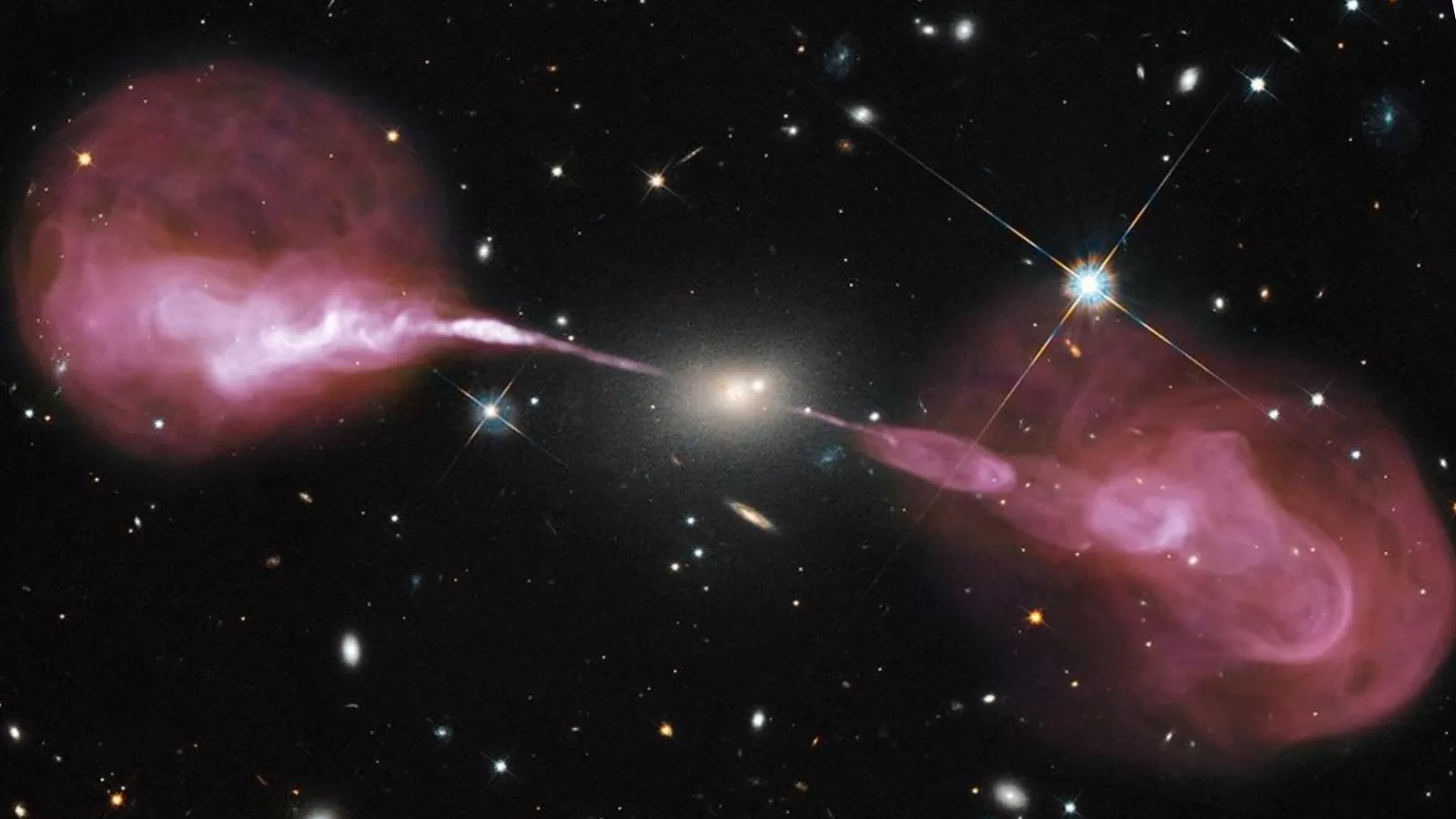 A vast Giant Radio Galaxy with its extended lobes, as seen by multiple telescopes
ASKAP’s ability to detect these faint, older lobes, which are often missed by shallower surveys, is crucial for this kind of “galactic archaeology”—studying the history of galaxies through their structures.
The Future of Giant Discoveries
The discovery of these 15 Giant Radio Galaxies, especially examples like ASKAP J0107–2347 with its tell-tale nested lobes, is helping astronomers map the lifecycle of these cosmic giants. It supports the idea that they grow by repeatedly turning their powerful jets on and off.
With its ongoing sky surveys, ASKAP is expected to find many more of these rare and enormous objects, both nearby and in the distant universe. Each new discovery adds a piece to the puzzle, bringing us closer to understanding how the largest single structures in the cosmos came to be.
A preprint of the team’s research is available on the paper repository site arXiv.





