
Step into the cosmos and discover a celestial beauty: the Dumbbell Nebula, also known as M27. This stunning cloud of gas isn’t a planet, but the glowing remnant of a star like our Sun nearing the end of its life, appearing like a shimmering dumbbell or bow tie in the night sky. As the first planetary nebula ever discovered, finding M27 offers a unique connection to astronomical history and the lifecycle of stars.
What is the Dumbbell Nebula?
Imagine a star shedding its outer layers into space, creating a colorful cosmic bubble. That’s essentially what a planetary nebula is, despite the misleading name given before their true nature was understood. M27 is a prime example, located about 1,200 light-years away in the constellation Vulpecula (the Little Fox), nestled near Sagitta (the Arrow).
Discovered by Charles Messier in 1764, M27 was the very first object of its kind cataloged, opening astronomers’ eyes to a whole new class of celestial phenomena. Visually, it appears distinctly pinched in the middle with brighter lobes on either side – hence the “Dumbbell” or “Bow Tie” shape. This appearance is thought to be caused by the star expelling material more quickly along its poles than its equator, perhaps influenced by its rotation or even a hidden companion star. Deeper photographs reveal this brighter region is embedded within a fainter, spherical shell of gas.
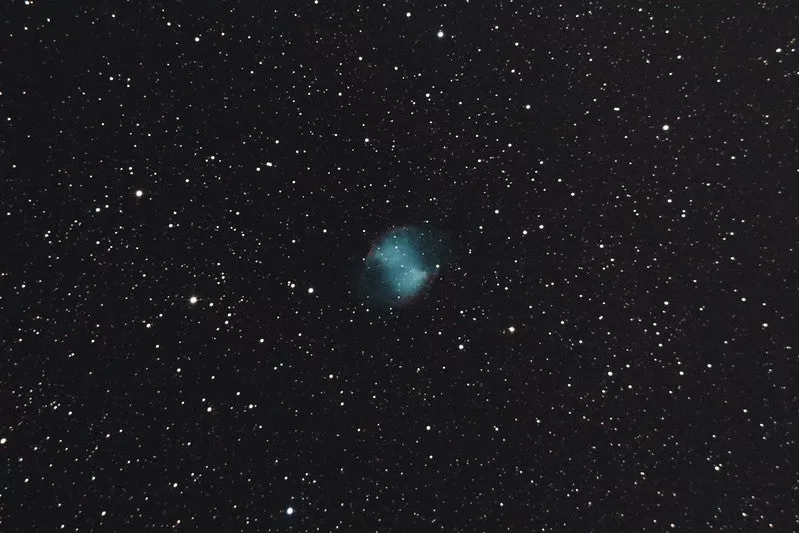 Detailed image of the Dumbbell Nebula (M27) in space, highlighting its colorful gas clouds forming a dumbbell or bow-tie shape
Shining at magnitude 7.4, M27 is bright enough to be seen with binoculars or a small telescope. It stretches about 8 by 6 arcminutes across the sky – roughly the size of a small coin held at arm’s length.
How to Find M27 in the Night Sky
Finding the Dumbbell Nebula is a rewarding challenge for stargazers. It’s typically best seen during the warmer months in the Northern Hemisphere, visible high in the southern sky in the predawn hours or earlier in the evening as the season progresses.
A great starting point is the bright star Altair in the prominent constellation Aquila (the Eagle). From Altair, look roughly 11 degrees north (about two binocular fields of view) to find Gamma (γ) Sagittae, a magnitude 3.5 star marking the tail of the Arrow. From Gamma Sagittae, it’s just a short hop of about 3.2 degrees further north to locate the Dumbbell Nebula.
If you’re using a telescope, start with a low-power eyepiece to easily find the nebula’s distinctive shape. Once you’ve located it, switch to a higher-power eyepiece to examine its details and structure. For those with larger telescopes (10 inches or more in aperture), try to spot the faint, magnitude 13 white dwarf star at the very center – this is the dense, hot core of the star that created the nebula!
Why the Dumbbell Nebula Matters
Beyond its visual appeal, M27 holds significant importance in astronomy. As the first planetary nebula ever identified, its discovery helped astronomers understand the complex ways stars evolve and die. It provided crucial evidence for the theory that stars like our Sun shed their outer layers at the end of their lives, enriching the galaxy with elements forged in their cores. Studying objects like M27 helps us predict the fate of our own Sun billions of years from now.
Its enduring beauty and accessibility to amateur astronomers also make it a beloved target, inspiring new generations to look up and explore the wonders of the universe.
For help navigating the night sky and finding M27, or to plan your stargazing sessions, check out resources like our Sky This Week column for up-to-date guides. Good luck hunting for this cosmic marvel!