
Imagine a star system where seven rocky planets, all about the size of Earth, huddle close to their sun. This is the TRAPPIST-1 system, located just 40 light-years away. A new study suggests these intriguing worlds could harbor surprisingly large, but wildly varying, amounts of water – a key ingredient in the search for life beyond Earth. The potential for water hinges on how much gas, including water vapor, is released from inside the planets through volcanic activity. This finding highlights the incredible diversity possible among exoplanets and offers new avenues for future exploration.
Contents
A System of Seven Earth-Sized Worlds
The TRAPPIST-1 system is unique. It hosts seven known planets that are similar in mass and radius to our own planet. They orbit a cool, small star known as a red dwarf, the most common type of star in our Milky Way galaxy. Because the star is much dimmer than our sun, these planets orbit very closely to stay warm. Three of the seven planets are located within the “habitable zone,” the region where temperatures might allow liquid water to exist on a planet’s surface.
The big question is: Do any of these planets actually have water? And if so, how much?
The Role of Volcanic Activity
Scientists still don’t have direct proof of oceans or abundant water on these distant worlds. However, a new study led by Trent Thomas at the University of Washington, involving researchers from NASA Ames Research Center, explores one way these planets could get and keep water: through volcanic outgassing.
Think of volcanic outgassing like a planet “breathing” out gases from its interior. On Earth, volcanoes release water vapor and other gases that contribute to our atmosphere and oceans over billions of years. The researchers used models based on volcanic activity seen on rocky planets in our own solar system to estimate how much water could be released on the TRAPPIST-1 planets. They then compared these models to existing observations of the system, likely including data from NASA’s James Webb Space Telescope, which has been observing these planets.
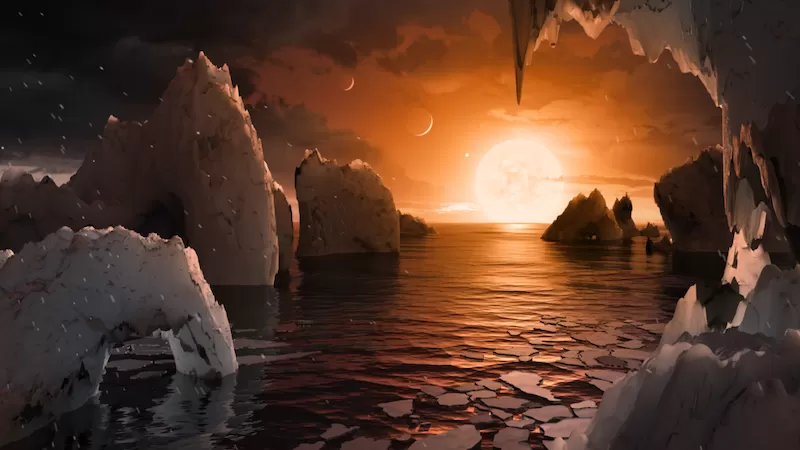 Artist's concept of TRAPPIST-1f surface, showing potential ocean, icy structures, and the large red host star on the horizon.
From Barren Rock to Water Worlds?
What the study found is fascinating: The amount of volcanic outgassing could vary dramatically from one TRAPPIST-1 planet to the next. The models suggest activity could be as low as just 0.03 times the rate on Earth, or as high as eight times greater. This wide range means the planets could be incredibly diverse in their water content.
Some planets might be dry and barren, while others could have shallow oceans, and still others might be “ocean worlds” completely covered in deep water. The study suggests that if outgassing rates are high enough, they could potentially replenish water lost to space over long periods, allowing planets to maintain surface oceans or atmospheres with water vapor.
The research indicates that while low volcanic activity is plausible for many of the planets, the possibility of much higher rates (even ten times Earth’s) cannot be ruled out. This variability likely extends to their internal structure and composition.
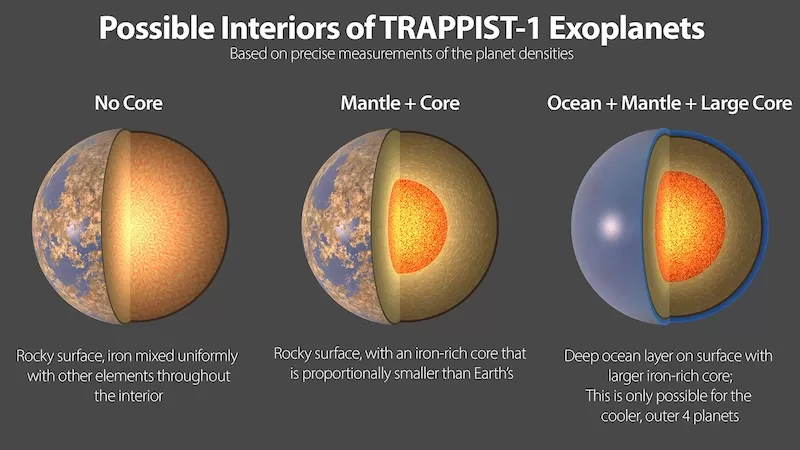 Diagram showing possible interior structures of TRAPPIST-1 planets, from dry rock to layers with water or deep oceans.
Compared to Earth, where water makes up only a tiny fraction (about 0.02%) of our planet’s total mass, the TRAPPIST-1 planets could potentially hold much more – perhaps up to 1% of their mass in water, especially at the higher end of estimates.
This variability is supported by other observations. For instance, the James Webb Space Telescope found that the two innermost planets, TRAPPIST-1 b and TRAPPIST-1 c, likely lack thick atmospheres. However, even without a thick atmosphere, these planets could still hide water beneath their surfaces or have thin atmospheres containing water vapor or oxygen, according to the study.
Implications for Other Worlds
The findings from this study aren’t just limited to the TRAPPIST-1 system. Since red dwarf stars are so common, understanding the potential for water and geological activity on their rocky planets is crucial for the broader search for habitable worlds.
The models used in this study could apply to other exoplanets of similar size, mass, and age orbiting red dwarfs. They provide a theoretical basis for how rocky planets around these stars could potentially maintain surface oceans or thin, water-rich atmospheres, even given the challenges like strong stellar radiation early in the star’s life.
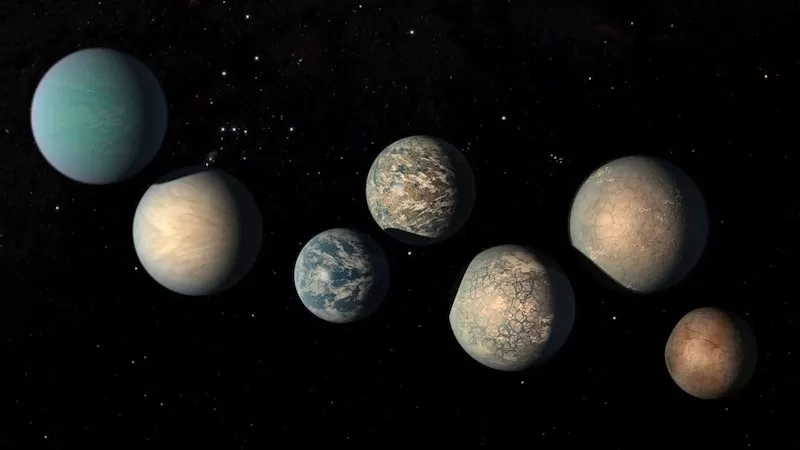 Artist's illustration depicting the seven rocky, Earth-sized planets of the TRAPPIST-1 system orbiting their red dwarf star.
As telescopes like the James Webb Space Telescope continue to observe these fascinating neighbors, we will undoubtedly learn more about their atmospheres, composition, and whether liquid water, or even life, could exist on these distant worlds.
This new research published in The Planetary Science Journal adds another layer to the complex picture of the TRAPPIST-1 planets, suggesting they are far from uniform and could hold surprising secrets beneath their surfaces.
Want to learn more about these exciting planets? Check out Are the TRAPPIST-1 exoplanets habitable, or not? and Exoplanet TRAPPIST-1 b might have a hazy atmosphere.





