
Scientists and archaeologists continue to peel back the layers of time and space, revealing incredible insights into our planet, ancient civilizations, and the mysterious universe around us. From uncovering unexpected gold hidden deep within Earth to finding traces of lost history and detecting bizarre signals from across the cosmos, recent discoveries highlight the relentless pace of human curiosity and exploration. These breakthroughs help us understand our past, present, and future, connecting distant cosmic events to the very ground beneath our feet.
Contents
- Digging Into Ancient History: Lost Treasures in Jerusalem
- Earth’s Fiery Heart Might Be Leaking Gold
- Reaching for the Stars: Starship’s Journey
- An Unexpected Ocean Gathering: Sharks Share a Meal
- Signals from the Cosmos: A Mysterious Deep-Space Object
- Unearthing Tombs in Ancient Egypt
- More Science Stories Making Headlines
Digging Into Ancient History: Lost Treasures in Jerusalem
For centuries, a significant piece of Jerusalem’s rich history remained frustratingly elusive: evidence from the Early Hellenistic Period, roughly 332 to 141 BC. Ancient texts hinted at the city’s life under Greek influence, but solid archaeological proof was scarce.
That changed dramatically during excavations at the Jerusalem Walls National Park. Within a year, excavators unearthed something truly unexpected: two small gold rings, perfectly preserved and set with gleaming red gemstones. They were so pristine, archaeologists initially thought they were modern artifacts.
These beautiful rings, now confirmed to be around 2,300 years old, offer a tangible link to this “missing” historical era. Researchers believe the rings may have been intentionally buried by young women, possibly as part of a coming-of-age tradition or ritual preceding marriage. Alongside other objects found at the site, these precious finds are starting to paint a clearer picture of daily life and cultural practices in Jerusalem during a time of significant Greek presence.
Earth’s Fiery Heart Might Be Leaking Gold
Imagine Earth as a giant, rocky candy with a molten, metallic center. Most of the good stuff – like gold and platinum – is thought to be locked away in that super-hot core, making up over 99.95% of the planet’s supply. So, how did we get precious metals closer to the surface where we can find them?
A new study looking at volcanic rocks from Hawaii suggests a fascinating answer: tiny amounts of these valuable metals might be slowly escaping the core and making their way towards the mantle.
By analyzing these rock samples, researchers found traces of a rare, silver-gray metal similar in rarity to gold. This metal was likely more abundant in the early “ingredients” that built Earth around 4.5 billion years ago, back when the core was forming. As volcanic islands erupt and grow over millions of years, magma carrying these deep-Earth materials rises, eventually bringing gold and other metals closer to the surface. Scientists speculate that if the core is still “leaking” these metals, albeit in minuscule amounts, it could explain some of the precious metal distribution in the crust over geological timescales. It’s a slow process, but a compelling idea that helps us understand our planet’s deep internal dynamics.
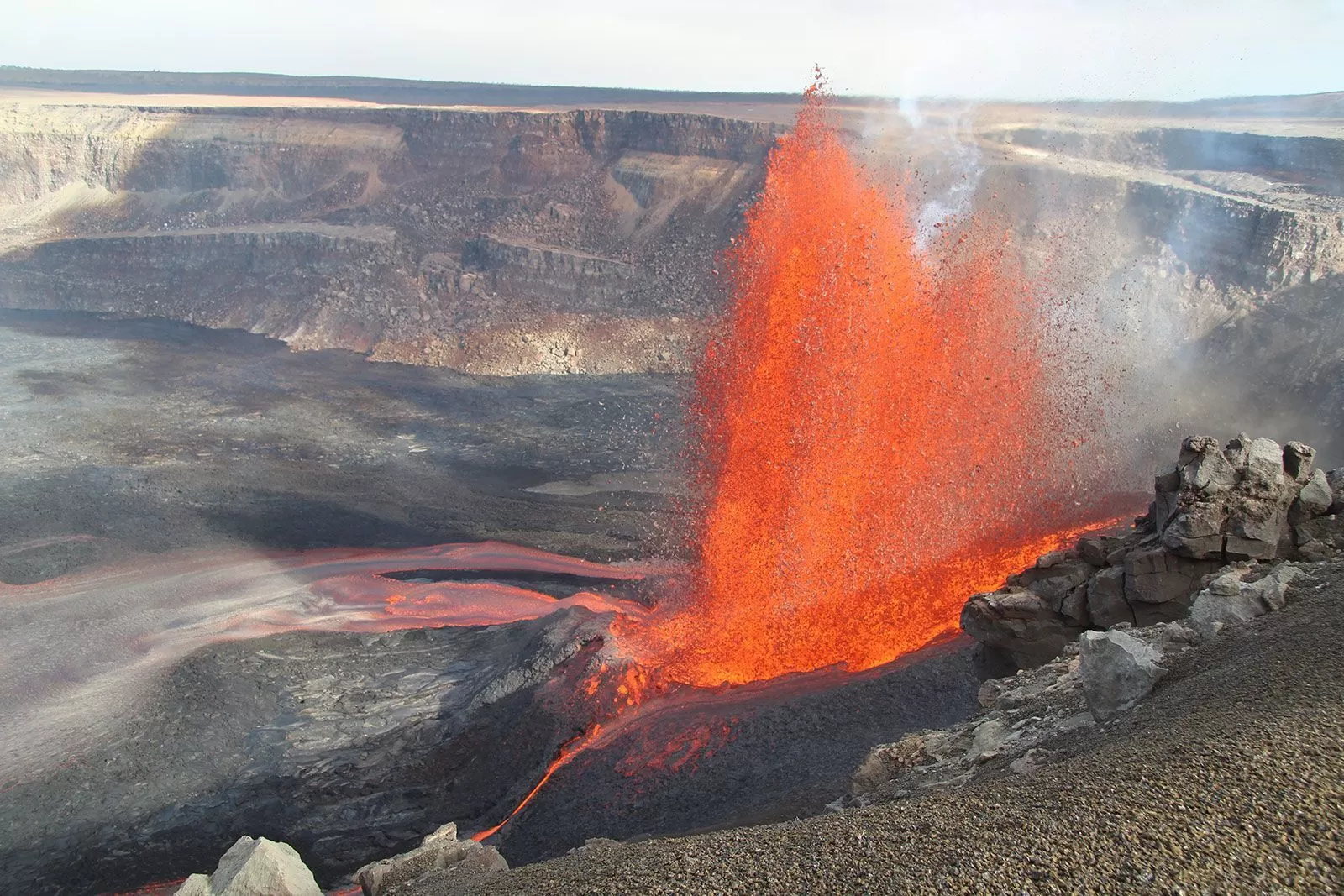 Kilauea volcano lava fountain, potentially showing gold-rich magma escaping Earth's core
Reaching for the Stars: Starship’s Journey
Space exploration continues to push the boundaries of technology. The world recently watched the ninth test flight of SpaceX’s Starship, designed to be the most powerful rocket ever built. This flight marked a significant milestone: it was the first time a Super Heavy booster was reused for a launch.
While the spacecraft traveled farther than in previous tests, the mission faced challenges. It didn’t achieve all key objectives, such as deploying test satellites or successfully reigniting its engines in space. Ultimately, mission control lost contact with Starship, and it spun out of control during its reentry back into Earth’s atmosphere. These test flights are crucial steps in the iterative process of developing complex spacecraft like Starship, providing valuable data that informs future design and missions aimed at reaching destinations like the Moon and Mars.
An Unexpected Ocean Gathering: Sharks Share a Meal
Sharks often have a reputation as solitary hunters, fiercely guarding their territory and kills. However, nature sometimes surprises us.
Off the coast of Hawaii’s Big Island, observers captured remarkable footage that defies this common perception. The video showed a peaceful feeding frenzy involving at least 12 sharks from two different species, sharing a single feast for over eight hours without conflict. This unusual gathering provides scientists with new insights into the complex social behaviors and feeding dynamics of these apex predators, suggesting that under certain circumstances, sharks may exhibit more cooperative or tolerant behavior than previously understood.
Signals from the Cosmos: A Mysterious Deep-Space Object
The universe is full of cosmic mysteries, and astronomers are constantly listening for faint whispers from across the vastness of space. Recently, an unusual object named ASKAP J1832-0911 caught their attention. This object is emitting powerful flashes of radio waves with remarkable regularity, pulsing every 44 minutes.
This rhythmic behavior places it potentially into a newly recognized category of celestial phenomena called long-period transients – objects that flare up periodically over hours or days, much slower than typical pulsars or fast radio bursts. But ASKAP J1832-0911 has another trick up its sleeve: it also emits powerful X-rays, detected by NASA’s Chandra X-ray Observatory. This combination of long-period radio pulses and high-energy X-rays makes it truly unique. According to Dr. Andy Wang from the Curtin Institute of Radio Astronomy, “This object is unlike anything we have seen before.” Studying such rare objects helps astronomers understand the extreme physics at play in the universe, potentially involving exotic objects like magnetars or unusual binary star systems.
Unearthing Tombs in Ancient Egypt
Ancient Egypt continues to yield incredible secrets, offering glimpses into a sophisticated and complex civilization that thrived thousands of years ago. Recent excavations in Luxor, home to some of Egypt’s most famous archaeological sites, have revealed three previously undiscovered tombs within an ancient burial complex.
These burial chambers are located in the Dra’ Abu el-Naga necropolis, a site historically reserved not for royalty, but for prominent non-royal individuals. The tombs date back to Egypt’s New Kingdom period, a powerful era spanning from around 1539 to 1077 BC. Inside, researchers were greeted by stunningly preserved painted figures, hieroglyphs, and detailed inscriptions.
These intricate decorations and texts aren’t just beautiful art; they are historical records. They have allowed researchers to identify the names, titles, and occupations of the people buried there, providing invaluable details about the lives, social structure, and beliefs of the non-elite class during this significant period of Egyptian history. Each discovery helps piece together the vibrant tapestry of life in ancient Egypt beyond the pharaohs.
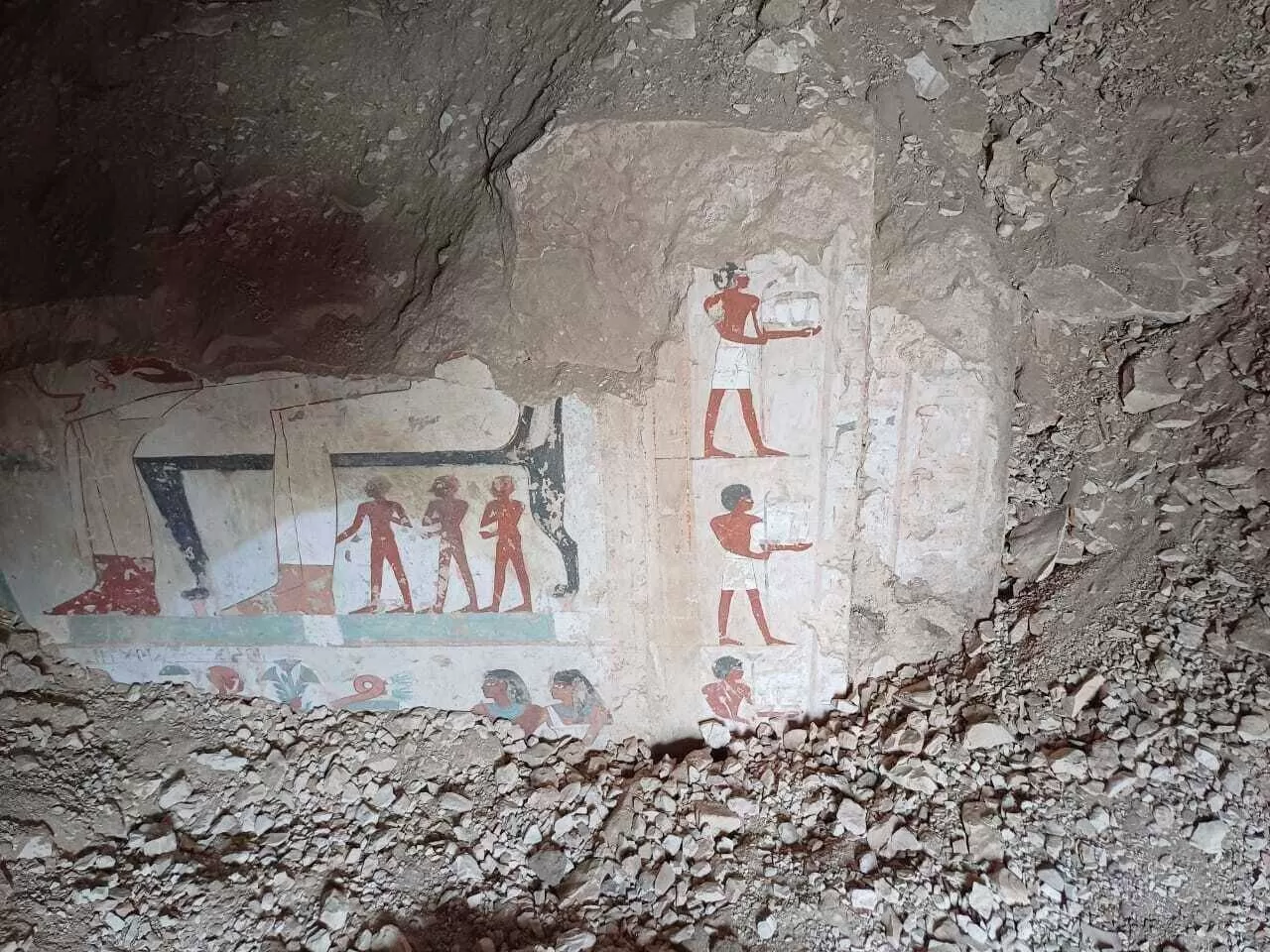 Ancient Egyptian tomb hieroglyphs and painted figures, revealing details of New Kingdom life
More Science Stories Making Headlines
The world of science is constantly buzzing with new findings. Here are a few more recent stories you might find fascinating:
- A legal challenge is underway as sixteen states have filed a lawsuit against the Trump administration over new National Science Foundation policies that are reportedly halting millions of dollars in research funding across the country. This raises questions about the future of scientific research support.
- Scientists believe they have finally figured out the preferred diet of the massive prehistoric shark, the Megalodon, shedding light on how it met its estimated 100,000-calorie daily requirement based on new fossil evidence.
- China’s Tianwen-2 mission is gearing up for an ambitious journey to land on an asteroid that some scientists suspect might be a fragment ejected from our own Moon, before also flying by an “active asteroid” that displays comet-like dusty tails.
- Adding to the evidence of early human artistic capabilities, a roughly 43,000-year-old fingerprint was found on a rock resembling a face. Forensic analysis is helping unravel the mystery of who made this ancient mark, possibly linking it to Neanderthals.
These diverse discoveries, from the depths of Earth’s core to the farthest reaches of space and the buried remnants of ancient civilizations, underscore the ongoing quest for knowledge that drives scientific exploration. Each finding adds another piece to the vast puzzle of our existence and the universe we inhabit.





