
NASA’s Perseverance rover is on a mission to uncover the mysteries of Mars’ distant past, quite literally digging deep into the planet’s surface. By grinding into Martian rocks, Perseverance exposes pristine material that holds vital clues about the Red Planet’s ancient environment, potential habitability, and even signs of past life. This crucial work helps scientists understand if Mars was once a world capable of supporting microbial life and prepares the way for future human missions.
Contents
Key takeaways:
- Perseverance uses specialized tools to grind into rocks and analyze their composition.
- Analyzing exposed rock interiors avoids billions of years of surface alteration.
- Recent analysis of the “Kenmore” rock revealed clay minerals, feldspar, and manganese hydroxide, pointing to a wet past.
- The findings contribute to the search for ancient life and potential resource use for future missions.
- Samples are being collected for a possible return to Earth.
Why Dig Into Martian Rocks?
Imagine a book left outside for billions of years. The cover is worn, faded, and hard to read. To understand the story inside, you need to open it up. That’s what Perseverance does with Mars rocks. The surface of Martian rocks is constantly bombarded by radiation, wind, and dust, altering their original chemistry over eons. By using a special abrasion tool, the rover scrapes away this outer layer, revealing the unaltered rock beneath – a fresh page from Mars’ geologic history book.
This method is a significant upgrade from earlier missions, like the Curiosity rover, which used a brush to clear dust. Perseverance employs a combination of mechanical grinding and a blast of nitrogen gas to reveal and clean the rock surface with less risk of contamination.
The Kenmore Challenge
One recent target was a rocky outcrop nicknamed “Kenmore.” While it looked promising initially, this particular rock proved a bit stubborn. According to Ken Farley, Perseverance’s deputy project scientist, Kenmore “vibrated all over the place and small chunks broke off” during the abrasion process. Despite the difficulty, the rover managed to grind just deep enough to expose a suitable surface for detailed study. This experience, even with a tricky rock, provides valuable data for future missions that might need to interact with Martian geology, perhaps even using rocks for construction materials.
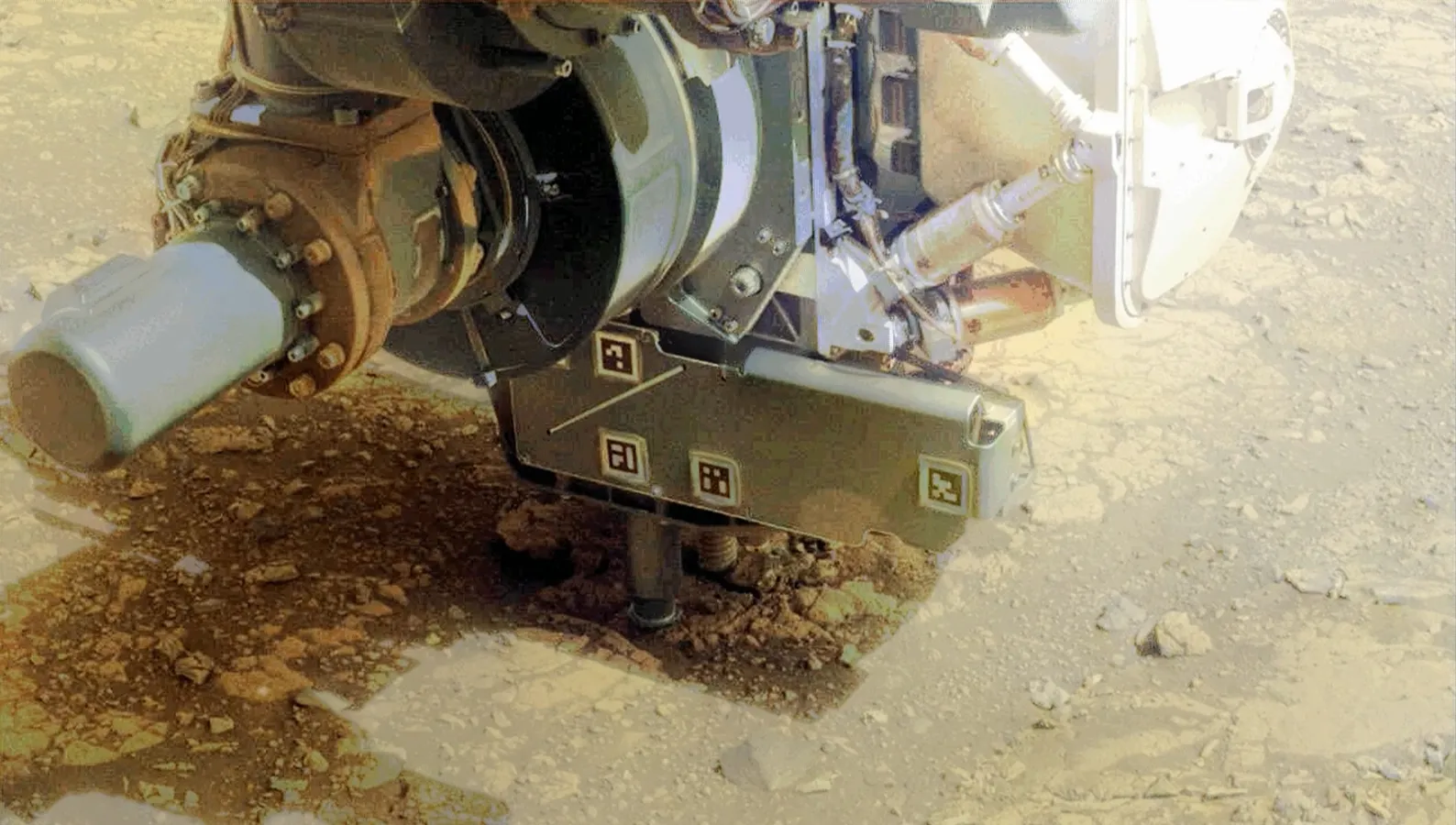 Perseverance rover using its abrasion tool on a Martian rock surface
Tools of the Trade
Once the rock’s inner layer is exposed, Perseverance deploys a suite of sophisticated instruments. The WATSON camera takes detailed close-up images. The SuperCam uses a laser to vaporize tiny bits of rock and analyze their composition using a spectrometer, while also studying the light reflected from the surface.
Other key instruments include SHERLOC and PIXL. SHERLOC uses Raman and luminescence spectroscopy to look for organic molecules and chemicals, potential signs of past life. PIXL uses X-ray fluorescence to map the elemental composition of the rock surface at a very fine scale. These tools work together like a team of detectives, each providing different clues about the rock’s makeup and history.
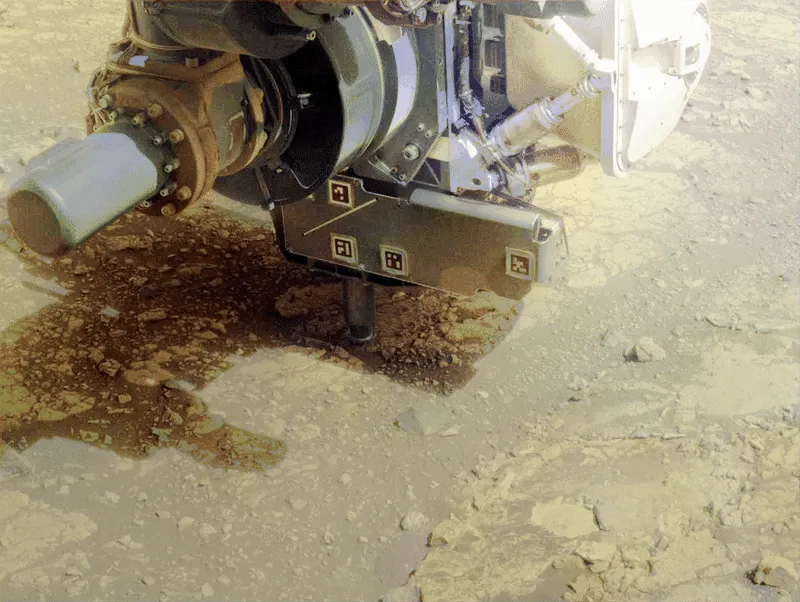 Animated GIF showing the Perseverance rover's abrasion tool grinding into a rock and clearing dust
What Perseverance Found Inside
Analyzing the Kenmore rock yielded exciting results. The instruments confirmed the presence of clay minerals, which are significant because they form in the presence of water. This supports the theory that the Jezero Crater, where Perseverance is exploring, was once a lakebed and river delta environment, offering ideal conditions for potential life.
The team also found feldspar, a common mineral on Earth, the Moon, and other rocky planets. Crucially, for the first time in this mission, they detected manganese hydroxide. Minerals like manganese hydroxide require abundant water to form, adding further strong evidence to the case for a wetter, more hospitable ancient Mars. Cathy Quantin-Nataf, a SuperCam team member, noted that the analysis showed “enhancements in iron and magnesium,” typical of ancient Martian clay minerals.
A Window into Mars’ Past
The Jezero Crater is a prime location for Perseverance’s work because scientists believe its geology holds some of the best-preserved records of Mars’ wet period billions of years ago. The minerals found in rocks like Kenmore act as time capsules, locking away chemical information about the water that flowed here. Discovering minerals associated with water activity is a key step in the search for ancient biosignatures – indicators that microbial life might have once existed on Mars. Kenmore is now the 30th Martian rock studied in this level of detail by Perseverance, building a rich database of the crater’s history.
Learn more about the Perseverance rover mission and its key goals.
Paving the Way for Future Missions
The data gathered from studying these rocks isn’t just about understanding the past; it’s vital for planning the future. By learning how different rock types behave when drilled and what resources they contain (like water bound in minerals), scientists are gathering practical information for future human missions. This knowledge could help identify suitable sites for landing, sampling, using local resources (like extracting water for fuel or life support), or even using rocks as construction material for habitats.
Perseverance continues to collect core samples from selected rocks, sealing them in tubes for a potential Mars Sample Return campaign. This ambitious plan aims to bring Martian rocks back to Earth for analysis in sophisticated labs, which could provide definitive answers about whether life ever existed on the Red Planet.
Read about how Perseverance recently hit a “Mars rock gold mine” in another area of Jezero Crater.
Digging Deeper for Answers
Perseverance’s painstaking work of grinding into Martian rocks is crucial for peeling back the layers of time and revealing the secrets held within. Each abrasion, each analysis, adds another piece to the puzzle of Mars’ evolution from a potentially habitable world to the dry planet we see today. The minerals discovered in rocks like Kenmore strongly suggest a watery past, fueling the excitement in the ongoing search for ancient life and providing essential data for the next giant leaps in Mars exploration, including bringing samples home.
Explore more about the search for water on Mars and its significance.





