
On Venus, volcanoes aren’t always cone-shaped mountains. Some look like giant, flat pancakes spread across the surface – a long-standing mystery for scientists studying the planet’s geology. Now, a new study offers a compelling explanation: these unusual Venus pancake domes might be shaped not just by the type of lava, but also by the way the planet’s solid outer shell bends under the weight. Understanding these unique structures helps us piece together the fiery history of Earth’s twin.
These isn’t a breakfast spread on Venus. The planet is covered in volcanic features, including more than 1,600 large volcanoes. Among the most peculiar are the pancake domes. Imagine a structure tens of miles wide but only about half a mile tall – vastly wider than it is high, unlike typical cone-shaped volcanoes like Hawaii’s Mauna Loa. How do these strange, flattened features come to be?
For a long time, one leading idea focused on the lava itself. Perhaps super-thick, slow-moving lava simply oozed out and solidified under its own weight, like pouring incredibly thick molasses onto a table. While lava viscosity definitely plays a role, lead author Madison Borrelli, a postdoctoral researcher at the Georgia Institute of Technology, suggested to Live Science that another factor might be crucial: the “bendiness” or flexibility of Venus’ upper crust.
Think of Venus’ surface, or even Earth’s in some spots, like the skin of an orange. If you press down on it firmly, it might dimple. Similarly, under a heavy load like a growing volcano, the planet’s solid shell can flex downwards. If this flexing happened while a pancake dome was forming, it should leave a subtle signature: a slight bulge in the crust surrounding the dome, where the material buckled upwards. Intriguingly, previous research from 2021 did find such signatures around about one-fifth of the pancake domes studied.
To investigate how a flexible crust would influence dome formation, Borrelli and her team focused on one specific pancake dome for which they had detailed data: Narina Tholus. This massive dome, spanning 55 kilometers (88.5 miles), sits on the edge of a huge oval feature called Aramaiti Corona. Using topographical data collected by NASA’s Magellan mission back in the 1990s, they built a virtual model of Narina Tholus.
Next, the researchers ran simulations. They modeled how thick, slow-flowing lava (like molasses, but a trillion times thicker than ketchup!) would behave on both a rigid surface and a flexible one, testing different lava densities. They then compared their simulation results to the virtual Narina Tholus dome.
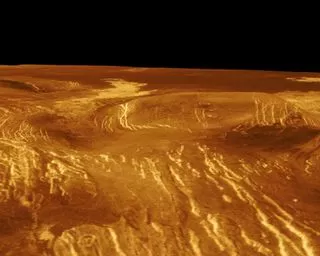 Simulated view of a Venusian corona, based on NASA Magellan data, similar to features linked to pancake dome formation
The simulations showed a striking difference. Domes formed on the virtual flexible crust looked much more like the real Narina Tholus dome, featuring the characteristic flat tops and steep sides. The scientists realized that the bulge created by the bending crust around the dome effectively acts like a barrier, preventing the lava from spreading out indefinitely. This forces the lava to pile up, creating the steep sides and flat top profile.
But the flexible crust wasn’t the whole story. The density of the lava also mattered. While less dense lavas could create the right shape on a flexible crust, they didn’t produce a surrounding bulge matching the size seen at Narina Tholus. Only lavas denser than about 2,400 kg/m³ (more than twice the density of water) created both the correct dome shape and the matching flexural signature. These dense lavas would have flowed incredibly slowly, taking hundreds of thousands of Earth-years to fully solidify into these giant pancakes.
This study offers a powerful new insight, but it’s based primarily on data from a single dome, Narina Tholus. The researchers are eager for more data. Upcoming missions to Venus, such as NASA’s VERITAS program, promise much higher-resolution maps of the surface. This new data will allow scientists to test this flexible crust hypothesis on many more pancake domes.
More data could also help determine the precise type of lava that forms these features. While many Venusian volcanoes seem to erupt basaltic lava (like Mauna Loa), the study couldn’t rule out other types, similar to those from Earth’s Mount St. Helens. Finding diverse lava types on Venus would be a major discovery, providing valuable clues about the planet’s internal processes, tectonic history, and even potentially shedding light on whether water might have played a role in its past.
This research brings us a step closer to understanding the unique geological forces shaping Venus. As new missions reveal more of its surface, the mystery of the pancake domes, and what they tell us about our cloud-covered neighbor, continues to unfold. You can read more about exciting recent discoveries about Venus, like evidence suggesting Venus may be geologically ‘alive’ after all, right here.